Masterworks Research · June 2026
Art Movements | Fine Art Market Strategy
How a movement built on soup cans and comic strips became one of the deepest, most liquid corners of the blue-chip art market.
Pop Art is the movement, born in mid-1950s Britain and matured in 1960s America, that took its imagery straight from advertising, packaging, comic strips, and celebrity photographs. Its central figures are Andy Warhol, Roy Lichtenstein, James Rosenquist, Claes Oldenburg, and Robert Indiana, and its emblems, a Campbell's soup can and a silkscreened Marilyn Monroe, are among the most recognized images of the twentieth century [4][5]. For investors, the same recognizability that made Pop Art popular made it tradable, and Pop is now one of the deepest and most liquid categories in the blue-chip art market, anchored by Warhol, who has repeatedly ranked among the most-traded and highest-grossing artists at auction [6][7][8].
What You Need to Know
- Pop Art started in Britain and peaked in 1960s America. Richard Hamilton's 1956 collage "Just what is it that makes today's homes so different, so appealing?" is widely cited as one of the first fully articulated Pop images. Warhol's "32 Campbell's Soup Cans" debuted at the Ferus Gallery in Los Angeles in 1962 [4][5].
- Warhol holds the record for a twentieth-century work at auction. "Shot Sage Blue Marilyn" (1964) sold for $195 million at Christie's New York in May 2022, the most expensive twentieth-century artwork ever sold at auction at the time and the highest auction price for an American artist [8][9].
- The Warhol market is unusually deep. In 2021 Warhol traded 1,219 lots at auction with an 82.4% sell-through rate and $347.6 million in total sales value. Artprice ranked him the number one artist by fine-art auction turnover in 2022 [6][7].
- Lichtenstein anchors the second tier. His auction record is "Nurse" (1964) at $95.4 million, Christie's New York, November 2015. His comic-strip painting "Masterpiece" (1962) reportedly sold privately for about $165 million in 2017 [10][11].
- Recognizable imagery is the price driver. A picture that anyone can identify in a second sells across New York, London, and Hong Kong to collectors of every kind, which is what makes a market liquid.
1. What Pop Art is, and where the soup cans came from
Pop Art took the visual language of mass culture, advertising, product packaging, comic panels, and celebrity photographs, and put it on the wall of the gallery. The movement emerged in the United Kingdom in the mid-1950s and in the United States in the late 1950s, reaching full force in the early-to-mid 1960s [4][5].
The British side came first. A discussion group called the Independent Group, formed in London in 1952, took advertising and American consumer culture seriously as material for art [4]. Richard Hamilton's small 1956 collage "Just what is it that makes today's homes so different, so appealing?", assembled for the exhibition "This Is Tomorrow," packed a body-builder holding a Tootsie Pop, a pin-up, a vacuum cleaner, a canned ham, and a television into one room. It is frequently cited as one of the first fully articulated Pop images [5]. In a 1957 letter Hamilton defined Pop as "popular, transient, expendable, low-cost, mass-produced, young, witty, sexy, gimmicky, glamorous, and Big Business" [4].
The American wave is the one most people picture. Andy Warhol showed his "32 Campbell's Soup Cans" at the Ferus Gallery in Los Angeles in 1962, one canvas per flavor, painted to look mass-produced [4][5]. The same year he made the "Marilyn Diptych," fifty silkscreened images of Marilyn Monroe pulled from a publicity still. Roy Lichtenstein blew up comic-book panels into paintings such as "Whaam!" (1963), built from Ben-Day dots and primary colors. James Rosenquist, a former billboard painter, fused fighter jets with spaghetti in the 86-foot "F-111" (1964 to 1965). Claes Oldenburg made soft sculptures of cake and hamburgers. Robert Indiana stacked four letters into "LOVE" [1][5].
The common thread is the source. Where earlier movements looked inward, Pop looked at the supermarket shelf and the television screen. That choice, more than any single painting, is why the work travels so well decades later.
2. Why recognizable imagery drives the pop art market
The feature that made Pop Art controversial in 1962 is the same feature that makes it liquid in 2026.
Recognition creates demand, and demand creates liquidity. A Warhol Marilyn or a Lichtenstein comic panel is legible to a collector in New York, a collector in Hong Kong, and a first-time buyer who has never set foot in a gallery. That breadth of recognition pulls in buyers far beyond the traditional connoisseur pool, including collectors from fashion, entertainment, technology, and finance [12][13]. When more potential buyers can identify and want a work, the spread between what a seller will accept and what a buyer will pay narrows, and the work clears more reliably at auction.
Warhol understood the mechanism himself. He described his subjects as "images that anybody walking down Broadway could recognize in a split second, comics, picnic tables, men's trousers, celebrities, shower curtains, refrigerators, Coke bottles" [12]. That is a description of a brand. We tend to translate it into investing terms: a globally recognized image behaves like a portable, liquid asset, easier to value because it trades often, and easier to sell because the demand is not confined to one city or one type of buyer.
3. Andy Warhol and the depth of the auction market
Warhol is the clearest case of Pop Art as a deep, tradable market. He is consistently among the most-traded artists in the world, and that turnover is what underwrites his standing as a blue-chip benchmark.
The numbers show the depth. In 2021, Warhol traded 1,219 lots at auction with a sell-through rate of 82.4% and total sales value of $347.6 million [6]. His best year on record reached $653.7 million in total sales [6]. In 2022, Artprice ranked Warhol the number one artist out of 500 by fine-art auction turnover [7]. The print market sits beneath the painting market and is enormous in its own right: Warhol produced more than 19,000 prints in his lifetime, and a complete or near-complete Marilyn portfolio still changes hands regularly [14][16].
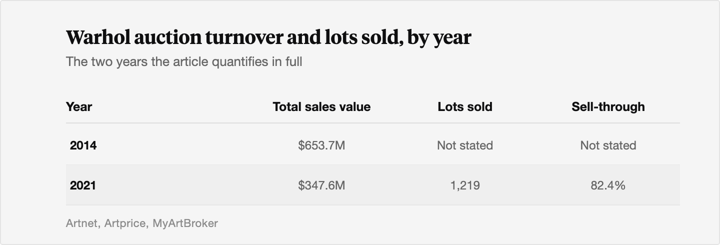
A market that trades over a thousand lots a year gives you something most of the art world does not have: frequent price discovery. When comparable works cross the block again and again, the market builds a reference range you can actually underwrite against. That is rare. Most artists trade a handful of works a year, and a single sale can move the whole perception of their market. Warhol does not have that problem.
Warhol's value is concentrated at the top, honestly. A handful of trophy paintings can swing his annual turnover sharply, which is why a single $195 million result reshapes a year [8]. The breadth of the print market and the steady mid-tier of six and seven-figure canvases is what keeps the broader market liquid underneath those headline lots [16][14].
4. Marquee records: the Marilyn at 195 million and the Lichtenstein ladder
Records matter in the art market for a reason beyond bragging rights. A new high resets the reference price for an entire category and pulls up the quality works beneath it.
Warhol's record is the anchor for all of Pop. "Shot Sage Blue Marilyn" (1964) sold for $195 million at Christie's New York in May 2022, in the evening sale of the Thomas and Doris Ammann collection [8][9]. At the time it was the most expensive twentieth-century artwork ever sold at auction and the highest auction price ever paid for an American artist [9]. It unseated Warhol's own prior record, "Silver Car Crash (Double Disaster)" (1963), which sold for $105 million at Sotheby's in 2013 [9].
Roy Lichtenstein sits one tier down, and the ladder there is instructive. His auction record is "Nurse" (1964), which sold for $95,365,000, often rounded to $95.4 million, at Christie's New York in November 2015 [10]. His comic-strip painting "Masterpiece" (1962) reportedly sold in a private transaction for about $165 million in 2017, a figure The New York Times attributed to the sale by collector Agnes Gund [11]. Private sales sit outside the public auction record, so the $95.4 million "Nurse" remains his auction high.
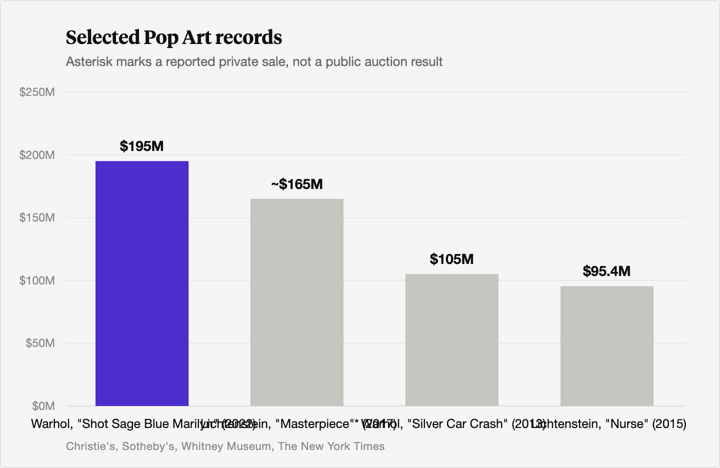
These are repricing events. When a top example crosses the block at a new high, it resets what an A-quality work in the same series is worth, and the effect ripples down to strong but secondary canvases. Past results are not predictive of future prices, and we would never suggest a record guarantees the next sale. Structurally, deep markets with iconic imagery reprice in steps, and the steps tend to pull the category with them.
5. Where Pop Art sits in the blue-chip market today
Pop Art is a core sub-segment of Post-War and Contemporary art, which has been the largest category in the fine-art auction market for roughly 25 years [3].
The 2025 market recovered. Global art sales rose 4% to $59.6 billion, with public auction sales up 9% to $20.7 billion, according to the Art Basel and UBS Global Art Market Report 2026 by Dr. Clare McAndrew [2][3]. The recovery was led from the top: sales above $10 million grew about 30% in value in 2025, concentrated in the United States, the United Kingdom, and China, which together held roughly 72% of public auction value [2]. The United States alone was $26 billion, or 44% of the global market [2].
For Pop Art specifically, the pattern in 2025 and 2026 reads as steady rather than euphoric. Demand favors established blue-chip names over speculative younger artists, and the strongest activity sits at two ends: trophy works above $10 million and entry-level prints and editions below the six-figure line [2][3]. The middle band has been more selective, with buyers disciplined on estimates. For an artist like Warhol, that environment plays to his strength, because his market has both a deep print base for new buyers and a top tier of museum-quality canvases for institutions and the very wealthy [13][16].
This is also where the art market's separate clock shows up. Post-War and Contemporary art does not move in step with other collecting categories or with equities, a divergence we cover in more detail in why contemporary art and Old Masters don't move together and in how art market cycles work.
6. How blue-chip Pop Art appreciates, and the limits
Three forces push prices up. As museums acquire and exhibit Warhol and Lichtenstein, and as scholarship reinforces their place in twentieth-century art, the perceived centrality of the work rises, and valuations follow [13]. At the same time, the best examples, iconic subject, strong color, clean provenance, early date, get locked into private and institutional collections, so supply at the top shrinks and a work that returns to market can set a step-change price [13]. And because the imagery is global, the buyer pool stays wide.
We have written before about what separates an investment-grade name from the rest of the market and how different price tiers behave, in what blue-chip art actually means and how 100K, 1M, and 10M works behave differently. Pop Art is a clean illustration of both: the imagery is recognized, the names are canonical, and the market is liquid enough to support trading at many price points.
Appreciation in this market tends to be lumpy rather than smooth, long stretches of stability punctuated by record events that reprice the category [8]. It is also series-specific. An iconic Marilyn or a prime comic-strip Lichtenstein behaves very differently from a peripheral or late work by the same artist, and the gap between an A example and a C example can be large. Art is illiquid relative to public markets, it carries transaction costs, and past performance is not predictive of future results. None of that is unique to Pop. It applies to the asset class. Pop Art simply has more of the features, recognition, depth, and breadth of demand, that make a market work.
Sources
- Perplexity Research synthesis (movement history). "Pop Art origins, key artists, and representative works." Drawing on Sotheby's, Christie's, MoMA, and Wikipedia, June 2026. https://www.sothebys.com/en/art-movements-pop-art
- Family Wealth Report. "US Remained Largest Art Market In 2025, Art Basel, UBS Report 2026." March 12, 2026. https://www.familywealthreport.com/article.php/US-Remained-Largest-Art-Market-In-2025-%E2%80%93-Art-Basel,-UBS-Report-2026-?id=207156
- Art Basel and UBS. "The Art Basel and UBS Global Art Market Report 2026," authored by Dr. Clare McAndrew, Arts Economics, 2026. https://www.artbasel.com/stories/the-art-basel-and-ubs-global-art-market-report-2026
- Sotheby's. "Pop Art: History, Characteristics, Artists." Updated March 2026. https://www.sothebys.com/en/art-movements-pop-art
- Wikipedia. "Pop art." Updated June 14, 2026. https://en.wikipedia.org/wiki/Pop_art
- Artnet News. "Are Rumors About the Softening Andy Warhol Market True? We Investigate." March 7, 2022. https://news.artnet.com/market/andy-warhol-the-appraisal-2081441
- MyArtBroker. "Andy Warhol In Auction: Results & What We've Learned." Updated June 2026. https://www.myartbroker.com/artist-andy-warhol/articles/andy-warhol-auction-results-q1-2023
- Andipa Gallery. "Andy Warhol's Most Expensive Paintings as Sold at Auction." Updated May 2026. https://andipagallery.com/blog/142-andy-warhol-s-most-expensive-paintings-as-sold-at-auction/
- Whitney Museum of American Art. "Andy Warhol." Updated June 2026. https://whitney.org/artists/1384
- Christie's. "Roy Lichtenstein, Nurse," Post-War and Contemporary Art Evening Sale, New York, November 9, 2015. https://www.christies.com/en/stories/the-a-z-of-andy-warhol-e6eb62423ba7495a952290e9f2112ba4
- The New York Times (Robin Pogrebin). "A Champion of the Arts Gives Warhol to Charity." June 16, 2017. https://www.nytimes.com/
- MoMA. "Pop Art: Consumer goods, mass media, and popular culture." Updated July 2025. https://www.moma.org/collection/terms/pop-art/consumer-goods-mass-media-and-popular-culture
- MyArtBroker. "Icons of Influence: Connecting Celebrity, Pop Art, and Legacy." June 1, 2026. https://www.myartbroker.com/collecting/articles/icons-of-the-influence
- MyArtBroker. "A Guide to Andy Warhol Print Sets." Updated May 2026. https://www.myartbroker.com/collecting/guides/guide-andy-warhol-print-sets
- Observer. "Beneath the Art Market's Recovery, a Structural Reset Is Underway." March 19, 2026. https://observer.com/2026/03/art-basel-ubs-art-market-report-2026-global-art-market-report/
- Revolver Warhol Gallery. "The Warhol Print Market in 2024: Performance, Analysis & Outlook." 2025. https://revolverwarholgallery.com/the-warhol-market/the-warhol-print-market-in-2024/
Disclosures
Investing involves risk. Past results are not indicative of future outcomes.
Masterworks is providing this communication as an agent for its issuer entities, not Masterworks Advisers. This material is produced by Masterworks for informational purposes only and does not constitute investment advice, a recommendation, or an offer or solicitation to buy or sell any security. Masterworks is not a licensed broker-dealer by the SEC or FINRA.
Masterworks can only make and accept sales after an offering statement has been filed, and "qualified", by the SEC. Any offers may be revoked before notice of qualification. Indications of interest involve no obligation. For further disclosure visit the offering documents filed with the SEC and Important Disclosures at masterworks.com/cd.
Forward-looking statements and internal estimates are based on assumptions that may prove incorrect, and actual outcomes may differ materially. Figures denoted in brackets are subject to confirmation. Investing in art and alternative assets involves risk, including loss of principal.
Art sales price data is comparative only. Each painting is unique and historical data is not a direct proxy for any specific painting or investment. Data represents whole art, not an investment into our offerings which includes fees and expenses. Any comparative images are not currently live offerings and are provided for educational purposes only.
Masterworks, LLC is located at 1 World Trade Center, 57th Floor, New York, NY 10007.