Masterworks Research · June 2026
How a practice that started as a crime became a blue-chip auction category, what the records actually say, and why the segment carries authentication risk most investors underestimate.
Street art moved from illegal subway tags in 1970s New York to the top of the contemporary auction market in roughly four decades, a faster climb to blue-chip status than almost any movement before it. The same canvas that Banksy shredded at Sotheby's in 2018, retitled Love Is in the Bin, resold three years later for 18.58 million pounds, about 25.4 million US dollars, the artist's auction record [1][2]. For an investor, the segment is worth understanding precisely because the rise was so quick and the demand is real but volatile. It brought a wave of younger and first-time buyers into auction rooms, and it carries authentication problems that older categories do not.
What You Need to Know
- The movement legitimized itself in under 40 years. Graffiti was a criminal-damage problem in 1970s New York. By 2011, the Museum of Contemporary Art in Los Angeles mounted Art in the Streets, the first major US museum survey of the field, covering subway writers through Banksy, KAWS, Invader, and Shepard Fairey [3].
- A few names carry the value. Jean-Michel Basquiat, who started as the SAMO tagger, was the most valuable contemporary artist at auction in 2024, with about $183.4 million in turnover and 12% of all contemporary sales [4]. Banksy and KAWS anchor the rest of the segment.
- The records are large and the cycle is sharp. KAWS set a $14.8 million painting record in 2019 [5]. Banksy's print market peaked near $41.9 million in turnover in 2021 and then fell by as much as 83% into 2024 and 2025 [6][7].
- Authentication is a structural risk, not a footnote. Banksy's Pest Control office will not authenticate street works removed from walls, which can leave a genuine mural functionally unsellable through blue-chip channels [8].
- It is the entry door for new collectors. Younger buyers participating at auction have more than doubled in five years, and street-adjacent, lower-priced works are a primary reason [9].
1. The 40 year climb from subway car to salesroom
Modern graffiti starts as a New York street phenomenon. Writers like TAKI 183 spread tags across the subway in the late 1960s and early 1970s, and a 1971 New York Times article brought the practice to mainstream attention [10]. The city treated it as vandalism and passed an anti-graffiti measure as early as 1972 [10]. The art world arrived almost as quickly. United Graffiti Artists staged what is often cited as the first gallery show of graffiti writers at SoHo's Razor Gallery in 1973, and by 1984 the photo book Subway Art had turned the New York aesthetic into a template copied worldwide [10][11].
The decisive shift came through two artists. Keith Haring began chalk drawings on empty subway advertising panels around 1980 and moved into galleries within a few years. Jean-Michel Basquiat went from spraying cryptic SAMO phrases in Lower Manhattan to participating in the 1980 Times Square Show and, soon after, to solo gallery representation [12]. The Sotheby's Institute describes the moment plainly: Basquiat and Haring "transitioned from the streets to the art world," and collectors and galleries backing them is what began to convert graffiti from a crime into a category [12].
Institutional recognition then layered on top of market acceptance. The 2011 MOCA survey Art in the Streets is widely treated as the museum-level validation of the field, and it placed the 1970s writers in the same room as Banksy and KAWS [3]. We translate that arc into one investing observation: a movement that took a generation to gain museum legitimacy compressed into the art market far faster than Impressionism or Modern art did, which is part of why the price action has been steep in both directions.
2. Why the value concentrates in a handful of names
The street and urban segment is a small slice of the contemporary auction market by value, on the order of single digits as a share, but it punches well above its weight in attention because a few artists carry most of the turnover. This is the pattern we see across the whole art market, where the top 100 artists account for the large majority of value, and it is even sharper here.
Basquiat sits at the top. In 2024 he was the most valuable contemporary artist at auction, with roughly $183.4 million in revenue and 12% of all contemporary art sales, on a 79% sell-through rate [4]. His 1982 skull painting Untitled set the benchmark in May 2017, selling at Sotheby's for $110.5 million, then the highest price ever paid at auction for an American artist [13]. Keith Haring's auction record stands at about $6.5 million for a 1982 Untitled, and his turnover rose roughly 22% in 2024 [14][9]. Below the two estate names, Banksy and KAWS are the living-artist pillars of the segment, both consistently among the most traded living artists by lot count [9]. The gap between those four top records, shown in Exhibit 1, is the clearest measure of how steep the concentration is.
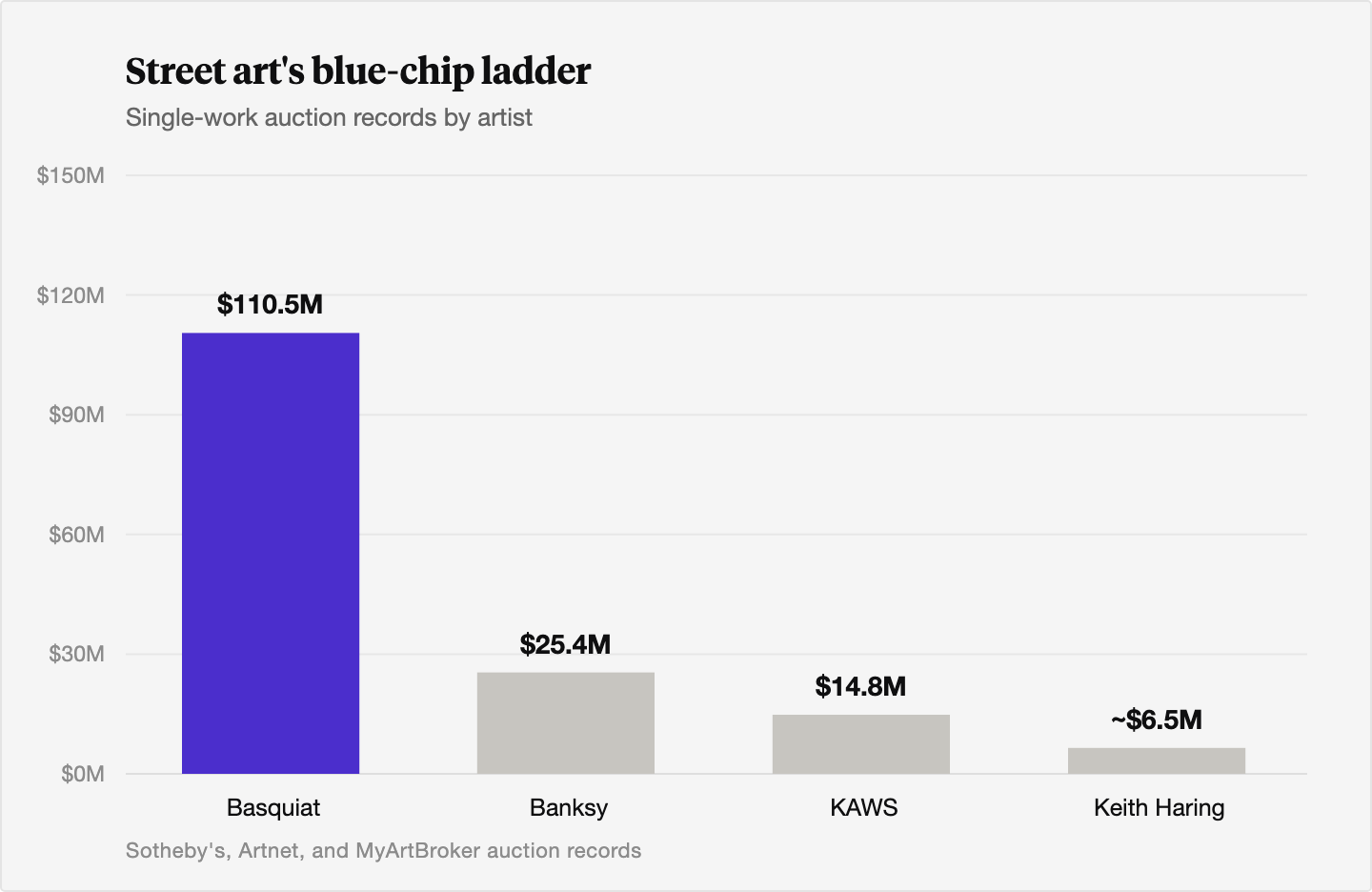
For an investor, concentration cuts both ways. It means the segment has genuine blue-chip depth at the very top, where Basquiat trades alongside Warhol and Rothko. It also means the field below that top tier is thin, and a portfolio built on lesser names in the category inherits far more risk than the headline records suggest.
3. Banksy: the depth of an anonymous market
Banksy is the clearest case of street art reaching auction depth, which is striking for an artist who works anonymously and started spray-painting walls illegally. His market runs across two layers: a small number of high-value unique works and a large, liquid market in signed prints.
The record is Love Is in the Bin, the canvas that partially shredded itself at Sotheby's in October 2018 just after selling for about 1.04 million pounds. Retitled and re-certified, it sold again in October 2021 for 18.58 million pounds, about 25.4 million dollars, roughly a 16-fold return for the seller in three years and well past its 4 to 6 million pound estimate [1][2]. That single result captures both the upside and the speculative character of the market.
Beneath the trophy lots, the print market gives Banksy real liquidity. In 2024, roughly 197 print lots sold at auction for about $7.4 million in turnover, with a sell-through rate near 78% [6]. His most recognizable image, Girl with Balloon, appeared at auction at least eleven times in a recent stretch and sold on nine of those occasions [7]. That kind of repeat trading in identifiable works is what lets a market be measured at all, which matters to us because our index methodology depends on tracking the same work across multiple sales rather than averaging a basket of different ones.
4. KAWS, Invader, and Fairey: the streetwear crossover
The generation after Banksy pushed street art into fashion and design, and the auction results followed. KAWS, the artist name of Brian Donnelly, began as a graffiti writer in the early 1990s, moved into vinyl toys and his recurring Companion figure, and built a market that crosses fully into luxury branding through collaborations with Dior and Uniqlo [9]. His painting record is THE KAWS ALBUM, an appropriation of a Simpsons parody of the Beatles, which sold at Sotheby's Hong Kong on April 1, 2019 for HK$115.97 million, about $14.8 million, more than 14 times its high estimate [5].
Invader, who installs tile mosaics of 8-bit video-game characters, and Shepard Fairey, whose OBEY campaign began in 1989 and whose 2008 HOPE poster became globally recognized, round out the cohort that the MOCA survey canonized [3]. The common thread for an investor is the demand driver. These artists sit where contemporary art overlaps with sneakers, gaming, and streetwear, which is exactly the territory that pulls in younger collectors.
That crossover shows up in the auction data. Younger buyers participating at auction have more than doubled over five years, with millennials and Gen Z accounting for a meaningful share of bidders, and street-adjacent, lower-priced works are a primary entry point [9]. We read this as a structural demand tailwind. A category that recruits new collectors at the bottom of the price range tends to build the buyer base that supports the top of it later.
5. The authentication problem street art carries
Authentication is the single feature that separates street art from older categories as an asset, and it is where new investors are most likely to be caught out. The work was often made illegally, in public, and sometimes meant to be temporary. None of that fits cleanly into the provenance and title conventions that auction houses require.
Banksy is the instructive case. He authenticates through Pest Control Office, the sole body that can certify his work, and the rule is effectively binary: a certified work can circulate at the major houses, and an uncertified one is shut out of serious trade [8]. Pest Control authenticates commercial works, mainly signed prints and originals the artist intended for sale, and refuses to authenticate street pieces removed from walls [8]. Part of the reason is principle, since the artist objects to commodifying work he placed in public, and part is legal, since a mural cut off a building carries questions of title and criminal damage that houses avoid [8]. The practical result is stark, and Exhibit 2 lays it out. A genuine Banksy mural sliced from a wall can be functionally unsellable through any blue-chip channel, while a certified print trades freely.
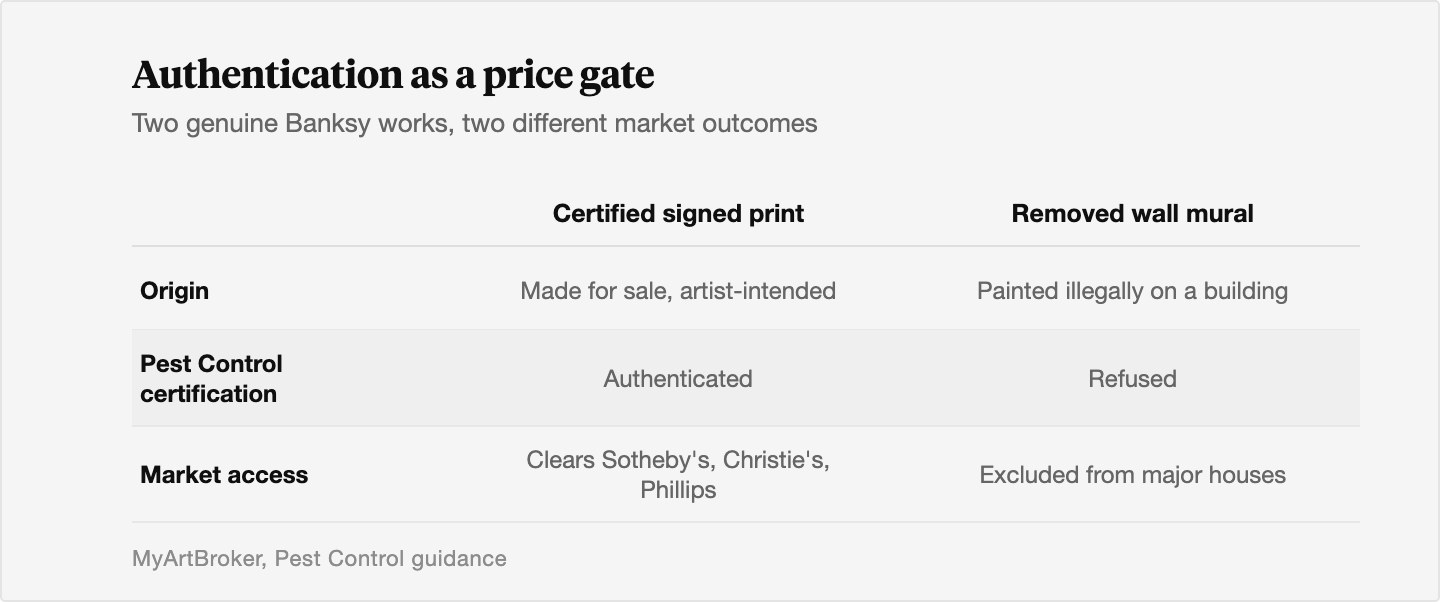
Two further issues compound the first. Editions and prints can be large, and a flood of multiples can dilute the value of any single impression, so edition size and condition matter more here than in a unique-work market. And ephemerality is built into the medium, since a piece made on a wall may be painted over, weathered, or destroyed, which means the durable, investable version of a street artist's output is usually the studio work and the certified edition, not the street piece itself.
6. Strong demand, sharp cycles: reading the volatility
Street art demand is real and growing, and it is also volatile, more so than the broader contemporary market. Both things are true, and an investor needs to hold them together.
The growth case is straightforward. The global art market generated about $57.5 billion in sales in 2024, and public auction sales reached roughly $20.7 billion in 2025, up about 9% year on year [15]. Within that, the accessible end of contemporary, where most street and urban work trades, has been the fastest-growing pocket, supported by the doubling of younger auction participants [9][15]. Past performance is not predictive, but the direction of the demand is not in dispute.
The volatility case is just as clear. Banksy's print market peaked near $41.9 million in turnover across 563 lots in 2021, fueled by pandemic-era speculation, then corrected hard, with prints down as much as 83% from peak by 2024 and 2025 [6][7]. Between mid-2023 and mid-2024, his total auction sales fell about 59% year on year [7]. This is the same correction that ran through the rest of contemporary art after the 2021 peak, and it hit the speculative, retail-driven street segment harder than the blue-chip trophy market. We have seen this shape before across art cycles, where a boom pulls in new money, prices overshoot, and the segment then reprices toward a more sustainable range.
The investing lesson is the one we apply to every artist market. The category has genuine appreciation history and a widening buyer base, and it is also a market where a single name, a single record, or a single hype cycle can distort the picture. The discipline is to weigh appreciation against volatility rather than chase the headline, and to assume the next cycle will test patience the way the last one did.
The Bottom Line
- Street art completed the move from criminal vandalism to museum-validated, blue-chip auction category in under 40 years, faster than any major movement before it.
- The value is highly concentrated in a few names, led by Basquiat, who was the most valuable contemporary artist at auction in 2024, with Banksy and KAWS as the living-artist pillars.
- The records are large, with Basquiat at $110.5 million, Banksy at $25.4 million for a single shredded canvas, and KAWS at $14.8 million for a painting.
- Authentication is a structural risk unique to the medium, since works made illegally or in public, including removed murals, can be refused certification and shut out of the major houses.
- Demand is strong and broadening through younger and first-time buyers, but the segment is more volatile than the broader market, as the 2021 peak and the subsequent print correction of up to 83% show.
Sources
- Wikipedia. "Love Is in the Bin." Accessed June 2026. https://en.wikipedia.org/wiki/Love_Is_in_the_Bin
- MyArtBroker. "Banksy's Love Is In The Bin: The Greatest PR Stunt of All Time." Accessed June 2026. https://www.myartbroker.com/artist-banksy/articles/banksys-love-is-in-the-bin-the-greatest-pr-stunt-of-all-time
- STRAAT Museum. "History of Graffiti and Street Art: The 1960s and the 1970s." Accessed June 2026. https://straatmuseum.com/en/about-straat/history-of-graffiti-and-street-art-the-1960s-and-the-1970s
- Artnet News, via Maddox Gallery. "Global Art Market Reports Reveal 5 Critical Trends Reshaping the Art Market in 2025." 2025. https://maddoxgallery.com/news/426-global-art-market-reports-reveal-5-critical-trends-reshaping-the-art-market-in-2025/
- Artnet News. "Sotheby's Was Hoping This KAWS Painting of 'The Simpsons' Would Sell for $1 Million. It Just Went for $14.7 Million." April 2019. https://news.artnet.com/market/kaws-auction-record-sothebys-1505122
- Banksy Explained. "BANKSY Prints 2024 Auction Results." 2024. https://banksyexplained.com/banksy-prints-2024-auction-results/
- MyArtBroker. "Banksy's Market Correction Explained: Buy Now?" 2025. https://www.myartbroker.com/artist-banksy/articles/inside-the-banksy-market-reset-buying-opportunity
- MyArtBroker. "Pest Control: Verifying Banksy Prints for Buyers and Sellers." Accessed June 2026. https://www.myartbroker.com/artist-banksy/guides/how-to-verify-banksy-prints-with-pest-control
- Maddox Gallery. "Global Art Market Reports Reveal 5 Critical Trends Reshaping the Art Market in 2025." 2025. https://maddoxgallery.com/news/426-global-art-market-reports-reveal-5-critical-trends-reshaping-the-art-market-in-2025/
- Wikipedia. "Graffiti in New York City." Accessed June 2026. https://en.wikipedia.org/wiki/Graffiti_in_New_York_City
- TIME. "How Martha Cooper Shot the New York Subway Graffiti Scene." April 2017. https://time.com/4743207/martha-cooper-subway-graffiti/
- Sotheby's Institute of Art. "A Brief History of Graffiti Art." Accessed June 2026. https://www.sothebysinstitute.com/news-and-events/news/a-brief-history-of-graffiti-art
- Wikipedia. "Untitled (1982 Basquiat skull painting)." Accessed June 2026. https://en.wikipedia.org/wiki/Untitled_(1982_Basquiat_skull_painting)
- MyArtBroker. "Keith Haring Value: Top Prices Paid at Auction." Accessed June 2026. https://www.myartbroker.com/artist-keith-haring/record-prices/keith-haring-record-prices
- Art Basel and UBS. "The Art Market 2025" and "The Art Market 2026," by Dr. Clare McAndrew. 2025 and 2026. https://theartmarket.artbasel.com/the-art-market-2025/global-market
Related Reading
- Banksy's Market Paradox: Anti-Establishment Art as a Blue-Chip Asset
- What Blue-Chip Art Actually Means, and Why It Matters
- How Art Market Cycles Work: Expansion, Peak, Correction, and Recovery
- Price Tier Analysis: How $100K, $1M, and $10M Works Behave Differently
Disclosures
Investing involves risk. Past results are not indicative of future outcomes.
Masterworks is providing this communication as an agent for its issuer entities, not Masterworks Advisers. This material is produced by Masterworks for informational purposes only and does not constitute investment advice, a recommendation, or an offer or solicitation to buy or sell any security. Masterworks is not a licensed broker-dealer by the SEC or FINRA.
Masterworks can only make and accept sales after an offering statement has been filed, and "qualified", by the SEC. Any offers may be revoked before notice of qualification. Indications of interest involve no obligation. For further disclosure visit the offering documents filed with the SEC and Important Disclosures at masterworks.com/cd.
Forward-looking statements and internal estimates are based on assumptions that may prove incorrect, and actual outcomes may differ materially. Figures denoted in brackets are subject to confirmation. Investing in art and alternative assets involves risk, including loss of principal.
Art sales price data is comparative only. Each painting is unique and historical data is not a direct proxy for any specific painting or investment. Data represents whole art, not an investment into our offerings which includes fees and expenses. Any comparative images are not currently live offerings and are provided for educational purposes only.
Masterworks, LLC is located at 1 World Trade Center, 57th Floor, New York, NY 10007.