Masterworks Research · June 2026
The eight paintings at the top of the market, what each actually sold for, and what the very top tells investors about scarcity, provenance, and where prices form.
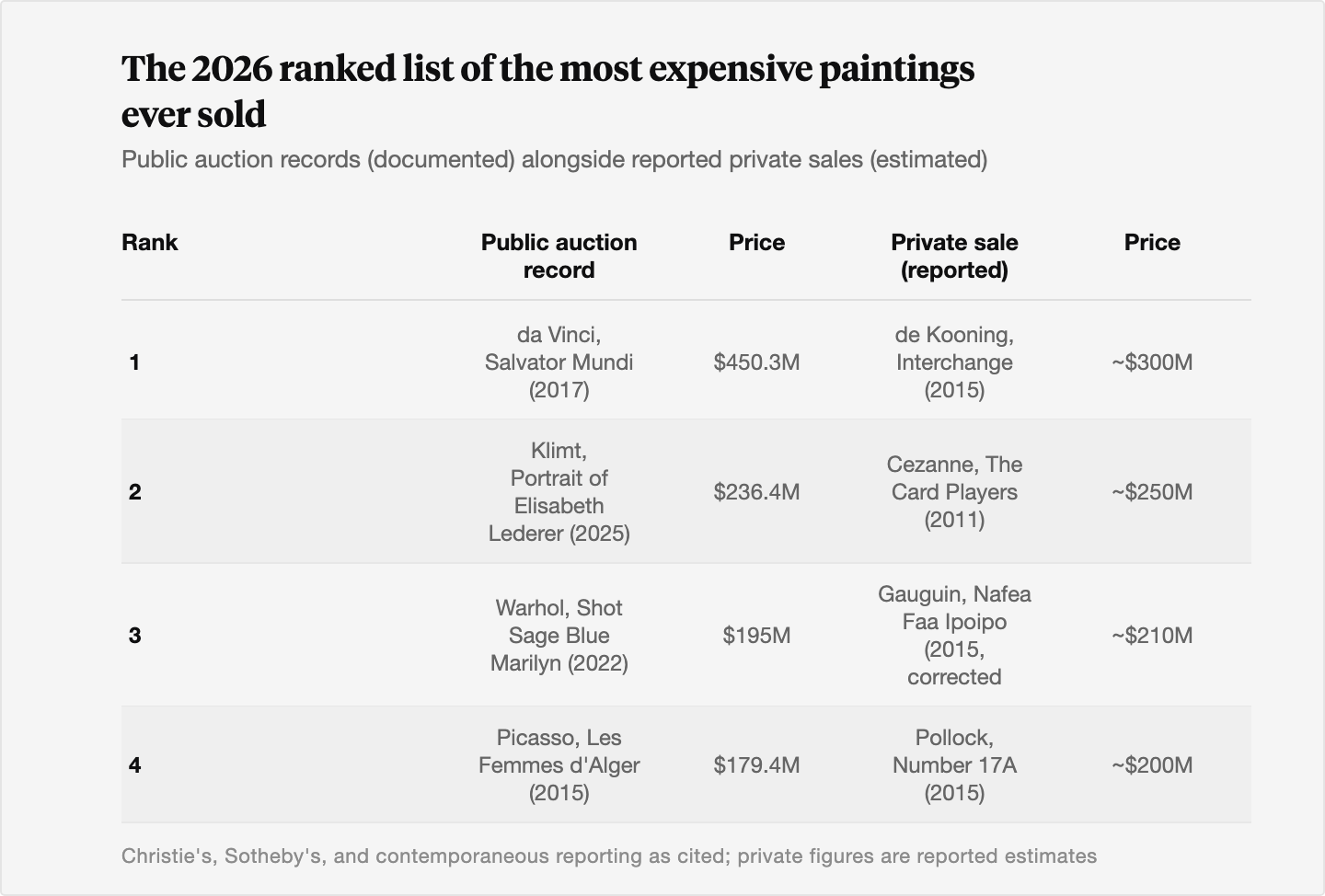
The most expensive painting ever sold is Leonardo da Vinci's Salvator Mundi, which brought $450.3 million at Christie's in New York in November 2017 [1]. That is the public auction record, and it has held for nearly nine years. Above the publicly reported prices sit a handful of private sales that are believed to have traded even higher, though the figures are reported and estimated rather than confirmed. The current second place at public auction, set in November 2025, is Gustav Klimt's Portrait of Elisabeth Lederer at $236.4 million [2]. For investors, this list matters less as trivia and more as a map of where value concentrates in the art market, and why the same few names keep showing up at the top.
What You Need to Know
- The auction record is $450.3 million. Da Vinci's Salvator Mundi set it at Christie's in November 2017 and still holds it. No public sale has come within $200 million of it since [1].
- The largest reported prices were private, and the figures are estimates. Three transactions are widely reported above $200 million, de Kooning's Interchange at roughly $300 million, Cezanne's The Card Players at roughly $250 million, and Gauguin's Nafea Faa Ipoipo at roughly $210 million. Private sales are not disclosed, so we present these as reported [3][4][5].
- A 2025 public sale reshaped the top of the auction list. Klimt's Portrait of Elisabeth Lederer sold for $236.4 million in November 2025, the highest price for any work of modern art at auction and the second highest auction price on record [2][6].
- The top of the market is concentrated. The names that appear here, da Vinci, de Kooning, Cezanne, Gauguin, Pollock, Klimt, Warhol, Picasso, are a short and stable list. Scarcity, deep provenance, and a secure place in the artist canon are the common thread.
- Past performance is not predictive. A record price is a single data point about a single object, not a forecast. We treat these sales as evidence about how the high end behaves, not as a promise about any future work.
1. The public auction record: da Vinci, Salvator Mundi, $450.3 million
The clearest figure on this list is also the largest verified one. Salvator Mundi, a depiction of Christ attributed to Leonardo da Vinci and dated around 1500, sold at Christie's New York on November 15, 2017 for $450.3 million including buyer's premium [1]. The buyer was later reported to be Badr bin Abdullah Al Saud, acting in connection with the Saudi state, and the seller was the Russian collector Dmitry Rybolovlev [1][7].
Two things make this sale useful to an investor. First, it is a public auction result, so the price is documented rather than reported. Second, it is an outlier even among outliers. The next highest public price is roughly $214 million below it. A single confirmed sale at nearly half a billion dollars tells you the absolute ceiling the market has been willing to pay in the open, with a name and a date attached.
The painting's attribution remains debated, which is a reminder that even at the top, the market is pricing scholarship and belief alongside the object itself.
2. The reported private peak: de Kooning, Interchange, around $300 million
The largest single transaction widely reported in the art market is Willem de Kooning's Interchange (1955), believed to have sold for roughly [~$300 million] in September 2015 [3][8]. The sale was private. The David Geffen Foundation is reported to have sold it to Kenneth C. Griffin, the founder of Citadel, as part of a pair of purchases [3][8].
We bracket the figure because private sales carry no disclosure requirement. The number comes from reporting rather than a salesroom record, and the actual terms are not public. Interchange had reportedly sold for $4,000 in 1955, which, if both figures are accurate, is a useful illustration of how far a single canvas at the very top of the abstract expressionist canon can travel over six decades [3].
3. The reported private list, in order, treated as estimates
Below the de Kooning sit three more private transactions, each reported above $200 million and each, by nature, an estimate rather than a confirmed price. We present them as reported, in descending order.
Cezanne's The Card Players (early 1890s) is reported to have sold for roughly [~$250 million] in 2011, bought by the State of Qatar from the estate of the Greek shipping magnate George Embiricos [4][9]. At the time it was understood to be the highest price ever paid for a painting, public or private, and it held that informal status until the Salvator Mundi auction in 2017.
Gauguin's Nafea Faa Ipoipo (When Will You Marry?, 1892) is the most instructive of the three, because its reported price was later corrected. The sale, from the Swiss collector Rudolf Staechelin's holdings, was first reported in 2015 at close to $300 million. A 2017 court case in London revealed the actual figure to be roughly [~$210 million] [5][10]. We carry the lower, corrected number, and we flag the gap on purpose. It shows why private art prices should be read with caution.
Jackson Pollock's Number 17A (1948) is reported to have sold for roughly [~$200 million], the second half of the same 2015 transaction in which Griffin reportedly bought the de Kooning from the Geffen Foundation [3][8]. As with Interchange, the figure is reported, not disclosed.
4. Back to the documented record: the rest of the public auction top tier
After Salvator Mundi and the Klimt, the highest documented auction prices are clustered tightly, which makes them a cleaner signal than the private estimates above.
Gustav Klimt's Portrait of Elisabeth Lederer (1914 to 1916) sold at Sotheby's New York on November 18, 2025 for $236.4 million [2][6]. The result roughly doubled Klimt's previous auction record of $108.8 million, set the record for the most valuable work of modern art ever sold at auction, and became the second highest auction price on record behind only the da Vinci [2][6]. The painting came to market for the first time as part of the Leonard A. Lauder collection, and its history includes Nazi-era looting and postwar restitution [6].
Andy Warhol's Shot Sage Blue Marilyn (1964) sold at Christie's New York in May 2022 for $195 million, the highest price for any twentieth-century work and any American work at auction at the time [11]. Pablo Picasso's Les Femmes d'Alger (Version O) (1955) sold at Christie's New York in May 2015 for $179.4 million [12]. Both were public, documented, and bought by the dealer Larry Gagosian in the room [11][12].
These four documented results, the da Vinci, the Klimt, the Warhol, and the Picasso, do something the private estimates cannot. They give you a precise number with a date and a salesroom attached, which is the only kind of data point you can actually build an index on.
5. What the top of the market has in common
Read the list as a portfolio rather than a set of headlines and three patterns hold across nearly every entry.
The first is scarcity, and specifically scarcity that does not grow. There is one finished Salvator Mundi, one Interchange, one Portrait of Elisabeth Lederer. As we have written elsewhere, the supply of blue-chip work tends to shrink over time as pieces move into museums and stay there. The objects at the very top are the most extreme version of that. When a unique work by a canonical name comes to market, the buyer is bidding on something that will, in most cases, never be available again. That is the cleanest version of the scarcity argument that runs through the whole asset class.
The second is provenance and condition. Every work here carries a documented chain of ownership, a place in serious collections, and in several cases a museum history. The Klimt's value was tied closely to the Lauder name and to its restitution history [6]. The market pays for certainty, and provenance is how certainty gets priced.
The third is the artist canon. The names on this list are a short and stable set, and that is the point. We have long argued that value in the art market concentrates in a small group of artists, and the very top of the price ladder is the sharpest illustration of it. A record price by a canonical artist tends to reset perceptions of value for that artist's other strong works, which is why these sales matter beyond the single object that traded. For more on how the highest band of the market behaves relative to the rest, see our price tier analysis and our explainer on what blue-chip art actually means.
6. What it signals, and what it does not
A list like this is easy to misread. The temptation is to treat $450 million as a target or a trend. We would caution against that.
What these sales do tell you is where demand concentrates and how durable it is. The same handful of names has held the top of the market for a decade, through a roughly three-year correction in the broader art market that ran into 2025, and through a global art market that the Art Basel and UBS report put at $59.6 billion in 2025 [13]. The top end is thin, it is driven by a very small number of buyers, and it is one of the clearest expressions of what we think of as a call option on wealth creation at the very top.
What they do not tell you is what any given work will do next, or that a record is repeatable. The Gauguin episode, reported at $300 million and later shown to be closer to $210 million, is a useful reminder that private headline figures are estimates [5][10]. And a single trophy sale is one object on one night with, sometimes, only two bidders. Past performance is not predictive. We read these results as evidence about the structure of the high end, scarce supply, canonical names, deep provenance, and not as a forecast for any specific painting. For a closer look at how a single record sale gets interpreted, our pieces on the story behind Salvator Mundi and on whether the Basquiat market has peaked work through the question in detail.
The Bottom Line
- The most expensive painting ever sold at public auction is da Vinci's Salvator Mundi, at $450.3 million in 2017, and that record still stands.
- The highest reported prices overall were private sales, de Kooning's Interchange near $300 million, Cezanne's The Card Players near $250 million, and Gauguin's Nafea Faa Ipoipo near $210 million, and all three are reported estimates rather than disclosed figures.
- The November 2025 sale of Klimt's Portrait of Elisabeth Lederer at $236.4 million reset the second spot at auction and set the modern-art record.
- Every work at the top shares three traits: scarcity that does not grow, deep documented provenance, and a secure place in a short artist canon.
- These sales are a map of where high-end demand concentrates, not a forecast. Past performance is not predictive of any future result.
Sources
- Christie's / Wikipedia. "Salvator Mundi (Leonardo)." November 2017. https://en.wikipedia.org/wiki/Salvator_Mundi_(Leonardo)
- The Value. "The 10 most expensive paintings at auction, now including Klimt's US$236m portrait." November 2025. https://en.thevalue.com/articles/sothebys-klimt-record-breaking-auction-most-expensive-paintings-list-2025-november
- ARTnews. "Here Are Five Paintings That Sold for More Than $100M (Interchange and Number 17A)." 2023. https://www.artnews.com/list/art-news/news/most-expensive-paintings-1234724562/interchange-by-willem-de-kooning-and-number-17a-by-jackson-pollock/
- Hyperallergic. "Qatar Buys World's Most Expensive Painting, $250M for Cezanne's The Card Players." February 2012. https://hyperallergic.com/46511/qatar-paul-cezanne-card-players/
- Artnet News. "World's Most Expensive Painting Actually Sold for $90 Million Less Than Reported: Suit." July 2017. https://news.artnet.com/art-world/uk-lawsuit-secret-gauguin-dealing-1011617
- Sotheby's. "$236.4 Million Klimt Portrait Sets Records as Sotheby's Inaugurates the Breuer." November 18, 2025. https://www.sothebys.com/en/articles/the-new-york-sales-november-2025-breuer-results
- Wikipedia. "List of most expensive paintings." Accessed June 2026. https://en.wikipedia.org/wiki/List_of_most_expensive_paintings
- The Boston Globe. "Lawsuit reveals Gauguin painting was not world's most expensive." July 2017. https://www.bostonglobe.com/lifestyle/names/2017/07/04/lawsuit-reveals-gauguin-painting-was-not-world-most-expensive/XPdHYmO6UNnsOmWqWhC72M/story.html
- Wikipedia. "The Card Players." Accessed June 2026. https://en.wikipedia.org/wiki/The_Card_Players
- Artsy. "$210 Million Gauguin Masterpiece Embroiled in Legal Dispute." 2017. https://www.artsy.net/article/artsy-editorial-210-million-gauguin-masterpiece-embroiled-legal-dispute-9-news-stories-week
- Artnet News. "An Ethereal Blue Warhol Marilyn Goes for $195 Million at Christie's." May 2022. https://news.artnet.com/market/evening-auction-report-ammann-sale-at-christies-2110810
- Smithsonian Magazine. "Watch the Record-Breaking Auction of This Gustav Klimt Portrait." November 2025. https://www.smithsonianmag.com/smart-news/watch-the-record-breaking-auction-of-this-gustav-klimt-portrait-which-just-became-the-second-most-expensive-painting-ever-sold-180987723/
- Art Basel and UBS. "Global sales rise 4% to $59.6 billion in 2025, amid ongoing market recalibration." March 2026. https://www.artbasel.com/stories/the-art-basel-and-ubs-global-art-market-report-2026
Disclosures
Investing involves risk. Past results are not indicative of future outcomes.
Masterworks is providing this communication as an agent for its issuer entities, not Masterworks Advisers. This material is produced by Masterworks for informational purposes only and does not constitute investment advice, a recommendation, or an offer or solicitation to buy or sell any security. Masterworks is not a licensed broker-dealer by the SEC or FINRA.
Masterworks can only make and accept sales after an offering statement has been filed, and "qualified", by the SEC. Any offers may be revoked before notice of qualification. Indications of interest involve no obligation. For further disclosure visit the offering documents filed with the SEC and Important Disclosures at masterworks.com/cd.
Forward-looking statements and internal estimates are based on assumptions that may prove incorrect, and actual outcomes may differ materially. Figures denoted in brackets are subject to confirmation. Investing in art and alternative assets involves risk, including loss of principal.
Art sales price data is comparative only. Each painting is unique and historical data is not a direct proxy for any specific painting or investment. Data represents whole art, not an investment into our offerings which includes fees and expenses. Any comparative images are not currently live offerings and are provided for educational purposes only.
Masterworks, LLC is located at 1 World Trade Center, 57th Floor, New York, NY 10007.