Masterworks Research · June 2026
Why holding one asset for each economic regime produces a smoother ride, a lower long-run return, and a lesson worth borrowing for the alternatives sleeve.
The Permanent Portfolio is a strategy designed by investment writer Harry Browne in the 1980s that splits a portfolio into four equal 25% pieces: stocks, long-term Treasury bonds, gold, and cash. Each piece is meant to carry the portfolio through one of four economic regimes. Stocks for prosperity, long bonds for deflation, gold for inflation, and cash for tight-money recession. The idea is that you cannot reliably forecast which regime is coming, so you hold something built to do well in each one and you rebalance back to equal weights once a year. The result, across roughly five decades of data, is a portfolio that gives up some long-run return in exchange for much lower volatility and much shallower drawdowns. For investors, it matters because it is one of the clearest worked examples of a principle that applies far beyond these four assets: diversifying across economic regimes, not just across securities, is what actually smooths a portfolio.
What You Need to Know
- The allocation is deliberately simple. Equal 25% weights in stocks, long-term Treasuries, gold, and cash, with each asset chosen to be the strong performer in a different macro regime [1][2].
- The core premise is humility about forecasting. Browne assumed you cannot know whether the next environment will be prosperity, recession, inflation, or deflation, so you hold one asset for each rather than betting on one outcome [1][8].
- The record is steady, not spectacular. Over the 30 years to May 2026 the portfolio returned roughly 7.1% a year nominal (about 4.4% after inflation) with a standard deviation near 6.8% and a worst drawdown under 16% [4].
- The smoother ride costs return. A heavy cash and bond weight and a one-quarter gold stake mean lower long-run growth than an all-equity portfolio, and a real drag in decades when gold and bonds lag [3][6].
- It is the simple cousin of risk parity. Ray Dalio's All Weather portfolio formalized the same regime-balancing logic in 1996, then used leverage and a wider asset set to push the idea further [5][7].
1. What the Permanent Portfolio actually holds
The Permanent Portfolio is one of the most stripped-down asset allocations in mainstream investing. Harry Browne, a financial writer and twice a Libertarian presidential candidate, laid it out in his 1980s work and condensed it in his book Fail-Safe Investing [8]. The instruction is short. Put 25% in US stocks, 25% in long-term US Treasury bonds, 25% in gold, and 25% in cash, where cash means Treasury bills or a short-term government fund [1][2].
In ETF terms, a modern build looks like a total US stock fund, a long Treasury fund, a gold fund, and a T-bill fund in equal quarters [4]. No security selection, no market timing, no tactical tilts. The whole portfolio is four positions and a rebalancing rule.
What makes it interesting is the reasoning behind the four. Browne did not pick these assets because he liked them individually. He picked them because each one is built to be the winner in a different state of the economy.
2. The four-regime logic: why each asset is in the portfolio
Browne assumed the economy moves through four broad regimes, and that a different asset leads in each [1][2].
In prosperity, when growth is strong and money is loose, stocks do the heavy lifting. In inflation, when prices are rising faster than expected, gold tends to hold or gain real value as paper currency loses it. In deflation, when prices and rates fall, long-term Treasury bonds rise as yields drop. In recession or tight money, when liquidity dries up and other assets fall together, cash holds its value and gives you something stable to rebalance from.
The point of the structure is that in any given environment, at least one of the four assets is designed to be working hard while the others may be flat or falling. You are never fully exposed to a single regime, and you are never fully protected either. You always own the loser of the moment alongside the winner. That is the trade.
This is worth translating into plain investing terms. The Permanent Portfolio is a bet on regime diversification rather than security diversification. Owning a hundred different stocks does not help much when the whole equity market falls in a liquidity crunch, because they all respond to the same forces. Owning stocks, bonds, gold, and cash helps, because the four respond to different forces. The deeper principle, which we have written about in the context of modern portfolio theory and its limits, is that real diversification comes from low correlation across economic drivers, not from counting holdings.
3. Why you cannot just forecast the regime instead
The obvious objection is that if you knew the next regime, you would simply hold its winning asset and skip the other three. Browne's answer was that you do not know, and that the people who are most confident they know are often the most wrong [8].
This is the same starting point Ray Dalio reached independently. Bridgewater's own account of the All Weather strategy puts it plainly: "If you can't predict the future with much certainty and you don't know which particular economic conditions will unfold, then it seems reasonable to hold a mix of assets that can perform well across all different types of economic environments" [5].
The Permanent Portfolio takes that humility to its simplest form. It does not weight the four assets by how likely each regime is, and it does not adjust for the fact that expansions are far more common than the other three states. It just holds an equal quarter of each and rebalances. Browne's view was that the cost of being wrong about a forecast is high enough that paying a small ongoing premium for protection is rational.
That ongoing premium is real, and we will come back to it. Cash is, in effect, recession insurance, and the US economy has been in expansion for the large majority of the time since World War II. Holding a permanent 25% in cash means paying for a tail event most of the time it does not arrive [6].
4. The historical record: lower volatility, shallower drawdowns, lower return
The reason the Permanent Portfolio has held attention for forty years is that the smooth-ride claim mostly holds up in the data.
Over the 30 years through May 2026, a four-ETF build returned about 7.1% a year before inflation, roughly 4.4% a year after it, with a standard deviation near 6.8% and a maximum drawdown of about 16% [4]. A separate analysis covering 1968 to early 2026 put the annual return near 8.5% with volatility around 7.3% and a worst drawdown of roughly 19% [3]. The two datasets use slightly different cash and gold proxies and different windows, which is why the figures differ, but the shape is the same in both. Mid-single-digit to high-single-digit nominal returns, single-digit volatility, and drawdowns that stay shallow by the standards of a stock-heavy portfolio.
For comparison, a conventional 60% stock and 40% bond portfolio has returned closer to 8.8% a year over the very long run but with meaningfully deeper drawdowns [9]. In the 2022 selloff, when stocks and bonds fell together, the 60/40 portfolio drew down about 18% while the Permanent Portfolio drew down about 19% [3][10]. That year is the exception that proves the design's limit, and we treat it directly in the next section.
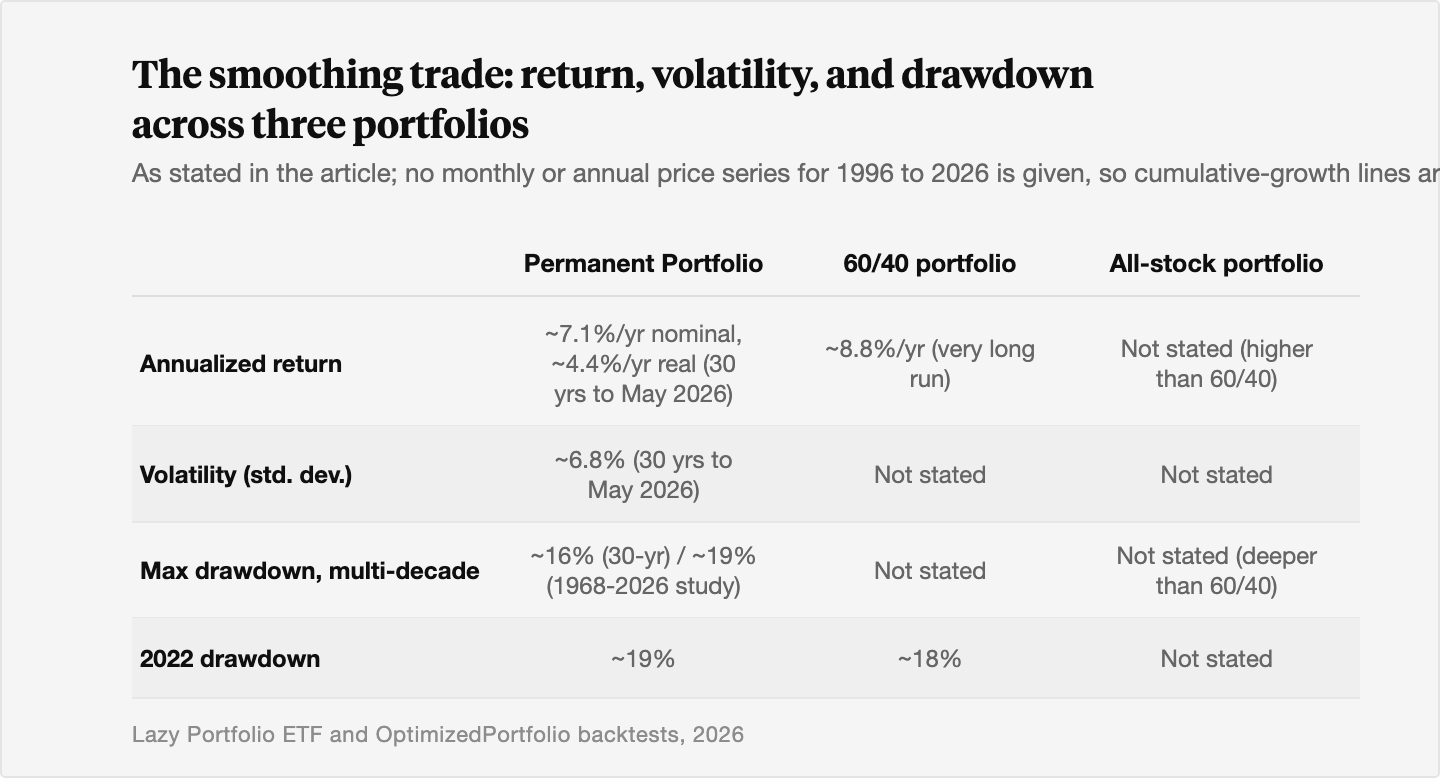
Past performance is not a reliable indicator of future results, and these are backtests of indices, not live accounts net of fees and taxes. The takeaway is structural and not a promise: across most of the last five decades, the Permanent Portfolio traded away some upside for a much steadier path.
5. Annual rebalancing and the discipline it forces
Rebalancing is where the strategy earns part of its keep. The mechanical act of selling the asset that has run up and buying the one that has lagged, back to equal 25% weights, is a built-in "sell high, buy low" rule that removes judgment from the process.
Browne's original guidance was loose. Rebalance when any asset drifts outside a band, below 15% or above 35% of the portfolio, rather than on a fixed calendar [3]. Most modern users simplify this to an annual rebalance, which is easier to run and captures most of the benefit. Either way, the point is the same. You are forced to trim winners and add to losers, which is the opposite of what most investors do under stress.
This discipline is also where the regime logic pays off in practice. When gold spikes in an inflation scare, rebalancing harvests some of that gain and rotates it into the assets that lagged, so you are positioned for the next regime rather than chasing the last one.
6. The common critiques: cash drag, bond drag, and gold dependence
We try to argue the other side honestly, and the Permanent Portfolio has real critics with real points.
The first critique is the perpetual cost of the cash sleeve. Cash is there to protect against tight-money recessions, but those are rare. With the economy in expansion most of the time since World War II, a permanent 25% cash weight acts as an insurance premium paid in nearly every year for a payoff that arrives in a few [6]. Over long horizons, neither cash nor gold has reliably produced much positive return after inflation, which means half the portfolio is structurally low-return by design [6].
The second critique is the bond sleeve in a rising-rate world. Long-term Treasuries are the deflation hedge, and they performed that job well across the long bond bull market that ran from the early 1980s to 2020. When rates rose sharply in 2022, long bonds and stocks fell at the same time, the gold position did not fully offset it, and the portfolio had its worst year on record with a drawdown near 19% [3][10]. The design assumes stocks and bonds usually move apart. In an inflation shock they can move together.
The third critique is gold dependence. Analysts have noted that gold delivered a large share of the Permanent Portfolio's gains in some periods, so when gold went through its long slump after 2012, the whole portfolio lagged US stocks and several simpler stock-and-bond mixes for years [6]. A strategy that leans on a non-income-producing metal for a quarter of its weight will have stretches where that quarter is dead money.
The honest summary is that the Permanent Portfolio is a low-real-return, low-stress strategy. It is built to lose less, not to win more, and in a long equity bull market it will look slow. Whether that is a flaw or the entire point depends on what the investor is trying to do.
7. How it relates to risk parity and All Weather
The Permanent Portfolio is the plain-English ancestor of a much larger idea.
In 1996, Ray Dalio, Bob Prince, and Greg Jensen at Bridgewater built the All Weather portfolio to manage Dalio's family trust, with the same starting question Browne asked: how do you build something that holds up when you cannot predict the regime [5][7]. Dalio framed the regimes slightly differently, as four boxes formed by growth rising or falling and inflation rising or falling relative to expectations, but the spirit is identical. Hold a balanced set of assets so that something is always working [5][7].
The mechanical difference is risk parity. Browne weighted by dollars, an equal 25% of capital in each asset. All Weather weights by risk, sizing each asset so that it contributes the same amount of volatility to the portfolio. Because low-volatility assets like bonds would otherwise contribute too little, risk parity often adds leverage to bring the overall risk back up toward an equity-like level [5][7]. A typical All Weather build leans heavily on long and intermediate bonds and adds gold and commodities for the inflation regimes [7].
For most individual investors, the Permanent Portfolio is the more practical version. It needs no leverage, no volatility targeting, and no rebalancing engine. It is four funds and an annual reset. The conceptual debt it owes, and that All Weather repaid by formalizing, is the move from picking the winning asset to owning the whole set.
8. The lesson for a real-asset and alternatives sleeve
Here is where the Permanent Portfolio is most useful to the kind of investor we write for, even one who would never run the strategy as written.
The portfolio's load-bearing insight is that you want assets that respond to different economic forces, and that at least one of them should be a hard real asset that holds value when paper currency is losing it. Browne used gold for that job. Gold is liquid, has no income, and tends to do its work specifically in inflation and crisis regimes. We have compared art and gold directly as inflation hedges, and the two share more than most people assume, including a low correlation to equities and a reliance on scarcity rather than cash flow, in our piece on art versus gold as a hedge asset.
Blue-chip art is another scarce real asset that some allocators add at a small weight for a similar regime-diversification reason. Its correlation to public equities has historically been close to zero, and its highest correlation to any major asset is with gold, in the range of roughly 0.1 to 0.2. That low correlation is the same property Browne was buying when he put gold in the portfolio. Art belongs to the broader category of real assets we cover in real assets: real estate, infrastructure, and commodities.
We want to be precise about the limits, because the comparison breaks in important ways. Art is illiquid, with holding periods we generally describe as 3 to 10 years. It produces no yield. It cannot be rebalanced on an annual schedule the way a public ETF can, and it is not a substitute for the portfolio's cash or short-bond sleeve, which exist precisely to provide liquidity and stability. In Browne's structure, cash is the part you can spend tomorrow. Art is the opposite of that.
So the honest framing is narrow. Art is not a Permanent Portfolio asset, and we would not present it as one. The transferable idea is the regime logic. If the reason you hold gold is that you want a scarce real asset that responds to inflation and sits outside the equity-and-bond complex, then a small, deliberately illiquid allocation to blue-chip art is one more expression of that same instinct, sized for a long horizon and capped at a modest share of the portfolio. We lay out how an advisor might size and frame that in art as an alternative allocation.
The Bottom Line
- The Permanent Portfolio holds equal 25% weights in stocks, long-term Treasuries, gold, and cash, with each asset chosen to lead in one of four economic regimes.
- Its premise is that you cannot reliably forecast the next regime, so you hold one asset for each and rebalance back to equal weights, usually once a year.
- The historical record is a steady one. Mid-single-digit to high-single-digit nominal returns, single-digit volatility, and drawdowns that have generally stayed below 20%, lower on every count than an all-equity portfolio.
- The smoother ride has a cost. A large cash and bond weight and a one-quarter gold stake mean lower long-run growth and real drag in decades when gold and bonds lag.
- It is the simple ancestor of risk parity and Bridgewater's All Weather, which weight by risk rather than dollars and often add leverage to push the same regime-balancing logic further.
- The portable lesson for a modern portfolio is to diversify across economic regimes, including with a scarce real asset for inflation. Blue-chip art can play that diversifying role at a small weight, though it is illiquid, yields nothing, and is not a substitute for the liquidity sleeve.
Sources
- PortfoliosLab. "Harry Browne Permanent Portfolio." PortfoliosLab, accessed June 2026. https://portfolioslab.com/portfolio/harry-browne-permanent
- Portfolio Charts. "Permanent Portfolio." Portfolio Charts, accessed June 2026. https://portfoliocharts.com/portfolios/permanent-portfolio/
- John Williamson. "Harry Browne Permanent Portfolio Review, Performance, & ETFs (2026)." OptimizedPortfolio, April 12, 2026. https://www.optimizedportfolio.com/permanent-portfolio/
- Lazy Portfolio ETF. "Harry Browne Permanent Portfolio: ETF allocation and returns." LazyPortfolioETF, as of May 31, 2026. https://www.lazyportfolioetf.com/allocation/harry-browne-permanent/
- Bridgewater Associates. "The All Weather Story." Bridgewater, January 2012. https://www.bridgewater.com/research-and-insights/the-all-weather-story
- Mutiny Fund. "The Unreasonable Effectiveness of the Permanent Portfolio." Mutiny Fund, accessed June 2026. https://mutinyfund.com/permanent-portfolio/
- John Williamson. "Ray Dalio All Weather Portfolio Review, ETFs, & Leverage (2026)." OptimizedPortfolio, 2026. https://www.optimizedportfolio.com/all-weather-portfolio/
- SoFi. "Understanding the Permanent Portfolio Strategy." SoFi Learn, accessed June 2026. https://www.sofi.com/learn/content/permanent-portfolio-strategy/
- QuantifiedStrategies. "The 60/40 Strategy Portfolio: Is It Dead? Backtests, Alternatives, And Substitutes Analysis." QuantifiedStrategies, accessed June 2026. https://www.quantifiedstrategies.com/60-40-portfolio-strategy/
- Bogleheads. "Harry Browne's Permanent Portfolio: 2022 update." Bogleheads Blog, January 10, 2023. https://www.bogleheads.org/blog/2023/01/10/harry-brownes-permanent-portfolio-2022-update/
- EBC Financial Group. "Ray Dalio Strategy Explained: All Weather, Risk Parity." EBC, accessed June 2026. https://www.ebc.com/forex/ray-dalio-strategy-explained-all-weather-risk-parity
Disclosures
Investing involves risk. Past results are not indicative of future outcomes.
Masterworks is providing this communication as an agent for its issuer entities, not Masterworks Advisers. This material is produced by Masterworks for informational purposes only and does not constitute investment advice, a recommendation, or an offer or solicitation to buy or sell any security. Masterworks is not a licensed broker-dealer by the SEC or FINRA.
Masterworks can only make and accept sales after an offering statement has been filed, and "qualified", by the SEC. Any offers may be revoked before notice of qualification. Indications of interest involve no obligation. For further disclosure visit the offering documents filed with the SEC and Important Disclosures at masterworks.com/cd.
Forward-looking statements and internal estimates are based on assumptions that may prove incorrect, and actual outcomes may differ materially. Figures denoted in brackets are subject to confirmation. Investing in art and alternative assets involves risk, including loss of principal.
Art sales price data is comparative only. Each painting is unique and historical data is not a direct proxy for any specific painting or investment. Data represents whole art, not an investment into our offerings which includes fees and expenses. Any comparative images are not currently live offerings and are provided for educational purposes only.
Masterworks, LLC is located at 1 World Trade Center, 57th Floor, New York, NY 10007.