
Masterworks Research · June 2026
The biases that quietly drain returns, the research that explains them, and the guardrails that help investors stay disciplined across a full cycle.
Behavioral finance is the study of how predictable errors in human judgment affect investment decisions and asset prices. The major biases that cost investors money are loss aversion, recency bias, herding, overconfidence, anchoring, the disposition effect, and mental accounting, and decades of research show they tend to push people to buy high, sell low, and trade too often. The cost is measurable. DALBAR's long-running study found the average equity fund investor earned 16.54% in 2024 against the S&P 500's 25.02%, a gap of roughly 848 basis points that the firm attributes mostly to mistimed buying and selling [1]. For any investor, the lesson is that the largest controllable risk in a portfolio is usually the person managing it.
What You Need to Know
- The behavior gap is real and recurring. In 2024 the average equity investor trailed the S&P 500 by about 848 basis points, the second-widest gap of the decade, driven by withdrawals that landed just before the market rallied [1].
- Losses hurt about twice as much as gains feel good. Prospect theory, the foundational work by Daniel Kahneman and Amos Tversky in 1979, showed that "losses loom larger than gains," which is why people freeze, sell winners early, and cling to losers [2][8].
- Overtrading is one of the most reliable ways to underperform. In a study of 66,465 households, the most active traders earned about 11.4% a year while the market returned 17.9%, a penalty Brad Barber and Terrance Odean tied directly to overconfidence [5].
- The biases do not stop at stocks. They show up in art markets too, where anchoring to a single auction result and herding into a hot artist can push prices well past fundamentals [9][10].
- Discipline and a long horizon are the practical defense. A written plan, a fixed allocation, and a multi-year hold are the simplest guardrails against decisions made under emotion.
1. What behavioral finance actually is
For most of the twentieth century, finance assumed people were rational. The theory held that investors weigh probabilities correctly, treat a dollar as a dollar, and act in their own long-term interest. Anyone who has watched a friend panic-sell at the bottom of a correction knows the assumption is shaky.
Behavioral finance replaced that model with a more honest one. It draws on psychology to explain why investors make systematic, repeatable errors, and why those errors can move prices for long stretches before the market corrects them. The field grew out of two papers. The first, Tversky and Kahneman's 1974 article in Science, "Judgment under Uncertainty: Heuristics and Biases," showed that people lean on mental shortcuts that are usually efficient and occasionally produce predictable mistakes [4]. The second, their 1979 paper "Prospect Theory: An Analysis of Decision under Risk," became the most cited article ever published in Econometrica and rebuilt the model of how people actually choose under risk [2][8].
The work earned formal recognition. Kahneman won the Nobel Memorial Prize in Economic Sciences in 2002. Richard Thaler, who extended these ideas into how people manage money in everyday life, won it in 2017 [3]. These errors are systematic and recurring, wired in and worth planning around.
2. Loss aversion: why losses loom larger than gains
The single most important finding in behavioral finance is loss aversion. Kahneman and Tversky's prospect theory showed that people evaluate outcomes as changes from a reference point rather than as levels of total wealth, and that the pain of a loss is roughly twice the pleasure of an equal gain [2][8].
Put yourself in the position of an investor whose portfolio is down 15%. Rationally, the question is whether the holdings are still worth owning at today's prices. Emotionally, the question becomes whether to "get back to even." Those are different questions, and loss aversion pushes people toward the second one. It is why investors hold a falling position long past the point where they would ever buy it fresh, and why a paper loss feels like a wound that selling would make permanent.
Loss aversion also explains the most expensive timing mistake of all: selling into weakness. DALBAR found that in 2024 investors pulled money out of equity funds in every quarter, with the largest outflows landing just before a major rally [1]. The instinct to stop the pain is exactly the instinct that locks it in.
3. The disposition effect: selling winners, holding losers
Loss aversion has a direct market footprint, and it has a name. The disposition effect is the tendency to sell winning investments too soon and hold losing ones too long. Terrance Odean documented it in a 1998 study published in The Journal of Finance, using trading records from 10,000 accounts at a discount brokerage between 1987 and 1993 [6].
About 60% of the sales investors chose to make were winners and only 40% were losers, meaning they realized gains at roughly a 50% higher rate than losses [6]. The behavior was not explained by rebalancing, by tax planning, or by the winners being worse bets going forward. In fact, for taxable accounts it was backwards, because selling winners triggers tax while holding losers forgoes the chance to harvest a loss.
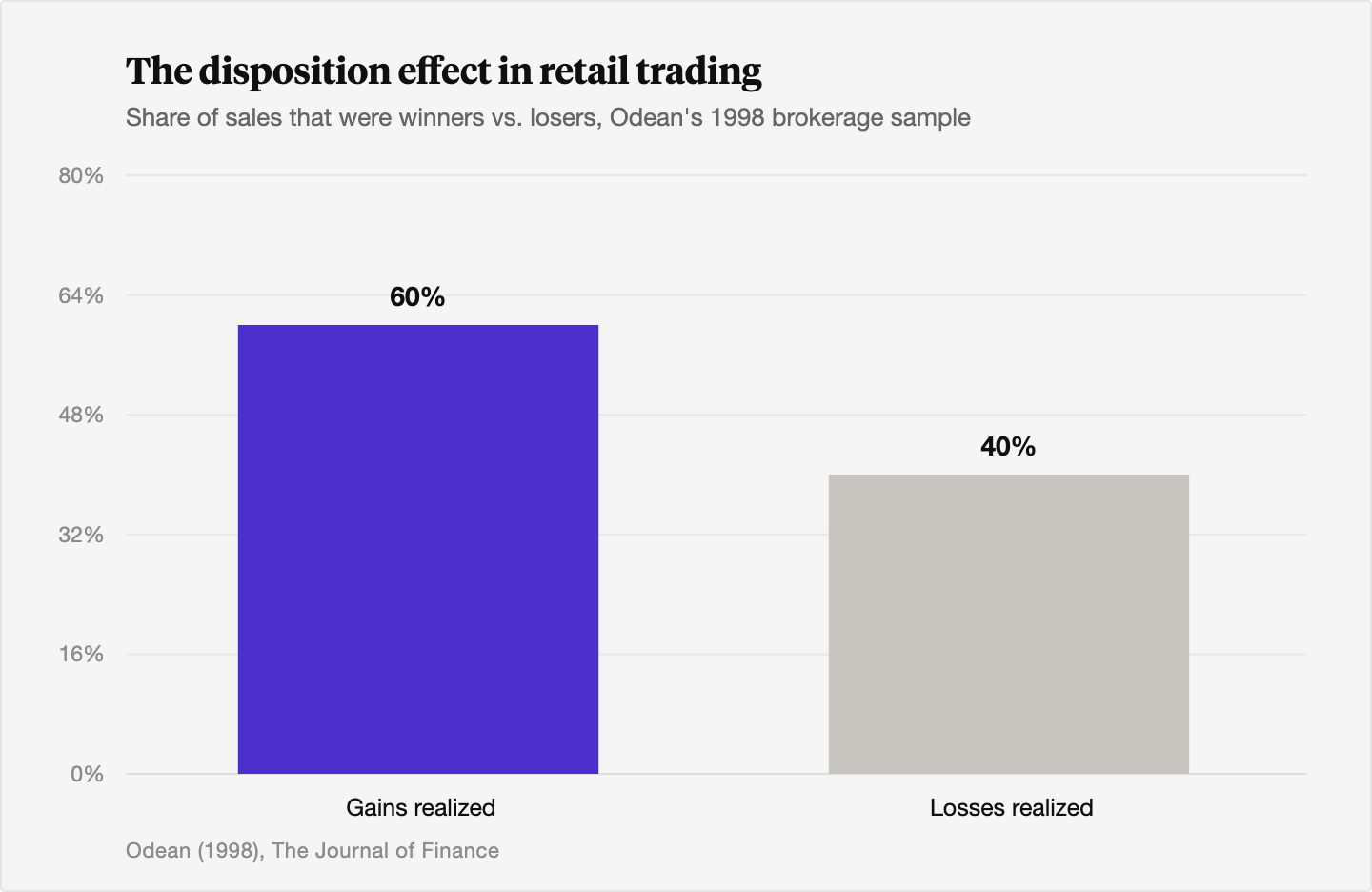
The investing translation is that the disposition effect cuts the upside off your best holdings and lets your worst ones compound their drag. It feels like prudence but behaves like the opposite.
4. Overconfidence and overtrading
Most investors believe they are above-average drivers, above-average judges of character, and above-average pickers of stocks. The first two beliefs are mostly harmless. The third one has a price.
Barber and Odean studied 66,465 households at a large discount broker from 1991 to 1996 and found that the households that traded most earned about 11.4% a year while the market returned 17.9% [5]. The most active traders underperformed the least active by roughly 5.5 percentage points a year. Their explanation was overconfidence. Investors who overestimate the quality of their information trade more, and every trade carries cost and the risk of being wrong about timing. They titled the work "Trading Is Hazardous to Your Wealth" [5].
Overconfidence is hard to see in yourself, which is what makes it dangerous. The useful guardrail is structural. Fewer decisions, made on a schedule rather than on impulse, remove most of the opportunities for overconfidence to act.
5. Anchoring: the first number wins
Anchoring is the tendency to lean too heavily on the first piece of information you see when making an estimate. Tversky and Kahneman demonstrated it in 1974: when people are given an arbitrary starting number and asked to estimate an unrelated quantity, their answers drift toward the irrelevant anchor [4].
In markets, the anchor is usually a price. An investor who bought a stock at $100 treats $100 as the reference point, even when nothing about the company supports it anymore. The number on the original receipt quietly governs the decision to hold or sell, long after it stopped carrying any information. Anchoring is also why a single headline price can reset expectations for an entire category, a dynamic that runs especially strong in art, which we come to below.
6. Recency bias and herding: chasing the recent past
Recency bias is the habit of giving recent events more weight than they deserve and assuming the latest trend will continue. With a 24-hour news cycle and markets discussed in real time on social platforms, the most recent move tends to crowd out the long-run record [11][12].
Recency bias rarely travels alone. When enough investors extrapolate the same recent trend, you get herding, the tendency to follow the crowd instead of doing independent work. Funds that have just outperformed pull in the heaviest inflows, which is the textbook description of buying high [11]. The mechanism is self-reinforcing on the way up and on the way down, and it is a large part of why the average investor's timing is so poor. DALBAR's "Guess Right Ratio," its measure of how often investors move money in the correct direction, fell to about 25% in 2024 [1].
7. Mental accounting: not all dollars are equal
Richard Thaler's contribution, recognized in his 2017 Nobel award, was the idea of mental accounting. People sort money into separate mental buckets and treat each bucket differently, even though a dollar is a dollar [3].
An investor will treat a tax refund or a market windfall as "house money" and take risks with it they would never take with their salary. The same investor will hold an underwater stock in one account while paying high-interest debt in another, because the two live in different mental boxes. Mental accounting is also why "gains" can feel spendable while "principal" feels untouchable, even when both are just numbers in the same portfolio. The guardrail is to evaluate the whole portfolio as one balance sheet rather than as a drawer full of separate envelopes.
8. How these biases show up in art markets
Art is often treated as a world apart from finance, governed by taste and connoisseurship. The behavioral biases do not respect that boundary. They show up in the salesroom in forms an equity investor would recognize instantly.
Anchoring to a single result. Academic work on auction data finds that the price a work fetches, and even the experts' presale estimate, tends to anchor on what that work or a comparable one sold for previously, with the pull strongest when sales are close together in time [9][10]. A record headline price can reset the perceived value of an entire artist's market, and bidders adjust too little away from it. We have written about how to read auction estimates with that bias in mind in what auction estimates reveal about market direction.
Herding into hot names. When a handful of buyers chase the same in-fashion artist, the bidding becomes social. Researchers studying art auctions describe the room as a setting where status signaling and the presence of known collectors can push prices well above what the fundamentals support [10]. It is the same performance-chasing that inflates fund flows, with paddles instead of order tickets.
The disposition effect, in oil and canvas. Collectors and speculators sell their winners to book a profit and hold their disappointments rather than admit a mistake, the identical pattern Odean found in brokerage accounts [6]. Many who bought at the inflated prices of the 2021 peak have held those works rather than realize a loss, waiting to "get back to even."
Selling into weakness. The art market moves on its own clock and has historically corrected and recovered over multi-year spans rather than months. Forced or fearful selling during a correction is how a paper drawdown becomes a permanent one. We lay out the cycle in detail in how art market cycles work: expansion, peak, correction, and recovery.
The structural defense against all of this is the same one that works in equities: a long horizon and the discipline to hold through the noise. Art's low correlation to stocks is only useful to an investor who actually holds it across a cycle, and the historical record rewards patience over reaction. We have assembled that evidence in why patience is rewarded in art markets: the data behind long holds and compared the two asset classes directly in art vs stocks over the last 30 years: a performance comparison. Past performance is not predictive of future results, in art or in equities, and a low historical correlation can change.
9. Guardrails: turning the research into discipline
Knowing about a bias does not remove it. Kahneman spent his career studying these errors and said repeatedly that he still fell for them. The practical answer is to build structure that makes the disciplined choice the default and the emotional choice harder to act on.
- Write the plan down before you need it. A target allocation and a rule for when you will add or trim removes most in-the-moment decisions, which is where loss aversion and recency bias do their damage.
- Rebalance on a schedule, not on a feeling. A calendar rule forces you to trim what has run and add to what has lagged, the reverse of the herding instinct.
- Decide your holding period in advance and respect it. A multi-year horizon defangs the disposition effect, because the question stops being "am I up or down today."
- Look at the whole portfolio, not the line items. This is the antidote to mental accounting. One balance sheet, evaluated together.
- Trade less. Barber and Odean's data is blunt about the cost of activity. When in doubt, the lower-turnover choice is usually the better one [5].
None of this is glamorous. The edge in behavioral finance is the patience to keep doing the boring, disciplined thing while other people react.
The Bottom Line
- Behavioral finance documents the systematic errors that lead investors to buy high, sell low, and trade too much, and the costs are measurable in the long-run gap between investor returns and index returns [1].
- Loss aversion and its market expression, the disposition effect, are the most expensive habits, pushing investors to sell winners early, hold losers too long, and sell into weakness [2][6].
- Overconfidence drives overtrading, and the most active traders have historically underperformed the market by a wide margin [5].
- Anchoring, recency bias, herding, and mental accounting compound the problem by distorting what investors think things are worth and when they act [4][11].
- The same biases operate in art markets, where anchoring to record prices and herding into hot artists can stretch valuations, which is why a disciplined, long-horizon approach matters. Past performance is not predictive of future results.
Sources
- DALBAR. "Investors Missed the Best of 2024's Market Gains, Latest DALBAR Investor Behavior Report Finds." DALBAR Press Release, March 31, 2025. https://www.dalbar.com/press-release/investors-missed-the-best-of-2024s-market-gains-latest-dalbar-investor-behavior-report-finds/
- Kahneman, Daniel, and Amos Tversky. "Prospect Theory: An Analysis of Decision under Risk." Econometrica, vol. 47, no. 2, 1979, pp. 263 to 291. https://en.wikipedia.org/wiki/Prospect_theory
- The Royal Swedish Academy of Sciences. "The Prize in Economic Sciences 2017: Richard H. Thaler." NobelPrize.org, October 9, 2017. https://www.nobelprize.org/prizes/economic-sciences/2017/press-release/
- Tversky, Amos, and Daniel Kahneman. "Judgment under Uncertainty: Heuristics and Biases." Science, vol. 185, no. 4157, 1974, pp. 1124 to 1131. https://www.cs.tufts.edu/comp/150AIH/pdf/TverskyKa74.pdf
- Barber, Brad M., and Terrance Odean. "Trading Is Hazardous to Your Wealth: The Common Stock Investment Performance of Individual Investors." The Journal of Finance, vol. 55, no. 2, 2000. https://papers.ssrn.com/sol3/papers.cfm?abstract_id=219228
- Odean, Terrance. "Are Investors Reluctant to Realize Their Losses?" The Journal of Finance, vol. 53, no. 5, 1998. https://faculty.haas.berkeley.edu/odean/papers%20current%20versions/areinvestorsreluctant.pdf
- University of Chicago. "Richard Thaler Wins Nobel Prize 'for his contributions to behavioural economics'." UChicago News, October 9, 2017. https://news.uchicago.edu/story/richard-thaler-wins-nobel-prize-his-contributions-behavioural-economics
- McLeod, Saul. "Prospect Theory in Psychology: Loss Aversion Bias." Simply Psychology, 2024. https://www.simplypsychology.org/prospect-theory.html
- Graddy, Kathryn, Lara Loewenstein, Jianping Mei, Mike Moses, and Rachel A. J. Pownall. "Empirical Evidence of Anchoring and Loss Aversion from Art Auctions." Journal of Cultural Economics, 2022. https://link.springer.com/article/10.1007/s10824-022-09459-2
- Beggs, Alan, and Kathryn Graddy. "Anchoring Effects: Evidence from Art Auctions." American Economic Review, summarized via Semantic Scholar. https://www.semanticscholar.org/paper/Anchoring-Effects:-Evidence-from-Art-Auctions-Beggs-Graddy/946ca0e5895412d87f5cc5c4a9f34141c70c8a0d
- LSEG / FTSE Russell. "Cognitive Biases and Learning from Past Market Volatility." LSEG Insights, 2025. https://www.lseg.com/en/insights/ftse-russell/cognitive-biases-and-learning-from-past-market-volatility
- Boston Institute of Analytics. "Behavioral Finance in 2025: How Psychology Is Driving Market Trends." Boston Institute of Analytics Blog, 2025. https://bostoninstituteofanalytics.org/blog/behavioral-finance-in-2025-how-psychology-is-driving-market-trends/
Disclosures
Investing involves risk. Past results are not indicative of future outcomes.
Masterworks is providing this communication as an agent for its issuer entities, not Masterworks Advisers. This material is produced by Masterworks for informational purposes only and does not constitute investment advice, a recommendation, or an offer or solicitation to buy or sell any security. Masterworks is not a licensed broker-dealer by the SEC or FINRA.
Masterworks can only make and accept sales after an offering statement has been filed, and "qualified", by the SEC. Any offers may be revoked before notice of qualification. Indications of interest involve no obligation. For further disclosure visit the offering documents filed with the SEC and Important Disclosures at masterworks.com/cd.
Forward-looking statements and internal estimates are based on assumptions that may prove incorrect, and actual outcomes may differ materially. Figures denoted in brackets are subject to confirmation. Investing in art and alternative assets involves risk, including loss of principal.
Art sales price data is comparative only. Each painting is unique and historical data is not a direct proxy for any specific painting or investment. Data represents whole art, not an investment into our offerings which includes fees and expenses. Any comparative images are not currently live offerings and are provided for educational purposes only.
Masterworks, LLC is located at 1 World Trade Center, 57th Floor, New York, NY 10007.


