
Masterworks Research · June 2026
What alpha and beta really measure, why persistent alpha is rare and expensive, and how to decide what is worth paying for.
Beta is your exposure to a market's systematic return, measured as how sensitive your portfolio is to a benchmark. A beta of 1.0 means you move roughly one for one with the index. Alpha is the risk-adjusted excess return that is left over after you account for that beta, the part of performance a manager can claim as skill rather than market exposure. The distinction matters to investors because beta is now nearly free, while alpha is expensive, rare, and hard to tell apart from luck or from simply taking more hidden risk. Getting the two confused is one of the most common, and most costly, mistakes in portfolio construction.
What You Need to Know
- Beta is cheap and alpha is scarce. You can buy broad U.S. equity beta for a few basis points a year through an index fund. Genuine, repeatable alpha is so rare that, in calendar 2025, 79% of active large-cap U.S. equity funds underperformed the S&P 500, the fourth-worst showing in the 25-year history of the SPIVA Scorecards [1].
- Long horizons make it worse. Over the 20 years through year-end 2024, roughly 9 in 10 active U.S. domestic equity funds trailed their benchmarks [2]. Time is the enemy of the average active manager, not the friend.
- Yesterday's winners rarely repeat. Of the top-quartile U.S. equity funds as of December 2020, not a single one stayed in the top quartile over the next four years [3]. Past ranking carries almost no information about future ranking.
- A lot of "alpha" is just unbudgeted beta. A fund that beats the S&P 500 by loading up on small-cap, value, or momentum exposure has taken a different, often cheaper-to-replicate risk rather than created alpha. Smart-beta and factor products exist precisely to package that exposure at low cost [4].
- Fees decide the contest. Among the priciest large-cap funds, only about 1.3% beat their average passive peer over the decade through 2024, against 13% of the cheapest [5]. The clearest predictor of whether you keep your return is what you pay for it.
1. What beta measures, and why it is the cheap part
Beta comes out of the Capital Asset Pricing Model, the framework that says an asset's expected return is the risk-free rate plus its sensitivity to the broad market times the market's risk premium. In that equation, beta is the sensitivity term. It tells you how much of your return is simply the market doing what the market does, scaled up or down by how aggressively you are positioned.
A portfolio with a beta of 1.0 rises and falls roughly in line with its benchmark. A beta of 1.2 amplifies the market's moves by about 20% in both directions. A beta of 0.8 dampens them. None of that is skill. It is a dial on how much systematic market risk you are holding, and the return you earn for holding it is compensation for bearing risk everyone can see.
If the return comes from broad market exposure, then anyone can capture it by owning the whole market. That is what an index fund does. The cheapest S&P 500 funds now charge in the low single digits of basis points, effectively a rounding error. So the rational way to think about beta is as a budgeting decision. You decide how much equity-market risk you want, and you buy it for almost nothing. There is no reason to pay an active fee for the part of your return that the index would have handed you for free.
2. What alpha measures, and why it is the expensive part
Alpha is what is left after you strip beta out. The cleanest formal definition is Jensen's alpha, introduced by Michael Jensen in his 1968 study of mutual fund performance from 1945 to 1964 [6]. The formula is straightforward: alpha equals the portfolio's realized return minus what the CAPM said you should have earned given your beta. In symbols, alpha = R_p minus [R_f + beta times (R_m minus R_f)], where R_p is the portfolio return, R_f the risk-free rate, R_m the market return, and beta the portfolio's sensitivity to that market [6].
Subtracting the beta term gives the manager no credit for market exposure. If you earned 12% in a year the market returned 12% and you ran a beta of 1.0, your alpha is zero. You did fine, but you did nothing the index would not have done. Positive alpha means you beat the return your risk exposure entitled you to. Negative alpha means you fell short of it.
True, persistent, positive alpha is the thing investors are willing to pay active fees for. The trouble is how seldom it shows up. Jensen's original finding, that the average fund did not beat the market after costs, has held up across nearly six decades of data. Most marketing material leaves that out.
3. Why persistent alpha is so rare: what SPIVA shows
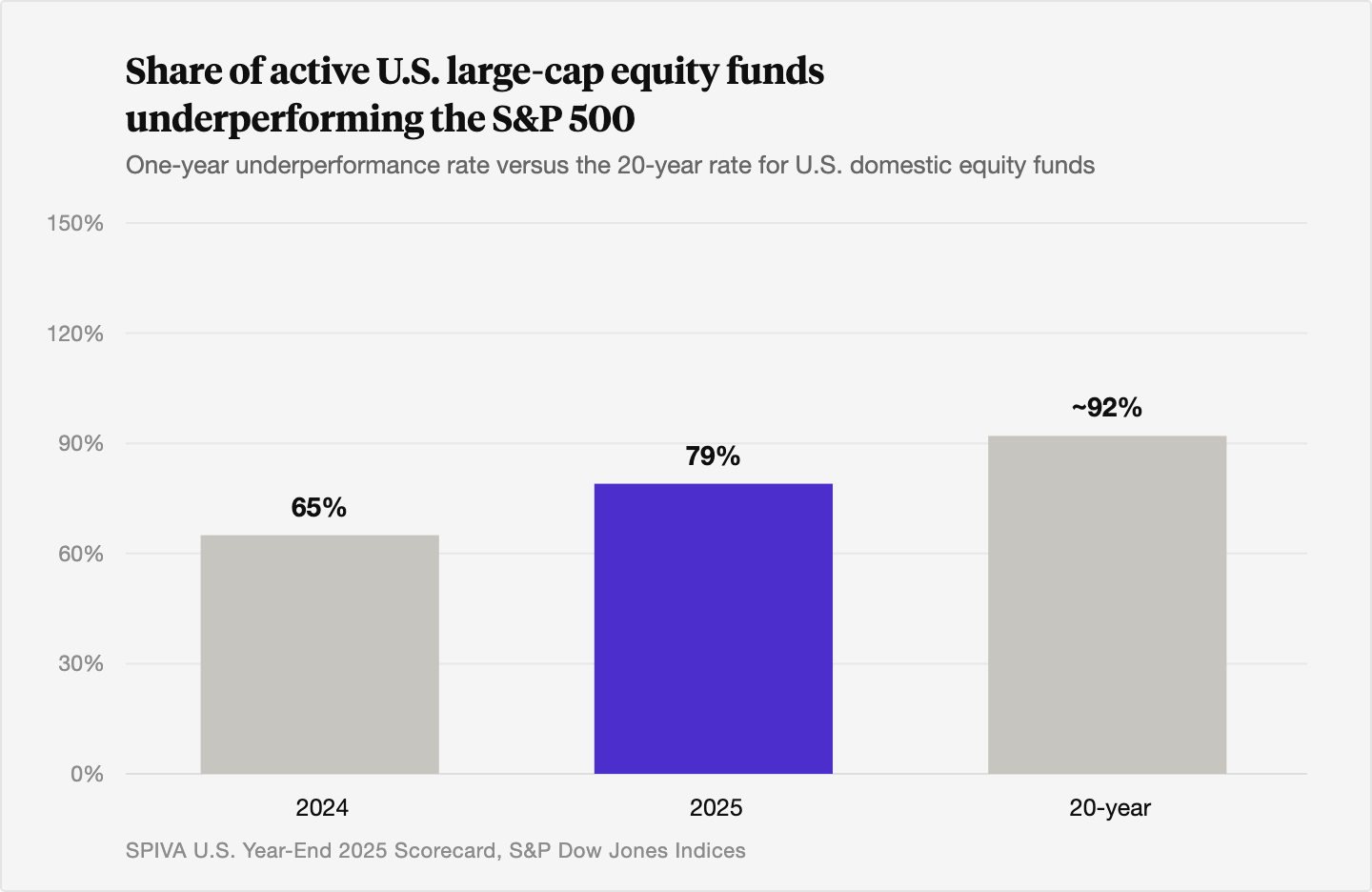
The most-cited public evidence is the SPIVA Scorecard from S&P Dow Jones Indices, which has compared active funds with their benchmarks for 25 years. The numbers are blunt. In calendar 2025, 79% of active large-cap U.S. equity funds underperformed the S&P 500, up from 65% in 2024, and the fourth-worst year for large-cap stock pickers in the scorecard's history [1].
Single years can be noisy, so the long horizons matter more. Over the 15 years through December 2024, there was no major fund category in which a majority of active managers beat their benchmark [2]. Over 20 years, roughly 92% of U.S. domestic equity funds trailed [2]. Whatever skill exists in the industry, it is not showing up in the aggregate after fees.
A skeptic might say the scorecard mixes good and bad managers, and that you only need to find the good ones. That brings us to persistence.
4. Yesterday's winner is not tomorrow's: the persistence problem
If alpha were a durable skill, last year's best funds should keep winning. They do not. The companion SPIVA U.S. Persistence Scorecard tracks whether top performers stay on top. Among top-quartile U.S. equity funds as of December 2020, not a single one remained in the top quartile over the following four years [3]. Lower the bar to the top half and the share that stays there over five years still comes in below what pure chance would produce [3].
In plain terms, a fund landing in the top quartile this year has roughly coin-flip odds, often worse, of repeating. That is the statistical signature of luck, not skill. It is also why "past performance is not indicative of future results" is a regulatory requirement rather than a polite suggestion. The data behind that sentence is overwhelming.
This is the core reason chasing last year's hot fund tends to disappoint. You are paying an active fee for a track record that carries almost no predictive information about what comes next.
5. Fake alpha: hidden beta and unbudgeted factor risk
A large share of what gets sold as alpha is something else entirely: extra beta you did not realize you were buying. Suppose a fund beats the S&P 500 in a year small-cap value stocks ran hot, and it happened to be tilted toward small-cap value. Its return looks like skill against a large-cap benchmark. Measured against the right benchmark, the small-cap value index, the outperformance can vanish. The manager took a different systematic risk and got paid for it when that risk was in favor.
Academic finance gave these systematic risks names. Beyond the market factor, decades of research identified size, value, momentum, quality, and low volatility as exposures that have earned premiums across long periods and many markets [4]. Each is, in effect, another flavor of beta. The honest way to evaluate a manager is to subtract out every factor exposure you could have bought cheaply, then ask what return is left. Usually the answer is: not much.
This is also why a fund can run a beta above 1.0 and look like a genius in a bull market. Amplified market exposure is just the market dialed up. When the cycle turns, the same dial works in reverse.
6. Smart beta and factors: paying the right price for the right thing
Once the industry understood that size, value, momentum, and the rest were systematic and rules-based, it packaged them. Smart-beta and factor funds follow transparent rules to tilt toward a factor, rather than weighting purely by market capitalization [4]. They are a middle ground between plain index funds and discretionary active management, and they typically cost far less than a traditional active fund.
If you want a value tilt, you can buy it as a rules-based factor product for a modest fee, with full transparency about what you own. You no longer need to pay a stock picker 1% or more and hope the tilt they are running is the source of their edge. Factors do not guarantee outperformance, and they can lag the broad market for years at a time [4]. But they let you separate "I want this systematic exposure" from "I am betting on a manager's skill," and price each correctly.
Beta, including factor beta, should be cheap because it is replicable. Only genuine, post-factor, post-fee excess return deserves an alpha price.
7. How to think about paying for alpha versus beta
Start from the default that beta is a budgeting decision and alpha is a bet. You decide how much market risk you want and buy it near cost. Then, for any active fee, ask one question: is there evidence this manager produces return that survives subtracting market beta, the major factor exposures, and the fee itself? For most public-equity managers, the SPIVA and Morningstar data say the answer is no [1][2][5].
Cost is the most reliable lever you control. Morningstar's Active/Passive Barometer found that lower-fee active funds beat their passive peers far more often than expensive ones. Among the cheapest large-cap funds, about 13% topped their average passive rival over the decade through 2024; among the priciest, only about 1.3% did [5]. Same asset class, same decade, an order-of-magnitude difference driven largely by what investors were charged.
None of this says alpha is a myth. Some managers, in some less efficient corners of the market, do earn it. It says alpha is scarce, hard to identify in advance, and easy to confuse with beta you could have bought cheaply. Pay accordingly. Buy beta like a commodity, and demand real evidence before paying up for skill.
8. Where this connects to art: low beta is not the same as alpha
This framework is why allocators have spent the past several years hunting for returns that do not simply ride the equity market. When almost every public manager is delivering beta dressed up as alpha, a return stream with genuinely low equity beta becomes valuable on its own terms, regardless of whether it clears a skill test. That search is part of what has drawn institutional attention to uncorrelated alternatives, blue-chip art among them.
Blue-chip art's return has historically been largely independent of equity beta. Its drivers, the purchasing power of the ultra-wealthy, a supply of major works that shrinks as pieces enter museums, and the international marketability of the asset, run on a different clock than the stock market [7]. Morgan Stanley's Global Investment Committee added art and collectibles to its long-term capital market assumptions in 2024, a sign that the low-beta case is being taken seriously by mainstream allocators [7].
What art is not is a reliable source of measured alpha. It carries its own risks, idiosyncratic exposure to individual artists and works, real illiquidity, and the same caveat that applies to every asset class on this page: past performance is not indicative of future results. Art can offer diversification through low correlation to equities. It does not offer a guaranteed risk-adjusted excess return, and anyone selling it as alpha is making the exact mistake this article is about.
For more on the machinery behind these ideas, see our explainers on modern portfolio theory and its limits, the Sharpe ratio and risk-adjusted returns, correlation and diversification, and art as an alternative allocation for advisors.
The Bottom Line
- Beta is your exposure to a market's systematic return, and it is cheap to buy through index and factor funds. There is rarely a good reason to pay an active fee for it.
- Alpha is the risk-adjusted excess return left after accounting for beta. It is what active fees are supposed to buy, and it is genuinely rare.
- The public evidence is consistent. Most active funds underperform over one year, and the underperformance share rises toward roughly 90% over 15 to 20 years.
- Top performers seldom repeat. Of top-quartile U.S. equity funds in 2020, none stayed in the top quartile through 2024, which is the signature of luck rather than skill.
- Much apparent alpha is hidden beta or unbudgeted factor risk that you could have bought cheaply. Subtract it before paying a premium.
- Fees are the most reliable lever. Cheaper active funds beat their passive peers far more often than expensive ones.
- A low-beta, uncorrelated return stream such as blue-chip art can add diversification value, but low beta is not the same as alpha, and art carries its own idiosyncratic and liquidity risks.
Sources
- S&P Dow Jones Indices. "SPIVA U.S. Year-End 2025 Scorecard." S&P Global, 2026. https://www.spglobal.com/spdji/en/spiva/article/spiva-us/
- S&P Dow Jones Indices. "SPIVA U.S. Scorecard Year-End 2024." S&P Global, March 2025. https://www.spglobal.com/spdji/en/documents/spiva/spiva-us-year-end-2024.pdf
- S&P Dow Jones Indices. "U.S. Persistence Scorecard Year-End 2024." S&P Global, 2025. https://www.spglobal.com/spdji/en/documents/spiva/persistence-scorecard-year-end-2024.pdf
- iShares by BlackRock. "Introducing Factors and Smart Beta." BlackRock, 2025. https://www.ishares.com/us/strategies/smart-beta-investing
- Morningstar. "Active Funds Trailed Passive Peers in 2024." Morningstar Research, 2025. https://www.morningstar.com/funds/active-funds-trailed-passive-peers-2024
- Wikipedia contributors. "Jensen's alpha." Wikipedia, accessed June 2026. https://en.wikipedia.org/wiki/Jensen's_alpha
- CAIA Association. "Investing in the Art Market: A $1.7 Trillion Asset Class." Chartered Alternative Investment Analyst Association, 2025. https://caia.org/blog/2021/07/22/investing-art-market-17-trillion-asset-class
- Institutional Investor. "Active Continues to Struggle, Especially When Measured Over Long Time Periods." Institutional Investor, 2025. https://www.institutionalinvestor.com/article/2ei0q73dr49zygyfxzu2o/portfolio/active-continue-to-struggle-especially-when-measured-over-long-time-periods
- Morningstar. "Measuring the Performance of Active Funds Against Their Passive Peers." Morningstar Research, 2025. https://www.morningstar.com/funds/measuring-performance-active-funds-against-their-passive-peers
- Saxo. "What Are Smart Beta Strategies? A Guide to Factor-Based Investing." Saxo Bank, 2025. https://www.home.saxo/learn/guides/diversification/what-are-smart-beta-strategies-a-guide-to-modern-diversification
- Chase. "Factor Investing Explained: Value, Momentum, Quality and How Smart Beta Strategies Work." JPMorgan Chase, 2025. https://www.chase.com/personal/investments/learning-and-insights/article/factor-investing-explained
- WallStreetPrep. "Jensen's Measure (Alpha): Formula and Calculator." Wall Street Prep, 2025. https://www.wallstreetprep.com/knowledge/jensens-measure-alpha/
Disclosures
Investing involves risk. Past results are not indicative of future outcomes.
Masterworks is providing this communication as an agent for its issuer entities, not Masterworks Advisers. This material is produced by Masterworks for informational purposes only and does not constitute investment advice, a recommendation, or an offer or solicitation to buy or sell any security. Masterworks is not a licensed broker-dealer by the SEC or FINRA.
Masterworks can only make and accept sales after an offering statement has been filed, and "qualified", by the SEC. Any offers may be revoked before notice of qualification. Indications of interest involve no obligation. For further disclosure visit the offering documents filed with the SEC and Important Disclosures at masterworks.com/cd.
Forward-looking statements and internal estimates are based on assumptions that may prove incorrect, and actual outcomes may differ materially. Figures denoted in brackets are subject to confirmation. Investing in art and alternative assets involves risk, including loss of principal.
Art sales price data is comparative only. Each painting is unique and historical data is not a direct proxy for any specific painting or investment. Data represents whole art, not an investment into our offerings which includes fees and expenses. Any comparative images are not currently live offerings and are provided for educational purposes only.
Masterworks, LLC is located at 1 World Trade Center, 57th Floor, New York, NY 10007.


