Masterworks Research · June 2026
How a movement born in a Paris photographer's studio in 1874 became the deepest, most established collector market in fine art, and what its records and slower appreciation mean for an allocator.
Impressionism is the French painting movement of the 1870s and 1880s, led by Claude Monet, Pierre-Auguste Renoir, Edgar Degas, Camille Pissarro, and Berthe Morisot, that broke with academic convention to capture light, color, and modern life in loose, visible brushwork. For investors, it is the original blue-chip art market: the category with the longest continuous collecting history, the deepest museum presence, and the broadest global buyer base of any modern movement. In our view, that maturity is the whole point. Impressionism appreciates more slowly than Contemporary art, by Masterworks' stated estimate roughly 6 to 7% a year against 12 to 13% for post-1970 Contemporary, and it tends to do so with lower volatility and steadier demand through a downturn. This piece explains what Impressionism is, why it earned its blue-chip status, and how that status behaves on a return basis.
What You Need to Know
- Impressionism began with a single exhibition in 1874. Thirty-one artists showed roughly 165 works at a former photography studio at 35 Boulevard des Capucines in Paris. A critic mocked Monet's "Impression, soleil levant" and gave the movement its name. [1][2]
- It is the oldest organized modern-art market. Dealers were building a professional market for Impressionism in the 1870s, more than 70 years before Abstract Expressionism. That gives the category roughly 150 years of continuous, globalized collecting. [9][10]
- The records are deep and durable. Monet's "Meules" sold for $110.7M at Sotheby's in May 2019, the first Impressionist work to clear $100M at auction. Renoir's market record, $78.1M set in 1990, still stands. [3][5]
- Impressionism led the market in 2025. Impressionist and Modern overtook Post-War and Contemporary to become the most lucrative auction category, generating about $4.7 billion, up roughly 30% year over year, as buyers moved toward time-tested names. [7]
- Slower appreciation is the trade-off for stability. By Masterworks' stated estimate, Impressionist works appreciate at roughly 6 to 7% a year, below Contemporary's 12 to 13%, with less volatility. Past performance is not predictive of future results. [11]
1. What Impressionism actually is
Impressionism is a French movement of the 1870s and 1880s, centered in Paris, that abandoned the smooth, idealized finish of academic painting in favor of open-air observation, broken brushwork, and a high-key palette built to record the passing effects of light. [1][2]
The movement has a precise birthday. On April 15, 1874, a group that had incorporated months earlier as the "Societe anonyme des artistes peintres, sculpteurs, graveurs" opened an independent exhibition in the former studio of the photographer Nadar, at 35 Boulevard des Capucines. Roughly 31 artists showed about 165 works, deliberately timed just ahead of the official Salon and conceived as a show without juries or prizes. [1][2] Among Monet's entries was "Impression, soleil levant," a loose 1872 harbor view of Le Havre. On April 25, 1874, the critic Louis Leroy published a satirical review in Le Charivari titled "L'Exposition des Impressionnistes," mocking the painting as a mere "impression" rather than a finished work. The insult stuck, and the movement had its name. [1][2]
The core group is a stable, recognizable cast. Claude Monet (1840 to 1926) built the serial landscapes the movement is known for, the haystacks, the Rouen Cathedral facades, the water lilies at Giverny. Pierre-Auguste Renoir (1841 to 1919) painted the cafes, dances, and figures of modern leisure. Edgar Degas (1834 to 1917) organized much of that first show and worked in ballet rehearsals, racecourses, and laundresses, often indoors, with sharp drawing and cropped, photographic compositions. Camille Pissarro (1830 to 1903) was the only artist to exhibit in all eight Impressionist shows, painting rural and suburban landscapes in small, broken touches of color. Berthe Morisot (1841 to 1895) painted domestic interiors and family life with rapid, luminous brushwork. Alfred Sisley (1839 to 1899) worked almost exclusively in landscape. [1]
For an investor, the relevant fact is that this is a closed canon. The artists are dead, the bodies of work are finite and well catalogued, and no new Monet will ever be painted. That is the starting condition for everything that follows.
2. Why Impressionism is the original blue-chip market
A blue-chip art market is one with a long track record, an established canon, deep institutional ownership, and a broad enough buyer base to absorb works through multiple cycles. Impressionism fits that definition more cleanly than any other modern category, and it got there first. [10]
The market was professionally intermediated from the start. The dealer Paul Durand-Ruel began systematically buying and promoting Monet, Renoir, and Pissarro in the early 1870s, when the academic establishment was hostile to them. Over the following decades he built many of the mechanisms of the modern art trade around these artists: exclusive contracts, stock-building, traveling shows, and the targeted cultivation of collectors, especially wealthy Americans in the Gilded Age. [9][10] That gives Impressionism an unbroken collecting history of roughly 150 years, longer than the organized market for Abstract Expressionism, Post-War, or Contemporary art, all of which were assembled later.
Then there is the museum anchoring. Impressionist galleries are core holdings at the Musee d'Orsay in Paris, the Metropolitan Museum of Art in New York, and the Art Institute of Chicago, which owns Monet's "Haystacks" and "Water Lilies" among many others. [9] That matters for the market in two ways. It cements the canon, which sustains collector confidence across generations, and it permanently removes supply. When a great Monet enters a museum collection, it almost never comes back. The free float shrinks, and the works that do trade increasingly come from estates and long-held private collections rather than dealer inventory. [9]
This is the same supply mechanic we describe across investment-grade art. As we have written elsewhere, the best examples migrate into permanent collections and leave the market for good, which is why scarcity in this category tends to increase over long hold periods. The difference with Impressionism is that the process has been running for more than a century. The pool was already thin. It keeps getting thinner.
3. The records: what the top of the market tells you
The headline prices for Impressionism are large, but the more useful signal for an investor is how durable they are.
Monet's "Meules" (Haystacks), painted in 1890, sold at Sotheby's New York on May 14, 2019 for $110,747,000. Sotheby's recorded it as the artist's auction record and the first Impressionist work to exceed $100M at auction. [3] The work had been bought at auction in 1986 for $2.53M, which frames the long-horizon math without our needing to annualize it. It broke Monet's prior record, $84.6M for "Nympheas en fleur" at Christie's in May 2018, so the ceiling moved meaningfully inside a single year. [3]
The water-lily series is the deepest pool of trophy Monets. "Le Bassin aux nympheas" (1917 to 1919) sold for $70,353,000 at Sotheby's New York on May 12, 2021, described by the house as the greatest late water lily painting to appear at auction. [5] Renoir's record is older and has held for a generation: "Bal du moulin de la Galette" (1876) sold for $78.1M at Sotheby's New York on May 17, 1990, and that figure still stands as the artist's record more than 35 years later. [5] Degas's top painting result at Sotheby's, "Danseuse au repos," realized about $37M in November 2008, in the teeth of the financial crisis. [5] For context at the neo-Impressionist edge of the category, Seurat's "Les Poseuses" realized $149.2M in 2022, the highest Impressionist-adjacent result of the last decade. [6]
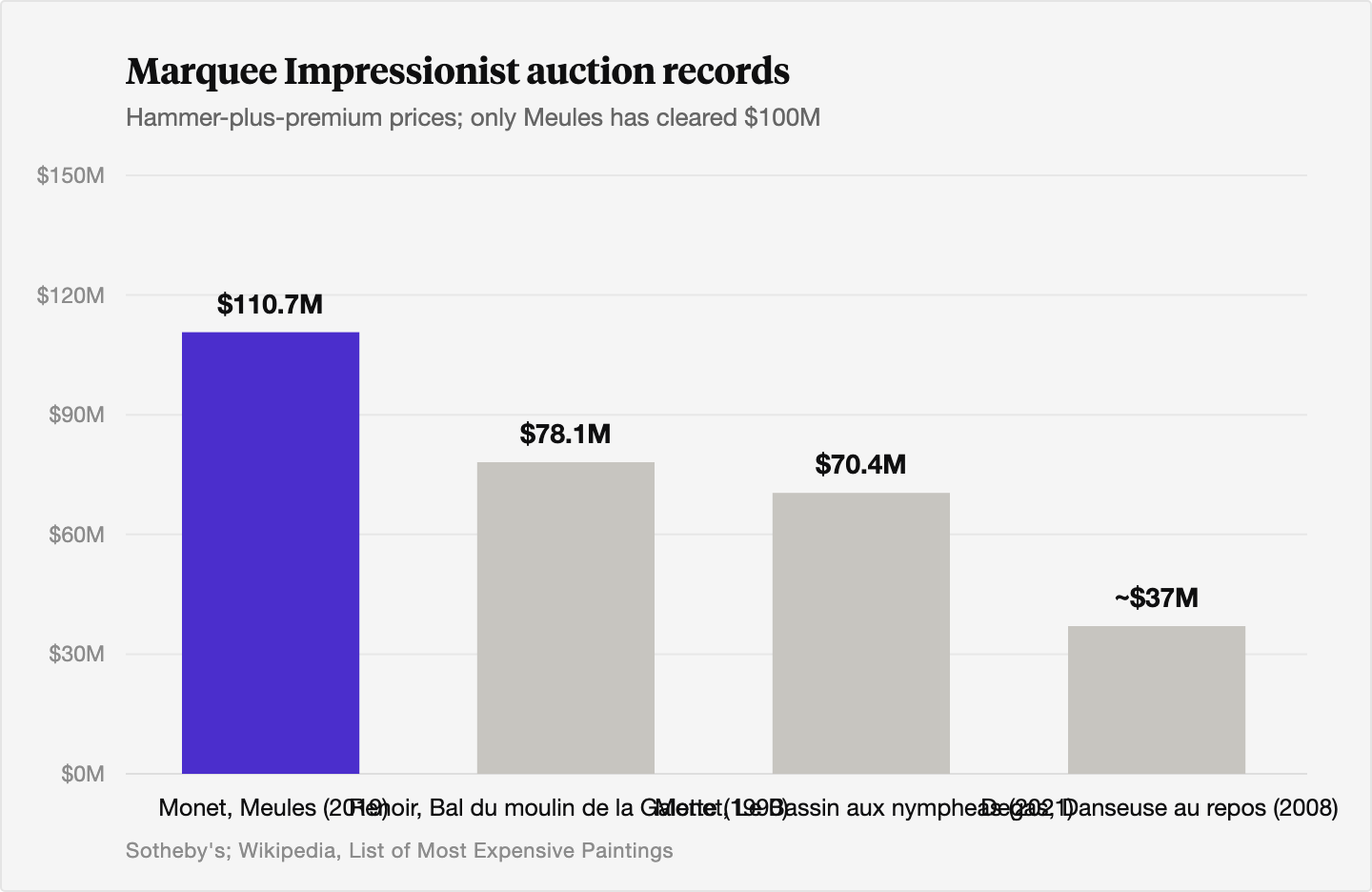
A note on how to read these. Records reset the market for quality. When "Meules" cleared $110M, it repriced the rest of Monet's haystack series and pulled up the A and B examples beneath it. The Renoir record holding for 35 years tells you something different, that demand for the very top of his market has been stable rather than explosive. Both are features of a mature category. Past performance, here and throughout, is not predictive of future results.
4. How the category behaved in 2025
The most important recent data point is that Impressionism led the market in 2025, after years in the shadow of Contemporary art.
According to the Artnet Intelligence Report covering 2025, the Impressionist and Modern category overtook Post-War and Contemporary to become the single most lucrative auction segment, generating roughly $4.7 billion in sales, up about 29.5% over 2024. [7] Over the same period, sales in the ultra-contemporary segment fell for a fourth consecutive year. The driver was a flight to time-tested names: in a cautious, selective market, capital moved toward established artists with long records and away from speculative young material. [7] Fine-art auction sales totaled about $11.7 billion in 2025, up 13.3% over 2024, the first annual increase since the 2021 peak. [7]
The macro backdrop supports the read. The Art Basel and UBS Art Market Report 2026, prepared by Dr. Clare McAndrew, put global art sales at about $59.6 billion in 2025, up 4%, with public auction sales up 9% to roughly $20.7 billion. Growth was concentrated at the high end, in works selling above $10M, led by blue-chip Modern names. [4]
This is the behavior we would expect from a blue-chip category in an uncertain year. When buyers get cautious, they reach for the canon. Impressionism is the canon. The 2025 result is a single year, and a flight-to-quality year at that, so we would not extrapolate the 30% category jump into a long-run rate. The pattern of capital favoring established names through a downturn, though, is consistent with how this market moves through expansion, peak, correction, and recovery.
5. Where Impressionism sits on the appreciation ladder
The case for owning Impressionism rests on steady appreciation, low volatility, and the deepest market in the asset class. It appreciates more slowly than Contemporary art, and that is the deliberate trade-off.
One of the first things we learned building the Masterworks index is counterintuitive: the older art gets, the less it appreciates. Most people assume the opposite. Our best hypothesis is that appreciation follows fashion, and fashion moves generationally. The ladder, as Masterworks' stated estimates, runs roughly like this: Contemporary art (post-1970) at 12 to 13% a year, Modern at 8 to 9%, Impressionist at 6 to 7%, and Old Masters at 1 to 2%. [11]
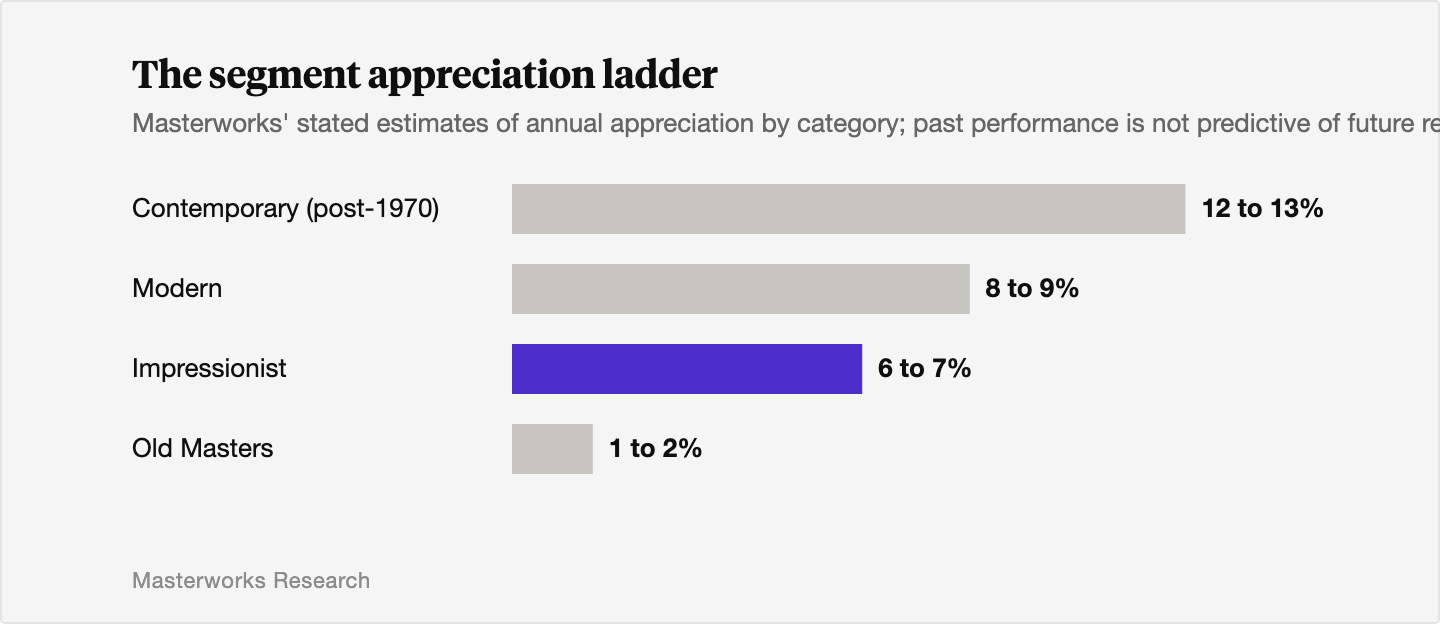
Impressionism sits in the lower-middle of that ladder, and the trade-off is deliberate. The same maturity that caps the appreciation rate, a fully formed canon, a century of price history, museum-anchored demand, also dampens the volatility. We have written separately about how the high end of the market behaves differently across price tiers, and about how Contemporary and Old Masters often move on different clocks. Impressionism is the steady middle of that structure. A buyer choosing it over Contemporary is choosing a slower, more predictable compounding profile with a deeper market to sell back into.
That is the right frame for an allocator. Higher expected appreciation in Contemporary comes with higher beta between artist markets and sharper drawdowns. Impressionism offers the opposite balance. Neither is the correct choice in the abstract. The choice depends on the time horizon and the risk the investor is willing to carry. We think of it the way we think about the rest of the asset class: art is a long-term, illiquid allocation, usually a single-digit percentage of a portfolio, held over a 3 to 10 year horizon.
6. The risks and limits
Three honest caveats belong on the table.
First, illiquidity. Even the deepest art market is illiquid relative to public equities. A Monet sells in a handful of evening sales each year, not on a continuous exchange, and the cost to transact, including buyer's premium, is high. An owner who needs to sell into a weak market may wait, or accept a discount.
Second, the data caveat. Art indices are built from infrequent auction sales and can understate true volatility, which is why we build the Masterworks index on a repeat-sale methodology, tracking the same work across multiple transactions rather than averaging a basket of different ones. Even so, headline category numbers like the 2025 figures above are turnover, not a like-for-like return on a single painting. The 6 to 7% estimate is our stated long-run figure for the segment, not a promise, and any year can diverge sharply from it.
Third, concentration at the top. Impressionist results, like the rest of the high end, are driven by a small number of trophy lots and a buyer pool concentrated at the very top of the wealth distribution. That depth is a strength in normal conditions. It also means the category is exposed to the fortunes of a narrow set of buyers. Past performance is not predictive of future results, and loss of principal is possible.
The Bottom Line
- Impressionism is the French movement of the 1870s and 1880s, led by Monet, Renoir, Degas, Pissarro, and Morisot, that broke with academic painting to capture light and modern life.
- It is the original blue-chip art market, with roughly 150 years of continuous, globalized collecting, the deepest museum presence of any modern category, and a steadily shrinking supply of available masterworks.
- The records are large and durable: Monet's "Meules" at $110.7M in 2019 was the first Impressionist work over $100M, and Renoir's $78.1M record from 1990 still stands.
- In 2025 the Impressionist and Modern category led the entire auction market at about $4.7 billion, as cautious buyers moved toward time-tested names.
- The trade-off for that stability is slower appreciation, by Masterworks' stated estimate roughly 6 to 7% a year against 12 to 13% for Contemporary, with lower volatility. Past performance is not predictive of future results.
Sources
- Wikipedia. "First Impressionist Exhibition." Accessed June 2026. https://en.wikipedia.org/wiki/First_Impressionist_Exhibition
- Khan Academy. "How the Impressionists Got Their Name." Accessed June 2026. https://www.khanacademy.org/humanities/becoming-modern/avant-garde-france/impressionism/a/how-the-impressionists-got-their-name
- Sotheby's. "Monet's 'Meules' Sells for Astonishing $110.7 Million, a New Artist Record." May 2019. https://www.sothebys.com/en/articles/monets-meules-sells-for-astonishing-110-7-million-a-new-artist-record
- Artlyst. "Art Basel and UBS Global Market Report 2026 Highlights Growth." 2026. https://artlyst.com/art-basel-and-ubs-global-market-report-2026-highlights-growth/
- Sotheby's. "The Most Iconic Impressionist Artworks Sold at Sotheby's." Accessed June 2026. https://www.sothebys.com/en/articles/the-most-iconic-impressionist-artworks-sold-at-sothebys
- Artnet News. "Impressionism Is 150 This Year. Is the Auction Industry Celebrating?" 2024. https://news.artnet.com/market/impressionism-auction-industry-2588892
- Artnet News. "Art Collectors Bet on Known Quantities Amid Market Reset." 2026. https://news.artnet.com/market/most-lucrative-category-auction-2025-2772357
- Artnet News. "How the Art Market Found Its Footing in 2025." 2026. https://news.artnet.com/market/fine-art-auction-sales-2025-2758603
- National Gallery of Art. "1874: The Birth of Impressionism." Accessed June 2026. https://www.nga.gov/stories/articles/1874-birth-impressionism
- Musee du Luxembourg. "Paul Durand-Ruel: The Gamble of the Impressionists." Accessed June 2026. http://museeduluxembourg.fr/en/paul-durand-ruel-gamble-impressionists
- Bank of America Private Bank. "Art Market Analysis Spring 2026: Trends, Sales, Auctions." Spring 2026. https://www.pbig.ml.com/articles/art-market-spring-update.html
- CNBC. "Monet Haystacks Painting Sells for Record $110.7 Million at Sotheby's Auction." May 15, 2019. https://www.cnbc.com/2019/05/15/monet-haystacks-painting-sells-for-record-110point7-million-at-auction.html
Disclosures
Investing involves risk. Past results are not indicative of future outcomes.
Masterworks is providing this communication as an agent for its issuer entities, not Masterworks Advisers. This material is produced by Masterworks for informational purposes only and does not constitute investment advice, a recommendation, or an offer or solicitation to buy or sell any security. Masterworks is not a licensed broker-dealer by the SEC or FINRA.
Masterworks can only make and accept sales after an offering statement has been filed, and "qualified", by the SEC. Any offers may be revoked before notice of qualification. Indications of interest involve no obligation. For further disclosure visit the offering documents filed with the SEC and Important Disclosures at masterworks.com/cd.
Forward-looking statements and internal estimates are based on assumptions that may prove incorrect, and actual outcomes may differ materially. Figures denoted in brackets are subject to confirmation. Investing in art and alternative assets involves risk, including loss of principal.
Art sales price data is comparative only. Each painting is unique and historical data is not a direct proxy for any specific painting or investment. Data represents whole art, not an investment into our offerings which includes fees and expenses. Any comparative images are not currently live offerings and are provided for educational purposes only.
Masterworks, LLC is located at 1 World Trade Center, 57th Floor, New York, NY 10007.