Masterworks Research · June 2026
How a loose group of French painters in the 1880s built the foundation of modern art, why almost none of their best work trades, and what that scarcity does to price.
Post-Impressionism is the French painting movement of roughly 1886 to 1905, led by Paul Cezanne, Vincent van Gogh, Paul Gauguin, and Georges Seurat, that took Impressionism's color and modern subject matter and pushed it toward structure, symbolism, and expressive form. [1][2] It is the bridge to modern art because its experiments fed directly into Cubism, Fauvism, and Expressionism, and Picasso, Braque, and Matisse cited these painters as their starting points. [1][3] For an investor, the more useful fact is what happened to the market that followed. The supply of top-tier Post-Impressionist work is among the thinnest in all of fine art, most of it sits permanently in museums, and the handful of works that do change hands have set some of the highest prices ever paid for a painting. This piece explains what the movement is, how it became the foundation of everything modern, and why scarcity plus art-historical weight drives the values you see.
What You Need to Know
- Post-Impressionism is the direct ancestor of modern art. Cezanne's geometry led to Cubism, Van Gogh's color and brushwork led to Fauvism and Expressionism, and the term itself was coined by the critic Roger Fry for a 1910 London show. [1][2][4] These four painters are the link between the Impressionist canvas and the 20th-century avant-garde.
- The supply of great work is close to fixed. Van Gogh painted roughly 860 to 900 oils in a single decade before his death at 37. Seurat left around 40 finished canvases before dying at 31. By scholarly estimate, well over 60 percent of the top oils by these artists already sit in museums and foundations, off the market for good. [5][6]
- The records are nine figures and mostly private. Cezanne's "The Card Players" reportedly sold to Qatar around 2011 for a figure widely reported at about [$250 million]. Gauguin's "Nafea Faa Ipoipo" reportedly sold privately around 2014 to 2015 for a figure reported between [$210 million] and [$300 million]. Both are unconfirmed private sales. [7][8]
- Confirmed auction prices are public and large. Van Gogh's "Orchard with Cypresses" sold for $117.2 million at Christie's in November 2022. Seurat's "Les Poseuses, Ensemble" sold for $149.2 million in the same sale. Cezanne's auction record is $137.8 million, set in 2022. [9][10]
- Scarcity and importance drive the price, with real risks attached. When supply of the best work is fixed and demand from the top of the wealth distribution grows, prices for the scarcest names tend to rise over long horizons. The asset is illiquid, pays no yield, and past performance is not predictive of future results. [11][12]
1. What Post-Impressionism actually is
Post-Impressionism is a predominantly French movement, running from about 1886 to 1905, in which a small group of painters kept the bright color and modern subjects of Impressionism but rejected its focus on capturing fleeting light. [1][2] They wanted something more durable. In its place they built order, symbolism, and personal expression into the picture.
The dates are precise enough to anchor. The movement is usually measured from the last Impressionist exhibition in 1886 to the arrival of Fauvism around 1905. [2] The label came later. The English critic Roger Fry coined "Post-Impressionists" for an exhibition he organized at the Grafton Galleries in London in 1910, "Manet and the Post-Impressionists," grouping Cezanne, Van Gogh, Gauguin, and Seurat after the fact. [1][4] None of them called themselves a movement. They worked in different cities, in different styles, often barely knowing one another.
The cast is small and recognizable. Paul Cezanne (1839 to 1906) is often called the father of the movement. His stated goal was to make of Impressionism "something solid and durable, like the art of the museums," which in practice meant reducing nature to cylinders, spheres, and cones and building space out of overlapping planes of color. [1][2] Vincent van Gogh (1853 to 1890) worked in Arles and Saint-Remy in 1888 and 1889, developing the intense non-naturalistic color and swirling brushwork that the Met describes as a proto-Expressionist technique. [3] Paul Gauguin (1848 to 1903) flattened his canvases into solid patches of color bounded by dark contours, a method called cloisonnism, and carried symbolic and exotic subjects from Brittany to Tahiti. [3] Georges Seurat (1859 to 1891) ran the most scientific path of the four, building entire compositions out of tiny dots of pure color, a method known as pointillism. [2]
For an investor, the relevant fact is the same one that governs every blue-chip art market. This is a closed canon. The artists are long dead, the bodies of work are finite and well catalogued, and no new Cezanne will ever be painted. That is the starting condition for everything that follows. The same closed-canon logic underwrites the older market we covered in Impressionism: The Original Blue-Chip Art Movement, and it is part of what blue-chip art actually means.
2. Why it is the bridge to modern art
The reason these four painters matter to art history, and to the market, is that 20th-century modern art runs directly through them. Impressionism captured light. Post-Impressionism turned that loose, optical canvas into the structural, expressive, and conceptual foundation of everything that came next. [1][2]
The lines are clean enough to name. Cezanne led to Cubism. His habit of breaking a landscape into geometric planes and showing objects from several viewpoints at once gave Picasso and Braque their starting point. A large Cezanne retrospective at the 1907 Salon d'Automne in Paris was a direct encounter for both men, and Braque's L'Estaque landscapes of 1908 famously broke houses and hills into cubes. [3] Van Gogh led to Fauvism and Expressionism. The Met notes that his late-1880s technique strongly influenced Matisse and the Fauves, who took his liberated, emotional color and ran with it, and later the German Expressionist groups Die Brucke and Der Blaue Reiter. [3] Gauguin's flat blocks of color fed Fauvism and Symbolism, and Seurat's systematic color theory pointed the way toward abstraction. [3]
For the investor, the takeaway is that art-historical importance is not a soft, decorative quality here. It is the most concrete thing about the asset. When museums, scholars, and the catalogues raisonne all agree that a Cezanne sits at the hinge between two eras of art, that consensus is what a buyer at the top of the market is paying for. We try to quantify that kind of importance the same way we do for any artist market, by looking at the museums that hold the work, the exhibition history, and the collectors who chase it. On every one of those measures, the Post-Impressionists score about as high as any names in the canon.
3. The scarcity is structural, and it is severe
Most asset classes can make more of the thing. The art market cannot, and Post-Impressionism is the sharpest version of that. We think of investment-grade art the way you might think of beachfront property. There is a lot of real estate in the world, but only a thin sliver of it actually appreciates, and they are not making more coastline.
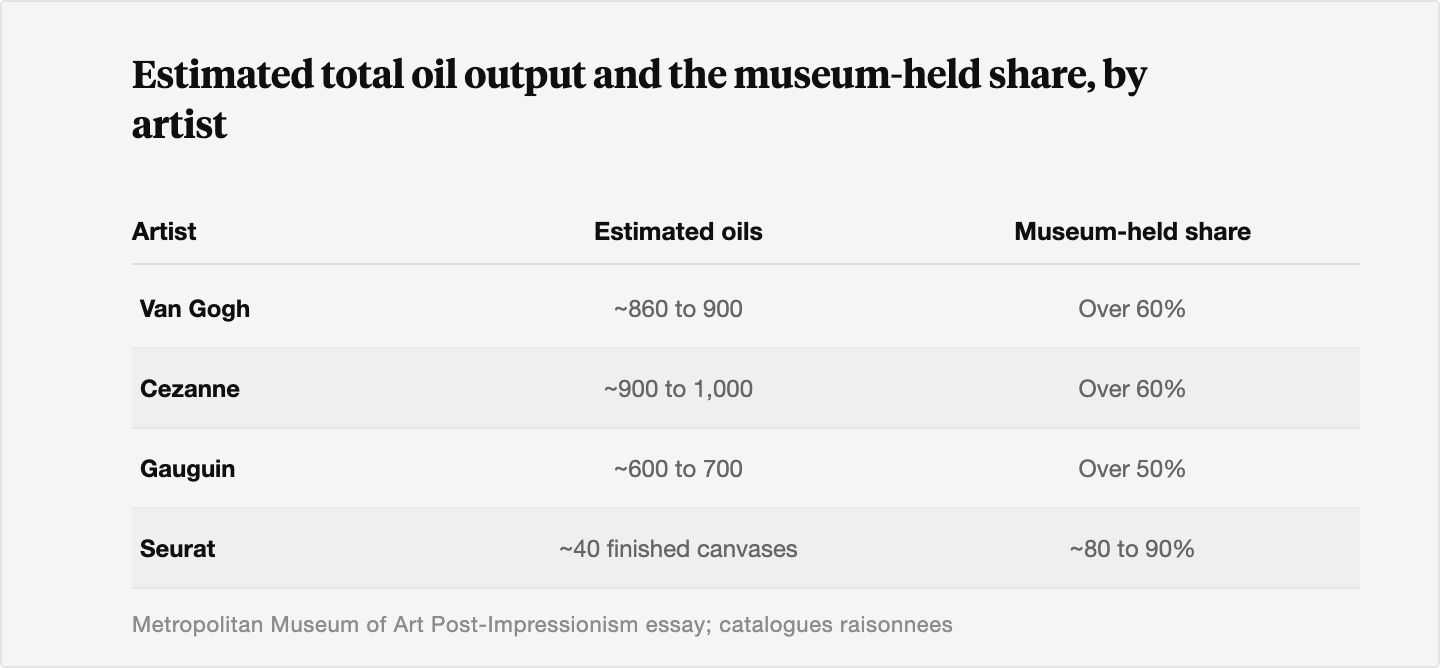
The production numbers tell the story. Van Gogh painted for only about a decade and produced an estimated 860 to 900 oils before his death in 1890 at 37. Seurat died at 31 and left roughly 40 finished canvases. Cezanne painted perhaps 900 to 1,000 oils over a long career, Gauguin somewhere around 600 to 700. [5][6] Those are the entire bodies of work that will ever exist.
Now layer in where they sit. By scholarly estimate, well over 60 percent of the top oils by Van Gogh and Cezanne are already in museums and foundations, and for Seurat the share of museum-quality finished canvases in public hands runs to 80 or 90 percent. [6] The Van Gogh Museum in Amsterdam alone holds more than 200 paintings. The most famous works, "Starry Night," the "Sunflowers," "A Sunday Afternoon on the Island of La Grande Jatte," are in institutions and will essentially never trade. Once a collector donates a work to a museum, it leaves the market for good. Supply does not just stay fixed. It shrinks.
The market data confirm how thin the trading is. Analysis of the Impressionist segment found that lot volume has been relatively steady over the past decade, around 6,000 lots a year, but that figure is dominated by lesser works. [5] True top-tier examples appear only sporadically, usually when a great collection is broken up. In November 2022, the sale of part of Paul Allen's collection at Christie's brought in about $1.5 billion in a single evening and pulled the year's Impressionist and Modern totals up with it. [5] That is the pattern. Aggregate volume looks stable, but the works that matter come to market a handful at a time, on no schedule anyone can predict.
4. What the great works have actually sold for
This is where scarcity meets price. The reported figures for the very top of the Post-Impressionist market are among the largest ever attached to a painting, and they split cleanly into two kinds: confirmed public auction results, and reported private sales that have never been officially disclosed. The distinction matters, so we will keep it.
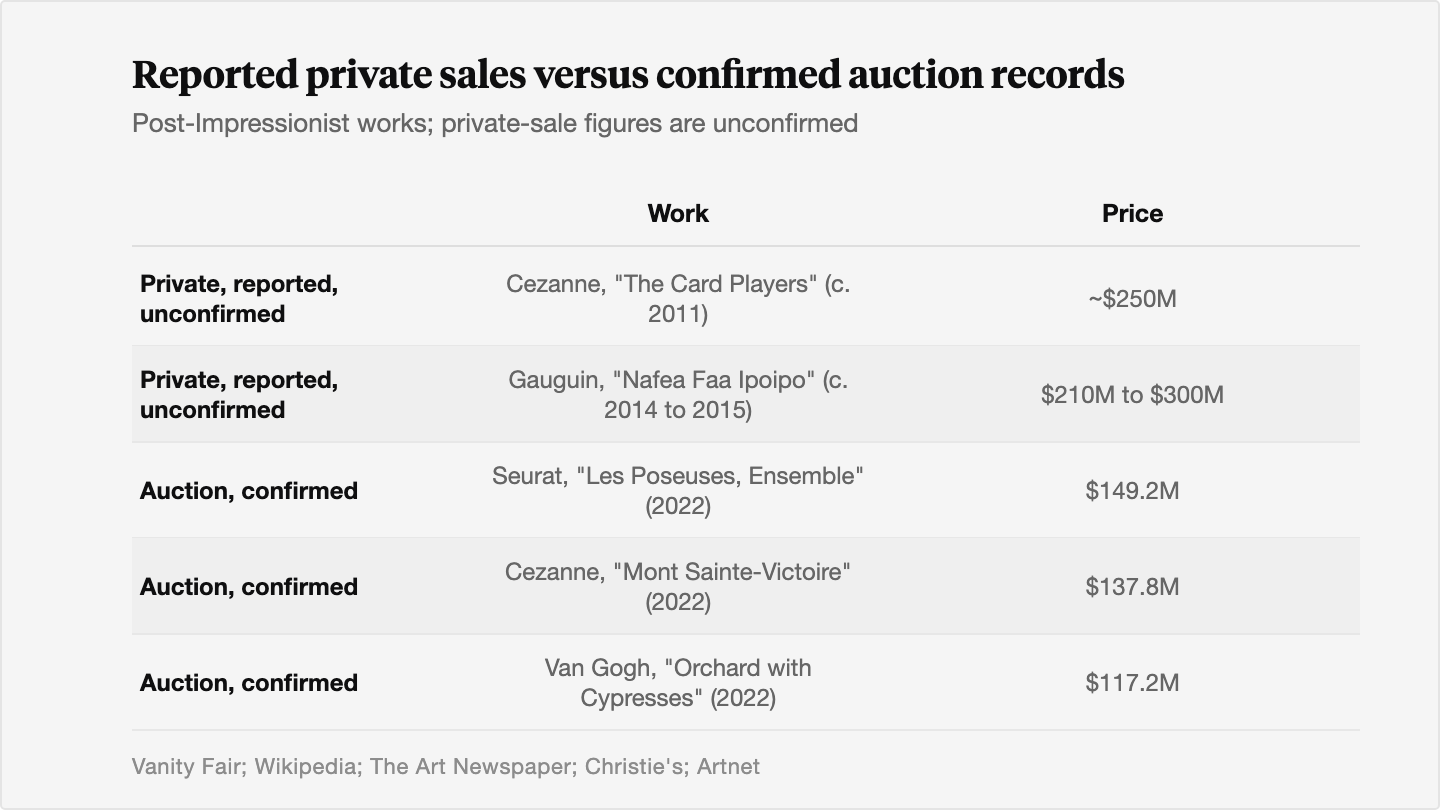
The private sales first, with the caveat that all of these figures are reported estimates rather than verified results. Cezanne's "The Card Players" (about 1892 to 1893) reportedly sold to the royal family of Qatar around 2011 for a figure widely reported at about [$250 million], with some estimates running higher, from the estate of the Greek shipping magnate George Embiricos. [7] At the time it was described as one of the highest prices ever paid for any work of art. Gauguin's "Nafea Faa Ipoipo (When Will You Marry?)" (1892) reportedly sold privately around 2014 to 2015, again to a reported Qatari buyer, from the Swiss collector Rudolf Staechelin, for a figure reported between [$210 million] and roughly [$300 million]. [8] Neither price has ever been confirmed by the parties. As one outlet put it, private-sale figures should be taken with a grain of salt because they are very hard to verify. [7] We treat them as bracketed, reported numbers.
The confirmed auction prices are public, documented, and large in their own right. Van Gogh's "Orchard with Cypresses" sold for $117.2 million at Christie's in New York in November 2022, his auction record by nominal price, in the same Paul Allen sale. [9] His "Labourer in a Field" took $81.3 million in 2017, and "L'Allee des Alyscamps" $66.3 million in 2015. [9] As recently as November 2025, his still life "Romans parisiens" sold for $62.7 million at Sotheby's after a seven-minute bidding battle. [10] Cezanne's auction record is $137.8 million for a "Mont Sainte-Victoire," also from the Allen sale in 2022. [7] Seurat's record is $149.2 million for "Les Poseuses, Ensemble," same sale. [9]
Read these as an investor and the logic is the same one that governs scarce assets everywhere. A record price does not just set a number for one painting. It resets the reference point for every comparable work and tends to pull up the value of the next-best examples. When the supply of A-grade work is fixed and the wealth of the people who can buy it keeps growing, the math points in one direction over long periods.
5. Why importance and scarcity translate into value
It is worth being precise about the mechanism, because "important and rare, therefore valuable" is too loose to underwrite anything. Two things do the work: a fixed canon, and the documentation that proves a given work belongs to it.
The fixed canon is the demand side. Museums, foundations, and ultra-high-net-worth collectors all want the same short list of names, and that list does not expand. We tend to think of high-end art prices as a call option on the very top of the wealth distribution. A serious collection runs into the tens of millions, so the buyers who can chase a nine-figure Cezanne are effectively the top fraction of one percent, and that group has grown with global wealth creation. [12] When a finite supply of canonical work meets a growing pool of buyers at the top, the price of the scarcest names tends to climb. This is also why different corners of the art market do not move together, a point we covered in When Markets Diverge: Why Contemporary Art and Old Masters Don't Move Together.
Provenance and exhibition history are the supply-side quality test. A work that has hung in major museum shows, been owned by a renowned collection, and appears in the catalogue raisonne carries three advantages at once: lower authenticity risk, a larger pool of willing institutional buyers, and a documented claim to art-historical importance. [11] Academic studies of art returns consistently find price premiums for works with strong provenance and exhibition history. [11] That documentation is what separates a museum-grade Van Gogh from a disputed one, and the gap in value between the two can be the whole investment.
A note on how this fits the broader pattern of appreciation. By Masterworks' stated estimates, the older a segment of the art market gets, the more slowly it tends to appreciate, because appreciation seems to follow fashion and fashion moves generationally. Contemporary work made after 1970 has appreciated at roughly 12 to 13 percent a year by our estimate, Modern at 8 to 9 percent, Impressionist at 6 to 7 percent, and Old Masters at 1 to 2 percent. Post-Impressionism sits in the Modern range, older and steadier than Contemporary, with the scarcity premium of a closed canon on top. These are Masterworks' stated estimates, and past performance is not predictive of future results.
6. The risks an investor should weigh
We do not paper over the hard parts, and this market has several. The case for Post-Impressionism is a case about the top of a very particular asset class, with caveats that apply to all of it.
It is illiquid. There is no exchange and no continuous bid. A specific Van Gogh may not have a natural buyer at your number in the season you want to sell, and forced sales can produce weak results. [11] It pays no yield. The entire return is price appreciation, and against that you carry insurance, storage, and conservation costs every year. [11] Transaction costs are high. Buyer's premiums and seller's commissions can add up to 15 to 25 percent or more around a single transaction at a major house, which pushes the breakeven holding period out for years. [11] Condition and authenticity are live risks. For names this valuable, the incentive to forge is real, and a negative ruling from an authentication committee can erase value. Strong provenance reduces these risks but never removes them. [11]
One risk is specific to reading the headlines. The nine-figure trophy sales are not representative of the broader art market or even the broader Impressionist and Modern segment. Repeat-sale indices like Mei Moses, which track the same work across multiple sales, tend to show art returning in the low-to-mid single digits in real terms over long periods, well below the record prices that make the news, and they carry survivorship bias because they over-weight works that were resold. [11][12] The very best museum-grade works can behave like a distinct trophy submarket with their own cycle, and that performance may diverge materially from the averages in either direction. [12]
And the market moves in cycles. The Impressionist and Modern category has run well below its 2022 peak in the years since, when no Allen-scale estate has come to market. [5] Anyone underwriting this segment should expect long holding periods, real drawdowns, and patience as the cost of entry. For how those cycles tend to play out over time, see How Art Market Cycles Work: Expansion, Peak, Correction, and Recovery.
The Bottom Line
- Post-Impressionism is the bridge between Impressionism and modern art. Cezanne fed Cubism, Van Gogh fed Fauvism and Expressionism, and Picasso, Braque, and Matisse named these painters as their starting points.
- The supply of top-tier work is close to fixed and shrinking. Van Gogh left roughly 860 to 900 oils, Seurat about 40 finished canvases, and well over 60 percent of the best oils already sit in museums.
- The reported private records are nine figures and unconfirmed. Cezanne's "The Card Players" reportedly sold for about [$250 million] around 2011, and Gauguin's "Nafea Faa Ipoipo" for a reported [$210 million to $300 million] around 2014 to 2015.
- The confirmed auction records are public and large. Van Gogh's "Orchard with Cypresses" took $117.2 million in 2022, Seurat's "Les Poseuses" $149.2 million, and Cezanne's record is $137.8 million.
- Scarcity plus art-historical importance is the value driver, with real risks attached: illiquidity, no yield, high transaction costs, and condition and authenticity risk. Past performance is not predictive of future results.
Sources
- The Metropolitan Museum of Art. "Post-Impressionism." Heilbrunn Timeline of Art History. https://www.metmuseum.org/essays/post-impressionism (accessed June 2026)
- Wikipedia. "Post-Impressionism." Last updated June 4, 2026. https://en.wikipedia.org/wiki/Post-Impressionism
- The Art Story. "Post-Impressionism Movement Overview." Last updated June 12, 2026. https://www.theartstory.org/movement/post-impressionism/
- Google Arts & Culture. "What Is Post-Impressionist Art?" Last updated March 28, 2026. https://artsandculture.google.com/story/what-is-post-impressionist-art/YgVBUtbq8PnjIA
- Artnet News. "Impressionism Is 150 This Year. Is the Auction Industry Celebrating?" December 18, 2024. https://news.artnet.com/market/impressionism-auction-industry-2588892
- The Barber Institute of Fine Arts. "What is Post-Impressionism?" April 29, 2025. https://barber.org.uk/what-is-post-impressionism/
- Vanity Fair. "For $250 Million, Qatar Buys One of Cezanne's The Card Players." February 2, 2012. https://www.vanityfair.com/culture/2012/02/qatar-buys-cezanne-card-players-201202
- Wikipedia. "The Card Players." Last updated May 25, 2026. https://en.wikipedia.org/wiki/The_Card_Players
- The Art Newspaper. "The ten most expensive Vincent van Gogh paintings." March 19, 2025. https://www.theartnewspaper.com/2025/03/19/the-ten-most-expensive-van-gogh-paintings
- Artnet News. "At $304.6 Million Sotheby's Tripleheader, Van Gogh and Kahlo Soar." November 21, 2025. https://news.artnet.com/market/sothebys-modern-pritzker-exquisite-corpse-auction-results-2716914
- Hyperallergic. "Qatar Buys World's Most Expensive Painting, $250M for Cezanne's Card Players." Last updated May 31, 2026. https://hyperallergic.com/qatar-paul-cezanne-card-players/
- Wikipedia. "List of most expensive paintings." Last updated May 29, 2026. https://en.wikipedia.org/wiki/List_of_most_expensive_paintings
- RAU Antiques. "What is Post-Impressionism? How Radical Color and Vision Reshaped Modern Art." December 29, 2025. https://rauantiques.com/blogs/canvases-carats-and-curiosities/what-is-post-impressionism-how-radical-color-and-vision-reshaped-modern-art
- Artsy. "The 10 Most Expensive Auction Works in 2025." December 19, 2025. https://www.artsy.net/article/artsy-editorial-10-expensive-auction-works-2025
Disclosures
Investing involves risk. Past results are not indicative of future outcomes.
Masterworks is providing this communication as an agent for its issuer entities, not Masterworks Advisers. This material is produced by Masterworks for informational purposes only and does not constitute investment advice, a recommendation, or an offer or solicitation to buy or sell any security. Masterworks is not a licensed broker-dealer by the SEC or FINRA.
Masterworks can only make and accept sales after an offering statement has been filed, and "qualified", by the SEC. Any offers may be revoked before notice of qualification. Indications of interest involve no obligation. For further disclosure visit the offering documents filed with the SEC and Important Disclosures at masterworks.com/cd.
Forward-looking statements and internal estimates are based on assumptions that may prove incorrect, and actual outcomes may differ materially. Figures denoted in brackets are subject to confirmation. Investing in art and alternative assets involves risk, including loss of principal.
Art sales price data is comparative only. Each painting is unique and historical data is not a direct proxy for any specific painting or investment. Data represents whole art, not an investment into our offerings which includes fees and expenses. Any comparative images are not currently live offerings and are provided for educational purposes only.
Masterworks, LLC is located at 1 World Trade Center, 57th Floor, New York, NY 10007.