
Masterworks Research · June 2026
How private banking and wealth management actually differ on lending, deposits, investment management, and price, and where a fine art allocation fits the relationship.
Private banking and wealth management overlap heavily, and the practical difference comes down to scope and structure. A private bank is a banking relationship with a balance sheet behind it, so it can take deposits, extend credit against a portfolio or a hard asset, and bundle banking, lending, and investment management under one roof, usually starting around $1 million to $10 million in investable assets [1][2]. Wealth management is an investment and planning relationship that grows, protects, and transfers capital, and it is available far lower down the asset scale, often with no bank attached [3]. For an investor, the choice is less about prestige and more about whether you need lending and deposit power on the same desk that manages your money, and how much you are willing to pay for it.
What You Need to Know
- The dividing line is the balance sheet. A private bank can lend you money and hold your deposits because it is a bank. A standalone wealth manager or registered investment adviser manages assets and plans, and routes banking elsewhere [3][4].
- Thresholds differ by an order of magnitude. Citi Private Bank sets a $10 million net worth requirement, J.P. Morgan and Goldman Sachs formally want roughly $10 million in investable assets, and UBS opens at about CHF 2 million, around $2.2 million [1][2]. Wealth management, in theory, is open to anyone with assets to manage [3].
- Price follows the bundle. A fee-only registered investment adviser typically charges around 1% of assets per year, while a major private bank's all-in cost can run materially higher, with one wirehouse listing a maximum advisory fee of 2.2% on accounts under $5 million [5][6].
- Both can lend against your portfolio. Securities-backed lines of credit price off SOFR plus a spread, and for large, high-grade portfolios at a private bank that spread can fall under one percent [7].
- Art sits inside this relationship. Private banks run art advisory desks and lend against fine art at roughly 50% loan-to-value on collections valued at $20 million or more, and the broader art-secured lending market is estimated at $33.9 billion to $40 billion in 2025 [8][9].
1. What a private bank actually does
A private bank is, first, a bank. That single fact explains most of the difference from a standalone wealth manager. Because a private bank holds a banking charter and a balance sheet, it can take your deposits, run your cash management, write your mortgage, and lend against your assets, all on the same desk that invests your portfolio [1][3].
Citi describes the full stack plainly. Its private bank offers alternative investments such as private equity, hedge funds, and real estate, discretionary investment management with bespoke portfolios, financing against commercial real estate, art, aircraft, and sports franchises, and family office advisory for the most complex cross-border situations [10]. A private banker at that tier may serve as few as 20 clients, with dedicated investment counselors layered on top [10].
The structural point for an investor is concentration. One relationship manager coordinates banking, credit, and investing, which is convenient when those pieces interact, for example when you want to borrow against a portfolio rather than sell it. The cost of that concentration is that the institution sees, and prices, your whole financial life.
2. What wealth management covers, and how it differs
Wealth management is the broader planning relationship. It grows, preserves, and transfers wealth over a long horizon, and it pulls together investment management, estate planning, tax strategy, and retirement planning [3][4]. Much of it is delivered by registered investment advisers, or RIAs, who are bound by a fiduciary duty to act in the client's best interest [4][5].
The key difference is the missing balance sheet. A standalone wealth manager or RIA does not take deposits and generally does not lend from its own book. It manages assets and coordinates planning, then routes banking and credit to a partner institution [3]. By 2025 there were roughly 15,870 RIAs registered in the United States, a sign of how much of the high net worth advice market now runs through fiduciary, fee-based firms rather than bank desks [5].
In practice the two relationships blur. A private bank does wealth planning. A large wealth manager can arrange lending through a partner bank. Many high net worth households run both at once, using the private bank for credit and cash and the RIA for fiduciary investment advice [3][11].
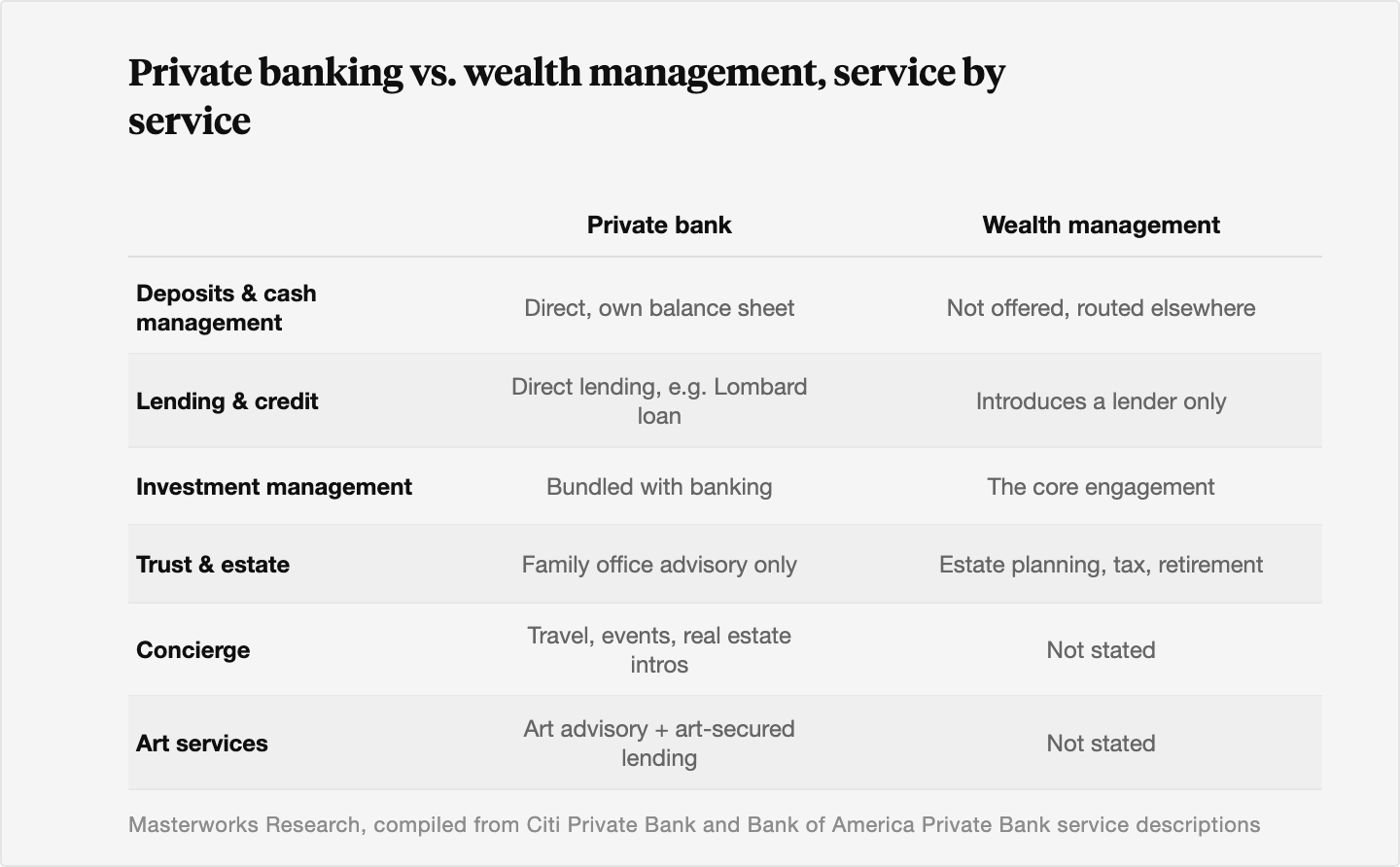
3. Lending and credit: the clearest line between the two
Lending is where the balance sheet shows up most clearly. A private bank can extend credit directly, and the workhorse product is the securities-backed line of credit, sometimes called a Lombard loan or pledged asset line. You pledge your investment portfolio as collateral and borrow against it without selling, which avoids triggering a taxable sale [7].
The pricing is transparent in structure. These lines price off a base rate, usually SOFR, plus a spread. SOFR sat near 3.64% in early 2026 [7]. The spread is where the relationship matters. General market spreads on securities-backed lines have run from roughly 1.90% to 4.40% depending on loan size, but for a large, well-diversified, high-grade portfolio at a major private bank, the spread can fall under 1% [7]. The Federal Reserve reported about $138 billion in securities-based loans outstanding in the first quarter of 2025, and the figure exceeds $300 billion once margin loans are included [7].
A standalone wealth manager cannot do this from its own book. It can introduce you to a lender, but the credit, the deposit, and the line live somewhere else. If borrowing against your assets is central to how you operate, that routing friction is the case for a private bank.
4. Deposits, cash management, and concierge
This is the part of private banking that has no real equivalent at a fee-only wealth manager, because it requires a bank. Private banking bundles deposit accounts, integrated cash management, mortgage and specialty lending, and a set of concierge and relationship services around the core banking offer [3][12].
The tiering inside a single institution shows how the deposit relationship scales. At Citi, Citigold opens at more than $200,000 in investable assets, Citigold Private Client at more than $1 million, and Citi Private Bank at a $10 million net worth, with single family office services reserved for relationships over $100 million in assets under management [10]. Each step up adds banking capacity, a more dedicated banker, and access to more bespoke credit and investment solutions.
Concierge services, travel, real estate introductions, access to events and offerings, are the soft layer on top. They are real, and for some clients they justify the premium. For an investor focused on returns and risk, they are rarely the deciding factor.
5. Investment management: where the relationships converge
On pure investment management, the gap narrows. Both private banks and wealth managers build and run portfolios, offer discretionary and advisory mandates, and provide access to alternatives. A private bank tends to fold investment management into the broader banking relationship, while a dedicated wealth manager or RIA makes it the center of the engagement [3][4].
The fiduciary distinction is worth stating plainly. Independent RIAs are held to a fiduciary standard and are generally compensated by fee rather than commission, which reduces product-sale conflicts [4][5]. A bank's investment arm may operate under a mix of standards, and the products it recommends can include the institution's own [4]. Neither model is automatically better. The point is to know which one you are in, and how the people advising you are paid.
This is also where art enters as an asset class rather than a service. We have long argued that an allocation to art behaves differently from the equities and credit that dominate most managed portfolios. The highest correlation art has shown to other assets is with gold, roughly 0.1 to 0.2, and its correlation to equities over long periods has been close to zero. Past performance is not predictive, and these are estimates from comparative market data rather than guarantees. Real diversification means owning something largely indifferent to the forces moving everything else, and that is the role art can play inside a managed portfolio. For more on how families build this allocation, see our piece on the rise of family offices and why they are allocating to art.
6. Pricing: what each relationship costs
Price tracks the bundle. A fee-only RIA typically charges around 1% of assets under management per year, and the 2025 to 2026 median for human advisers sits near 1%, with some fee schedules as low as 0.30% [5][6]. Fee compression has pushed those numbers down as competition and technology platforms have grown [5].
Private banking generally costs more, because the institution is delivering and underwriting more. One wirehouse lists a maximum advisory fee of 2.2% on accounts below $5 million, dropping as assets rise [6]. Lending spreads, deposit terms, and product fees sit on top of, or alongside, any advisory fee. The all-in cost of a private banking relationship is harder to read on a single line, which is itself a reason to ask for it in writing.
For an investor, the discipline is to separate what you are paying for advice from what you are paying for credit and convenience. A 1% fiduciary fee on a managed portfolio and a sub-1% spread on a Lombard line are different costs doing different jobs. Bundling them under one roof can be efficient. It can also obscure the total. We think the right move is to price each component on its own. For a fuller treatment of how to evaluate the people managing your money, see how to choose a wealth manager or RIA.
7. Where art fits the private banking relationship
Most large private banks now run a dedicated art practice, and it has two distinct sides: advisory and lending. On the advisory side, banks such as Citi and Bank of America offer collection strategy, valuation guidance, acquisition support, and long-term planning around a collection as a balance sheet asset [10][8]. On the lending side, they let a collector borrow against the collection while keeping the works on the wall.
The lending terms are reasonably consistent across the major banks. Bank of America Private Bank lends generally up to 50% of the appraised value of an internationally recognized collection valued at $20 million or more, with a minimum loan of $10 million, and the client keeps ownership and usually keeps the art on display [8]. The liquidity can fund a business, a philanthropic gift, more art, or other long-term goals [8]. J.P. Morgan and Citi run comparable art finance desks, structuring purchase financing, bridge loans, and portfolio liquidity against marketable works [12][10].
The market behind this is sizable and growing. Deloitte and ArtTactic estimate the global art-secured lending portfolio at $33.9 billion to $40 billion in 2025, growing around 10% a year, with the report projecting it could reach $50 billion by 2027 or 2028 [9]. The same report flags an estimated $992 billion in art and collectibles set to change hands over the next decade as wealth transfers between generations [9]. Auction houses are a meaningful share of this lending: Sotheby's Financial Services alone reports over $12 billion originated since inception and loans ranging from $1 million to over $250 million [13].
Two practical points follow for an HNW client. First, an art allocation does not have to sit outside the private banking relationship. It can be advised, valued, and even financed within it, which is part of why the asset is increasingly treated as core rather than ornamental. Second, art-secured lending is the mechanism that turns an illiquid holding into liquidity without a forced sale, the same logic as a securities-backed line, applied to a different collateral. We cover the mechanics in detail in can art be used as collateral for loans: how art-backed lending works, and the broader allocation picture in art in multi-family office portfolios: current allocation trends. As always, past performance is not predictive, and art carries real risk, including illiquidity and loss of principal.
The Bottom Line
- Private banking is a bank relationship that bundles deposits, lending, and investing, and it typically requires $1 million to $10 million or more in investable assets depending on the tier and institution.
- Wealth management is the broader investing and planning relationship, often delivered by fiduciary RIAs, and it is available well below private banking thresholds because it does not require a bank.
- Lending is the clearest distinction, since a private bank can extend credit against your portfolio directly while a standalone wealth manager must route you to a lender.
- Pricing follows the bundle, with fee-only advice running near 1% of assets and private banking costing more once lending, deposits, and product fees are added.
- Art belongs inside this relationship, advised and often financed by the same private bank, with art-secured lending estimated at $33.9 billion to $40 billion in 2025 and growing.
- The right choice depends on whether you need credit and deposits on the same desk that invests your money, and on pricing each component on its own rather than as one number.
Sources
- Top10PrivateBanks. "Private Banking Minimum Requirements 2025: Complete Eligibility Guide." Top10PrivateBanks, 2025. https://top10privatebanks.com/private-banking-minimum-requirements.html
- Private Banker International. "Unveiling Minimum Investment Requirements for Private Banking." Private Banker International, 2025. https://www.privatebankerinternational.com/features/minimum-amount-private-banking/
- Unbiased. "Private banking: benefits, requirements, and how it works." Unbiased.com, 2025. https://www.unbiased.com/discover/banking/what-is-private-banking
- Unbiased. "Private Banking vs Wealth Management." Unbiased.com, 2025. https://www.unbiased.com/discover/financial-advice/private-banking-wealth-management
- Bright Advisers. "Understanding Registered Investment Advisor Fees." Bright Advisers, 2025. https://brightadvisers.com/understanding-registered-investment-advisor-fees-for-young-families/
- NerdWallet. "How Much Does a Financial Advisor Cost in 2026?" NerdWallet, 2026. https://www.nerdwallet.com/financial-advisors/learn/how-much-does-a-financial-advisor-cost
- FINRA. "Securities-Backed Lines of Credit Explained." FINRA.org, 2025. https://www.finra.org/investors/insights/securities-backed-lines-credit
- Bank of America Private Bank. "How to Use Your Fine Art Collection as Loan Collateral." Bank of America, 2025. https://www.privatebank.bankofamerica.com/articles/your-art-collection-as-loan-collateral.html
- Deloitte and ArtTactic. "Art & Finance Report 2025." Deloitte Private, November 2025. https://www.deloitte.com/nl/en/services/deloitte-private/research/art-and-finance-report.html
- Citi Private Bank. "Private banking vs wealth management." Citi Private Bank, 2025. https://www.privatebank.citibank.com/insights/private-banking-vs-wealth-management
- MercerWM. "Private Banking vs Wealth Management: What's the Real Difference." Mercer Wealth Management, 2025. https://www.mercerwm.com/blog/private-banking-vs-wealth-management-whats-the-real-difference
- J.P. Morgan Private Bank. "Fine Art Financing." J.P. Morgan Private Bank U.S., 2025. https://privatebank.jpmorgan.com/nam/en/services/lending/specialty-lending/fine-art-financing
- Sotheby's. "Art-Backed Lending 101: Unlocking the Value of Your Fine Art Collection." Sotheby's, 2025. https://www.sothebys.com/en/articles/art-backed-lending-101-unlocking-the-value-of-your-fine-art-collection
- ARTnews. "Amid Art Market Slowdown and High Interest Rates, Specialist Art Lenders Claim Business Is Booming." ARTnews, 2024. https://www.artnews.com/art-news/market/high-interest-rates-art-lending-boom-1234723734/
Disclosures
Investing involves risk. Past results are not indicative of future outcomes.
Masterworks is providing this communication as an agent for its issuer entities, not Masterworks Advisers. This material is produced by Masterworks for informational purposes only and does not constitute investment advice, a recommendation, or an offer or solicitation to buy or sell any security. Masterworks is not a licensed broker-dealer by the SEC or FINRA.
Masterworks can only make and accept sales after an offering statement has been filed, and "qualified", by the SEC. Any offers may be revoked before notice of qualification. Indications of interest involve no obligation. For further disclosure visit the offering documents filed with the SEC and Important Disclosures at masterworks.com/cd.
Forward-looking statements and internal estimates are based on assumptions that may prove incorrect, and actual outcomes may differ materially. Figures denoted in brackets are subject to confirmation. Investing in art and alternative assets involves risk, including loss of principal.
Art sales price data is comparative only. Each painting is unique and historical data is not a direct proxy for any specific painting or investment. Data represents whole art, not an investment into our offerings which includes fees and expenses. Any comparative images are not currently live offerings and are provided for educational purposes only.
Masterworks, LLC is located at 1 World Trade Center, 57th Floor, New York, NY 10007.


