
Masterworks Research · June 2026
The levers a high earner can pull to keep more of what they earn, why the same return can leave very different after-tax outcomes, and where art sits in a tax-aware plan.
Tax-efficient investing is the practice of arranging what you own, where you hold it, and how long you hold it so that more of your pre-tax return survives as after-tax return. For a high earner in the top federal brackets, the difference is large: ordinary income and short-term gains are taxed up to 37%, while long-term capital gains and qualified dividends top out at 20%, and a 3.8% surtax sits on top of investment income above [1][2][3]. The core levers are asset location, tax-advantaged accounts, holding-period discipline, loss harvesting, tax-exempt income, and charitable timing. None of them changes what you earn before tax. All of them change what you keep. This piece walks the toolkit, and ends on a part most plans overlook: the very different tax treatment of art and collectibles, and where they fit. It is general education, not tax advice.
What You Need to Know
- The top of the schedule is a 17-point gap. Ordinary income and short-term gains run to 37% for single filers above $626,350 and joint filers above $751,600 in 2025; long-term gains and qualified dividends cap at 20% [1][3][4]. Holding period alone can move the same dollar of gain by nearly half its tax.
- A 3.8% surtax rides on top. The Net Investment Income Tax adds 3.8% on investment income once modified AGI passes $200,000 single or $250,000 joint, pushing the top rate on long-term gains and qualified dividends to 23.8% [2]. Those thresholds are not indexed to inflation, so more earners cross them each year.
- Where you hold an asset can matter as much as which asset. Asset location, putting tax-inefficient holdings in tax-deferred accounts and tax-efficient ones in taxable accounts, is a no-cost lever. Tax-exempt municipal bond interest is worth a 5% muni yielding roughly 7.9% pre-tax to a 37% earner [5][7].
- Art is taxed on a separate, higher track. Long-term gains on collectibles, which the IRS defines to include art, are taxed at a maximum 28% rate rather than 20%, and the wash-sale rule does not apply to art [6][8][9]. The same features that raise the rate also make appreciated art unusually efficient to give.
- None of this is advice, and past results do not predict future ones. Tax law changes, thresholds shift, and individual situations differ. The levers below are a map. A qualified tax professional draws the route.
1. Why the after-tax number is the only one that counts
Start with the gap, because it frames everything else. In 2025 a high earner's ordinary income runs into a 37% top federal bracket, reached at $626,350 of taxable income for single filers and $751,600 for married couples filing jointly [4]. Short-term capital gains, meaning gains on assets held one year or less, are taxed at those same ordinary rates [1]. Long-term gains, on assets held more than a year, top out at 20% [1][3]. Qualified dividends get the same favorable long-term treatment [3].
That is roughly a 17-point spread on the same dollar of profit, decided by nothing more than how the income is classified and how long the asset was held.
Then add the surtax. The Net Investment Income Tax applies an extra 3.8% to net investment income once modified adjusted gross income clears $200,000 for single filers and $250,000 for joint filers [2]. For a top-bracket investor, that turns the headline 20% long-term rate into 23.8%, and a 37% short-term rate into 40.8% [2][5]. The thresholds are fixed in statute and not adjusted for inflation [2], which means the surtax reaches a wider group of earners every year through simple wage growth.
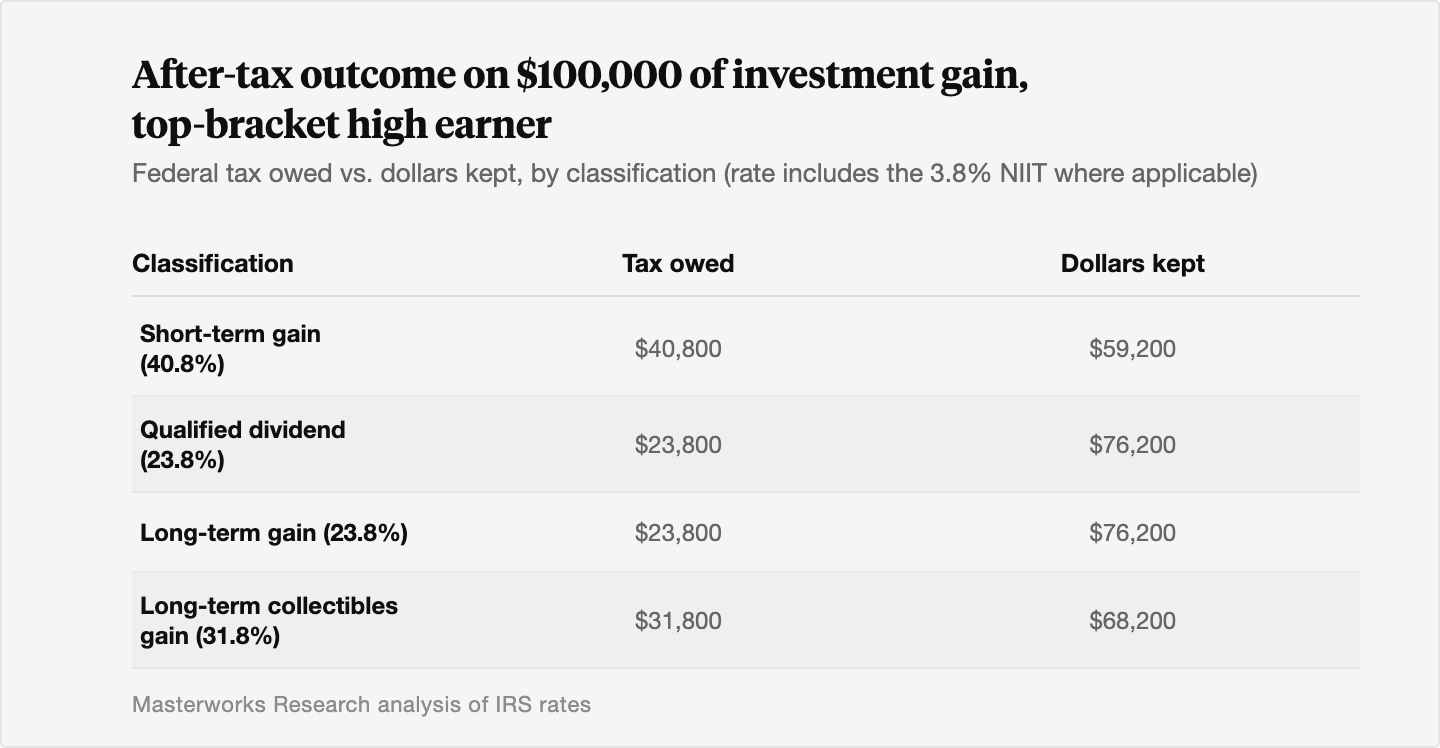
The lesson is plain. Two investors can earn the identical pre-tax return and walk away with very different amounts. The levers below are the ones that close that gap.
2. Asset location: the free lever
Asset location is the practice of holding tax-inefficient assets in tax-sheltered accounts and tax-efficient assets in taxable ones. It costs nothing and changes no investment decision. It only re-sorts where each holding sits.
The logic follows the rate gap. Assets that throw off ordinary-rate income, such as taxable bonds, REIT dividends, and high-turnover strategies, do their best work inside a tax-deferred or tax-exempt account, where that income compounds untaxed. Assets that are already tax-efficient, such as broad equity index funds that generate mostly long-term gains and qualified dividends, can sit in a taxable account and still face the lower 20% schedule [1][3].
A simple worked example. Imagine a high earner holding a taxable bond fund yielding 5% and a stock index fund. Held in a taxable account, the bond interest is taxed at up to 40.8% [2][5]. Moved into a tax-deferred account, that same interest compounds with no annual drag. The stock fund, with its qualified dividends and deferred long-term gains, takes the taxable-account slot. Same two funds, same total dollars invested, a better after-tax result. That is the whole idea.
3. The accounts: deferred, exempt, and taxable
High earners have three buckets, and the art is in using all three.
Tax-deferred accounts, such as a traditional 401(k) or IRA, give a deduction now and tax withdrawals later as ordinary income. For 2026 the 401(k) elective deferral limit is $24,500, with an $8,000 catch-up for those 50 and older, and a higher $11,250 catch-up for ages 60 through 63 under SECURE 2.0 [10]. The 2026 IRA limit is $7,500 [10]. These caps are modest relative to a top earner's income, which is why the taxable account does most of the heavy lifting.
Tax-exempt accounts, chiefly the Roth, are funded with after-tax dollars and grow and distribute tax-free. Direct Roth contributions phase out at high incomes, so many high earners reach Roth treatment through conversions or after-tax 401(k) contributions. The trade is straightforward: pay tax now at a known rate to remove all future gains from the tax base.
The taxable brokerage account carries no contribution cap and no forced withdrawal. Its disadvantage is the annual tax on dividends and realized gains. Its advantages are flexibility, the step-up in basis at death, and access to the favorable long-term and qualified-dividend rates that the deferred accounts convert away into ordinary income. For most high earners the taxable account is where asset location, holding-period discipline, and loss harvesting actually play out.
4. Hold longer, harvest losses, and the wash-sale line
Two levers live inside the taxable account, and they are the most actionable of the toolkit.
The first is holding period. Crossing the one-year line converts a short-term gain taxed up to 37% into a long-term gain taxed at 20% [1]. On a large position that single calendar threshold can be worth more than most active trading ever adds. We think the discipline of waiting is underrated precisely because it is so dull.
The second is tax-loss harvesting: selling a position at a loss to realize a capital loss, then using that loss to offset realized gains, with up to $3,000 of net loss deductible against ordinary income each year and the rest carried forward [9]. The constraint is the wash-sale rule, which disallows the loss if you buy a substantially identical security within 30 days before or after the sale [8][9]. Harvesting works around it by rotating into a similar but not identical holding to keep market exposure while the loss clears. We cover the mechanics in depth in Tax-Loss Harvesting: Turning Losses Into After-Tax Returns.
Worth flagging now, because it returns in the art section: the wash-sale rule is written to cover "stock or securities" only [8]. It does not reach collectibles or other property [8][9]. That is one of several places where art sits outside the rules that govern a securities portfolio.
5. Tax-exempt income: municipal bonds and the equivalent yield
For the income side of a portfolio, municipal bonds are the classic high-earner tool. Interest on most municipal bonds is exempt from federal income tax, and from state tax too if the bond is issued in the investor's home state [5][7].
The way to compare a muni to a taxable bond is the tax-equivalent yield, which divides the muni yield by one minus the investor's marginal rate. At a 37% rate, a 5% municipal yield equals a taxable yield of about 7.9% [5][7]. Municipal interest is also outside the base for the 3.8% surtax [5], which widens the gap further for investors above the NIIT thresholds.
Two cautions belong here. Some private-activity municipal bonds can trigger the alternative minimum tax, and municipal interest still counts toward the modified AGI used to tax Social Security benefits [5]. The exemption is broad. It is not absolute.
6. Charitable timing and deferral
Two more levers round out the conventional kit.
Charitable giving, done with appreciated assets rather than cash, does double duty. Donating a long-term appreciated security to a qualified public charity generally lets the donor deduct the full fair market value and skip the capital-gains tax that a sale would have triggered, subject to a deduction limit of 30% of adjusted gross income for that category of gift [11][12]. Vehicles such as donor-advised funds and charitable remainder trusts let a donor separate the timing of the deduction from the timing of the gift, and a charitable remainder trust can also spread the recognition of a large embedded gain over years. We walk those vehicles in Charitable Remainder Trusts and Other Giving Vehicles.
Deferral is the quieter lever. Every year a gain stays unrealized is a year its tax is postponed and its full value keeps compounding. Holding a low-basis position, rather than churning it, is itself a tax strategy. At death, the basis steps up to fair market value, and the deferred gain can disappear from the income-tax base entirely. Deferral is not avoidance. It is the time value of a tax not yet paid.
7. Where art sits in a tax-aware plan
Art belongs in this conversation because it is taxed on a separate, higher track, and because the same features that raise its rate make it unusually efficient to give. We size the asset class first, because scale frames the rest. Private individuals hold art worth on the order of a trillion dollars, an asset class with very low correlation to equities, and we believe a small long-term allocation can sit alongside the levers above. The tax mechanics, though, are their own subject.
Three points a high earner should understand before treating art as a portfolio asset.
The rate is higher. Long-term gains on collectibles are taxed at a maximum federal rate of 28%, not the 20% that applies to stocks [6]. The IRS defines collectibles to include works of art [6]. Add the 3.8% surtax and a top-bracket seller can face 31.8% on a long-term art gain, against 23.8% on a long-term stock gain [2][6]. The holding-period rule still helps: art sold within a year is taxed at ordinary rates up to 37%, so the one-year line matters here as much as anywhere [1][6].
The wash-sale parity is missing. As noted, the wash-sale rule covers securities only [8]. There is no equivalent for art, which changes how losses and repurchases interact for collectibles. The treatment of art and securities is not symmetric, and a tax professional should map the specifics for any real position. We discuss the related 1031 question, and what changed for art, in Art and 1031 Exchanges: What Changed and What Options Remain.
Giving appreciated art is efficient, with a catch. Donating long-term appreciated art to a public charity can yield a full fair-market-value deduction while skipping the 28% gain, but only if the related-use rule is met: the charity must use the work in a way connected to its exempt purpose, such as a museum displaying it [11][12]. Give the same painting to a charity that sells it, and the deduction drops to cost basis, stripping the appreciation out [12]. The fair-market-value deduction for this category is limited to 30% of AGI [11][12]. The arithmetic favors giving the most-appreciated, highest-rate asset, which is often exactly the art.
For advisors thinking about how an art sleeve fits a broader allocation, we lay out the case in Art as an Alternative Allocation: A Framework for Advisors. The estate angle is its own piece of work: art carries a step-up in basis at death like other capital assets, but valuation, appraisal, and illiquidity make estate planning around a collection a specialist's job. We are not giving advice here. We are pointing at the questions a high earner should bring to a qualified tax professional.
The Bottom Line
- For a high earner, after-tax return is the only return that matters, and the same pre-tax dollar can be taxed anywhere from 20% to 40.8% depending on classification and holding period.
- Asset location costs nothing and changes no investment decision, yet it can meaningfully improve after-tax results by sorting tax-inefficient income into sheltered accounts.
- Holding past one year, harvesting losses within the wash-sale rule, and earning tax-exempt municipal interest are the most actionable levers inside a taxable account.
- Charitable giving with appreciated assets and simple deferral both convert tax timing into compounding, and the step-up at death can erase deferred gains from the income-tax base.
- Art is taxed at a higher 28% maximum long-term rate and sits outside the wash-sale rule, which makes appreciated art both a heavier asset to sell and an efficient one to give under the related-use rule.
- All of this is general education. Past performance is not predictive, tax law changes, and a qualified tax professional should design any actual plan.
Sources
- Internal Revenue Service. "Topic no. 409, Capital gains and losses." IRS.gov, accessed June 2026. https://www.irs.gov/taxtopics/tc409
- Internal Revenue Service. "Topic no. 559, Net investment income tax." IRS.gov, accessed June 2026. https://www.irs.gov/taxtopics/tc559
- Internal Revenue Service. "Questions and Answers on the Net Investment Income Tax." IRS.gov, accessed June 2026. https://www.irs.gov/newsroom/questions-and-answers-on-the-net-investment-income-tax
- Tax Foundation. "2025 Tax Brackets and Federal Income Tax Rates." Tax Foundation, 2025. https://taxfoundation.org/data/all/federal/2025-tax-brackets/
- Charles Schwab. "Tax-Free Municipal Bonds? Not Always." Schwab.com, accessed June 2026. https://www.schwab.com/learn/story/not-always-tax-free-7-municipal-bond-tax-traps
- Internal Revenue Service. "Topic no. 409, Capital gains and losses (collectibles maximum 28% rate)." IRS.gov, accessed June 2026. https://www.irs.gov/taxtopics/tc409
- Hartford Funds. "What Every Muni Investor Should Know About Tax-Equivalent Yields." Hartford Funds, accessed June 2026. https://www.hartfordfunds.com/practice-management/client-conversations/investing-for-income/what-every-muni-investor-should-know-about-tax-equivalent-yields.html
- Legal Information Institute, Cornell Law School. "26 U.S. Code § 1091 - Loss from wash sales of stock or securities." law.cornell.edu, accessed June 2026. https://www.law.cornell.edu/uscode/text/26/1091
- NerdWallet. "2025 and 2026 Capital Gains Tax Rates and Rules." NerdWallet, 2026. https://www.nerdwallet.com/taxes/learn/capital-gains-tax-rates
- Internal Revenue Service. "401(k) limit increases to $24,500 for 2026, IRA limit increases to $7,500." IRS.gov, November 2025. https://www.irs.gov/newsroom/401k-limit-increases-to-24500-for-2026-ira-limit-increases-to-7500
- Internal Revenue Service. "Charitable contribution deductions." IRS.gov, accessed June 2026. https://www.irs.gov/charities-non-profits/charitable-organizations/charitable-contribution-deductions
- Internal Revenue Service. "Publication 526 (2025), Charitable Contributions." IRS.gov, 2025. https://www.irs.gov/publications/p526
Disclosures
Investing involves risk. Past results are not indicative of future outcomes.
Masterworks is providing this communication as an agent for its issuer entities, not Masterworks Advisers. This material is produced by Masterworks for informational purposes only and does not constitute investment advice, a recommendation, or an offer or solicitation to buy or sell any security. Masterworks is not a licensed broker-dealer by the SEC or FINRA.
Masterworks can only make and accept sales after an offering statement has been filed, and "qualified", by the SEC. Any offers may be revoked before notice of qualification. Indications of interest involve no obligation. For further disclosure visit the offering documents filed with the SEC and Important Disclosures at masterworks.com/cd.
Forward-looking statements and internal estimates are based on assumptions that may prove incorrect, and actual outcomes may differ materially. Figures denoted in brackets are subject to confirmation. Investing in art and alternative assets involves risk, including loss of principal.
Art sales price data is comparative only. Each painting is unique and historical data is not a direct proxy for any specific painting or investment. Data represents whole art, not an investment into our offerings which includes fees and expenses. Any comparative images are not currently live offerings and are provided for educational purposes only.
Masterworks, LLC is located at 1 World Trade Center, 57th Floor, New York, NY 10007.


