Masterworks Research · June 2026
What the record NFT sales of 2021 actually were, what happened to their prices afterward, and why a two-year-old digital category behaved nothing like a five-century-old art market.
The most expensive NFTs ever sold were Pak's "The Merge" at roughly $91.8 million across nearly 30,000 buyers on Nifty Gateway in December 2021, and Beeple's "Everydays: The First 5000 Days," which sold as a single token for $69.3 million at Christie's in March 2021 [1][2]. Most of the category that surrounded those headlines did not hold its value. Art-NFT trading volume fell roughly 93% from its 2021 peak, top collections lost 90% or more of their floor prices, and one 2023 study found that about 95% of NFT collections had effectively zero market value [3][4]. For investors, the useful part of this story is not the spectacle of the record. It is the contrast in market structure between a thin, reflexive, two-year-old asset and the deep, slow, institutionally validated market for blue-chip physical art.
We want to be precise here, because the lesson is easy to get wrong. Digital art is a legitimate medium with serious artists working in it. The critique that follows is about the way the speculative market was built and traded, not about pixels versus paint.
What You Need to Know
- The two records were structured very differently. Pak's "The Merge" raised about $91.8 million, but it was fractionalized across 28,983 buyers who purchased 312,686 token units, so no single person paid $91.8 million [1]. Beeple's "Everydays" was one token bought by one person for $69.3 million [2]. Calling either "the most expensive NFT" hides that gap.
- The collapse was fast and broad. Average NFT sale prices fell about 92% between May 2022 and February 2023, and overall trading volume was down roughly 97% from its January 2022 high by September 2022 [4][5].
- A large share of the volume was not real. Roughly 58% of NFT trade volume on Ethereum in 2022 showed signs of wash trading, peaking above 80% in January 2022, which means the prices many buyers were chasing were partly manufactured [6].
- The plumbing turned against creators too. Weekly royalty payments to NFT creators fell from a peak near $76 million in April 2022 to about $3.8 million by mid-2023 as marketplaces made royalties optional to compete on price [7][8].
- Blue-chip physical art behaves differently for structural reasons. It has centuries of repeat-sale price history, deep institutional validation, real provenance, and supply that shrinks over time, which is the opposite of an infinitely reproducible token in a market that was barely two years old.
1. The most expensive NFTs ever sold, with the figures
Three sales anchor the top of the market, and the differences between them matter.
Pak's "The Merge" took in about $91.8 million over a 48-hour sale on Nifty Gateway from December 2 to December 4, 2021 [1]. It is usually cited as the most expensive NFT, but the structure was unusual. Buyers purchased "mass" units rather than a single object, the price started at $575 per unit and rose $25 every six hours, and 28,983 unique buyers bought 312,686 units in total [1]. The $91.8 million is an aggregate across tens of thousands of wallets, closer to a public token offering than to a single lot crossing the block.
Beeple's "Everydays: The First 5000 Days" is the cleaner record for a single work. Mike Winkelmann, who works as Beeple, made a digital collage of 5,000 daily images. Christie's offered it over a 14-day online sale in March 2021, and it hammered at $69.3 million to Vignesh Sundaresan, a Singapore-based crypto investor known as MetaKovan [2]. That sale put a living digital artist in the same price conversation as a small group of the most expensive living artists at auction, and it is the moment the category went mainstream. For context on where those figures sit against the physical market, see our ranked list of the most expensive paintings ever sold.
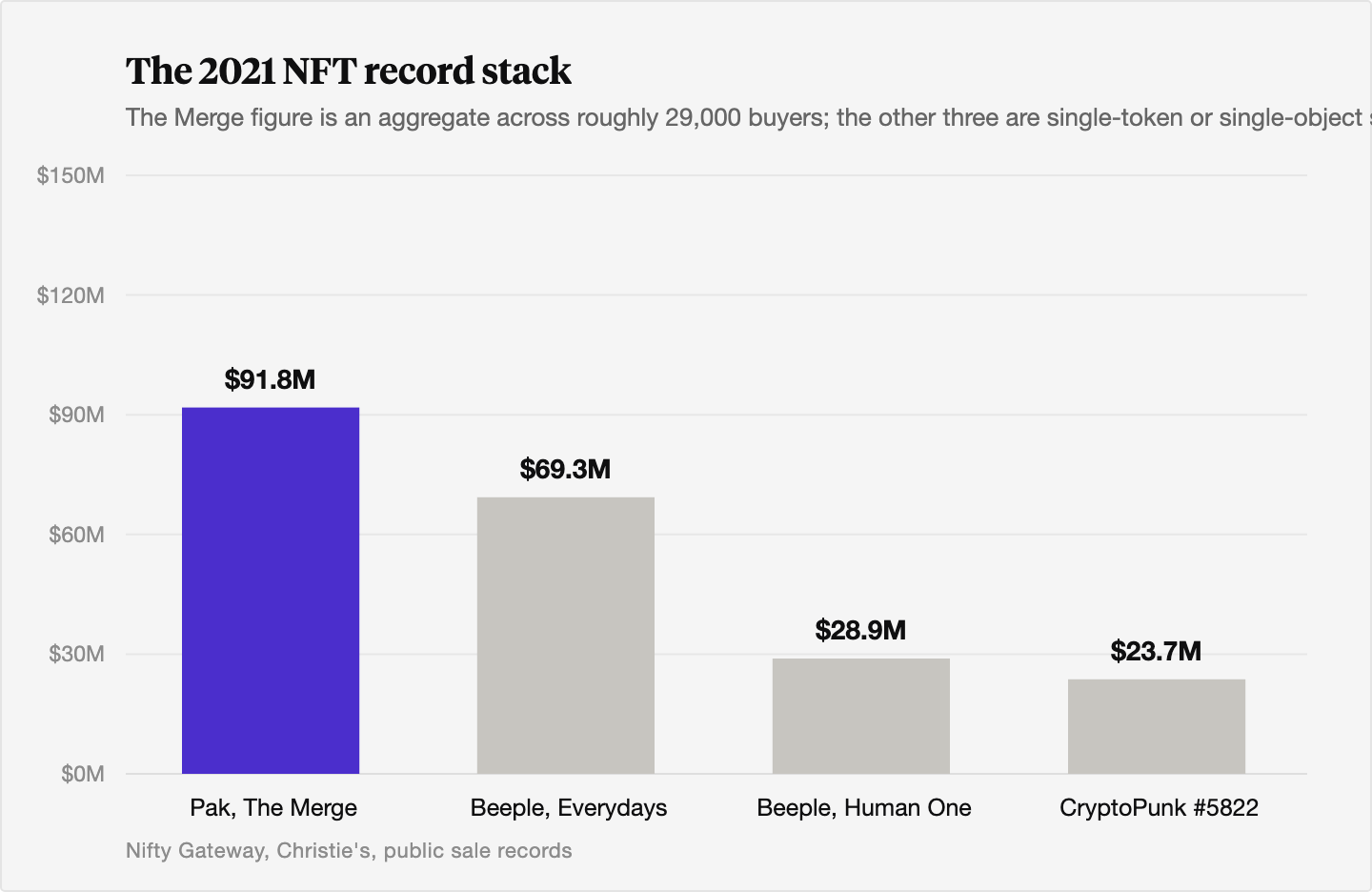
Two more rounded out the top tier. Beeple's "Human One," a seven-foot rotating sculpture paired with a dynamic NFT, sold at Christie's for $28.9 million in November 2021 against a pre-sale estimate above $15 million [9]. And CryptoPunk #5822, a rare "alien" punk, sold for 8,000 Ether, worth about $23.7 million on February 12, 2022, the highest price ever paid for a CryptoPunk [10].
2. The 2021 boom: why prices went vertical
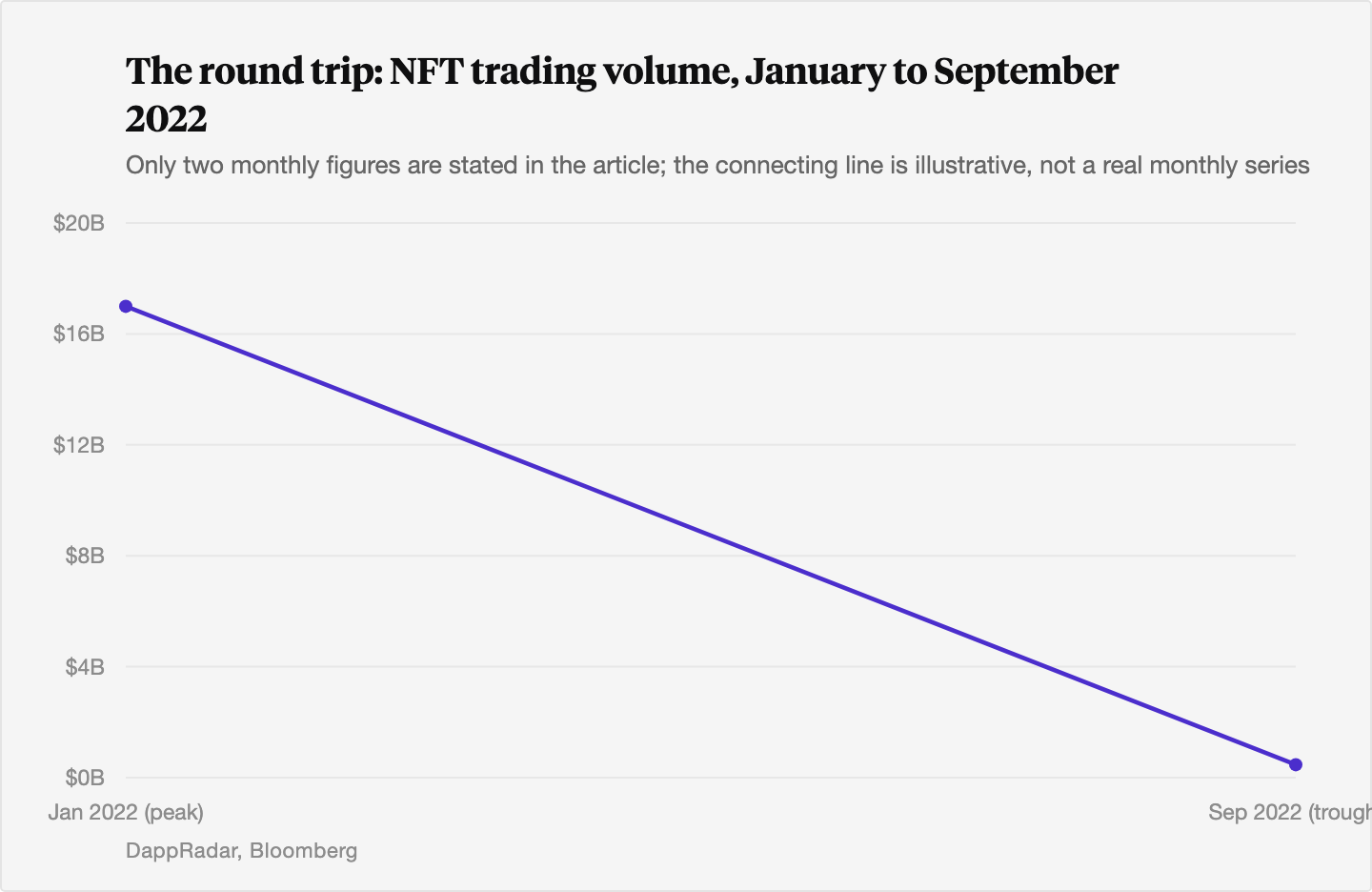
The run-up was real money moving fast, and it had a recognizable shape. The total crypto market was inflating through 2021, and a slice of that paper wealth flowed into digital collectibles. NFT trading volume across the market hit about $17 billion at the start of 2022, up from a rounding error two years earlier [5].
The mechanics rewarded speed. Collections like Bored Ape Yacht Club tied ownership to status, celebrity endorsement, and community access, which turned a JPEG into a membership card and a social signal. Justin Bieber bought a Bored Ape in 2021 for the equivalent of about $1.3 million [11]. The Bored Ape floor price, the lowest price at which any ape in the collection traded, peaked at 128 Ether on May 1, 2022, worth more than $420,000 at the time [11][4].
This is the kind of price action that draws in late buyers. The asset is going up, the people who got in early are visibly rich, and the fear of missing out does the rest. Scott Lynn, our founder, has been clear about why Masterworks stayed out. "The data is very messy," he has said of NFTs. "A lot of wash trades on the blockchain. We could never get comfortable with how much they appreciate or what their volatility is." That discipline looks better in hindsight than it felt in 2021.
3. The 2022 to 2023 collapse: how far prices fell
The reversal was severe and quick. By September 2022, NFT trading volume had fallen roughly 97% from its January 2022 high, sliding to about $466 million a month from $17 billion [5]. The average price of an NFT sale fell about 92% between May 2022 and February 2023, from $3,894 to $293 [4].
The flagship collections tracked the same path down. The Bored Ape floor fell from its April 2022 peak above $420,000 to about $80,000 by May 2023, and kept sliding into 2024 and 2025 as the floor dropped near 10 Ether [11]. Art-NFT trading volume specifically fell about 93% from the 2021 peak, from roughly $2.9 billion that year to about $197 million in 2024, per DappRadar [3].
The capstone figure came from a September 2023 study by dappGambl, which reviewed 73,257 NFT collections and found that about 95% of them, roughly 69,795, had effectively zero market value, with nearly four-fifths of collections unsold [12][3]. The headline buyers were not spared. Two Bored Apes bought by Justin Bieber and Eminem for a combined $1.76 million had top bids of around $2,800 each by early 2026, close to a total wipeout [11].
4. What top holders actually experienced: illiquidity and the bid that vanishes
A falling price is one thing. The harder problem for NFT holders was that the bid disappeared. A floor price only matters if you can sell at it, and in a thin market the floor is often a number with no buyer behind it.
This is the difference between a quoted price and a realized price. Deepak Thapliyal, who paid $23.7 million for CryptoPunk #5822, transferred it to a new wallet in August 2024 in a quiet, off-market move and never disclosed a sale figure, which is the kind of exit that happens when public bidding has dried up [13]. For the bottom 95% of collections, illiquidity was total. There was no exit at any price, because there was no buyer.
Even Beeple's record buyer makes the point. The "Everydays" purchase was entangled with B20 tokens that both buyer and seller held, which gave both a reason to drive the price up. The B20 token reached $23.62 and then fell below a dollar by May 2021 [2]. The marquee sale and the speculative wrapper around it did not protect anyone from the air coming out.
5. Wash trading and royalty erosion: the market structure problem
Two structural features explain why so much of the boom was unsound, and both are about how the market was wired.
The first is wash trading, where a trader sells an asset to a wallet they also control to fake volume and price. Analysis compiled on Dune found that about 58% of NFT trade volume on Ethereum in 2022 showed wash-trading patterns, and the share topped 80% in January 2022 [6]. Marketplaces that paid token rewards for trading were the worst, with reported wash-trade shares near 98% on some platforms [6]. When most of the volume is manufactured, the prices late buyers are reacting to are partly fictional. That is exactly the data problem that kept us out.
The second is royalty erosion. NFT creators were supposed to earn a cut on every resale, a feature often cited as the medium's advantage over physical art. That cut collapsed. Weekly creator royalties fell from a peak near $76 million in April 2022 to about $3.8 million by a peak week in mid-2023, according to Nansen [8]. As Blur and other zero-fee venues took share, OpenSea moved royalties from mandatory to optional in August 2023, and reports showed roughly 80% of volume flowing to platforms that did not enforce royalties [7]. A right that exists only when a marketplace chooses to honor it is a weak right.
6. NFTs versus blue-chip physical art: the market-structure contrast
Here is where the NFT story connects to how we think about art as an investment. The two markets look superficially similar, two people bidding on art, and behave almost nothing alike, for reasons that are structural rather than aesthetic.
Start with price history. Half of the physical art market trades at public auction, and Sotheby's has been running auctions for more than 275 years, older than the United States. That gives blue-chip art something an NFT category that was about two years old in 2021 simply could not have: a long, observable record of the same works selling, and selling again, across decades and through multiple cycles. At Masterworks we built our Post-War and Contemporary Art Index using a repeat-sale method, the same approach Robert Shiller used for home prices, tracking the same work across multiple sales to isolate real appreciation. You cannot run that test on an asset with no trading history.
Then consider scarcity. A blue-chip painting is genuinely scarce, and the supply tends to shrink as works enter museums permanently. There are, by Scott's count, about 21 Jackson Pollocks left in private hands. An NFT lives on a blockchain where the underlying image is infinitely reproducible and where a creator can mint adjacent editions, which is closer to unlimited supply than to a fixed one. Scarcity that increases over time is the opposite of a market where the next drop is always coming. NFTs were often pitched as digital gold, so the contrast with a real scarce hedge is worth reading directly in our comparison of art versus gold as a hedge asset.
Validation differs too. Blue-chip value rests on layered institutional validation built over decades: museum acquisitions, scholarly catalogues, gallery representation, and a documented chain of provenance establishing who owned a work and when. NFT value in 2021 rested largely on community sentiment and celebrity attention, which can reprice in days. Provenance on a blockchain proves which wallet holds a token. It does not supply the cultural and scholarly weight that anchors a Basquiat, whose market we examine in our look at whether the Basquiat market has peaked.
None of this makes digital art illegitimate as a medium. It does explain why a $69 million NFT and a $69 million painting are not the same kind of asset, and why one held its market and one largely did not.
7. The behavioral lessons: recency, FOMO, and narrative-driven assets
The NFT cycle is a clean case study in the biases that cost investors money. Recency bias led people to project a few months of vertical gains indefinitely. The fear of missing out pulled in late buyers near the top, when the early holders had already made their money. And narrative did the heavy lifting, because the story of "the future of art" and "internet-native ownership" carried prices that the underlying liquidity could not support.
A narrative-driven asset is one whose price depends on a story staying intact rather than on cash flows or a deep history of comparable sales. When the story wobbles, the price has nothing to stand on. That is reflexivity: rising prices attract buyers, which raises prices further, until the loop runs in reverse and falling prices drive buyers away, which lowers prices further.
Blue-chip art is not immune to sentiment, and we are careful never to suggest it cannot fall. It has corrected, and it will again. The difference is that its price is tethered to a deep record of real transactions, genuine scarcity, and institutional validation, so it tends to fall less far and recover on its own fundamentals rather than vanish. For a fuller treatment of the biases at work in the NFT cycle, see our piece on the biases that cost investors money.
The Bottom Line
- The most expensive NFTs were Pak's "The Merge" at about $91.8 million (spread across nearly 30,000 buyers) and Beeple's "Everydays" at $69.3 million for a single token, both in 2021.
- The category then collapsed, with average sale prices down about 92% from mid-2022 to early 2023 and roughly 95% of collections later found to hold no value.
- Much of the boom-era volume was not real, with wash trading accounting for a majority of Ethereum NFT volume in 2022 and creator royalties collapsing as marketplaces made them optional.
- Top holders learned that a quoted floor price is worthless without a buyer behind it, and that the largest sales often had speculative wrappers that unwound fast.
- Blue-chip physical art behaves differently because of structure: centuries of repeat-sale history, deep institutional validation, real provenance, and supply that shrinks rather than expands.
- The episode is a textbook lesson in recency bias, FOMO, and the fragility of narrative-driven assets, and we believe past performance of any asset is not predictive of its future returns.
Sources
- Artnet News. "Artist Pak Just Sold 266,445 Shares of an NFT for $91.8 Million on Nifty Gateway." Artnet, December 2021. https://news.artnet.com/market/pak-nft-91-8-million-2044727
- Wikipedia. "Everydays: the First 5000 Days." Accessed June 2026. https://en.wikipedia.org/wiki/Everydays:_the_First_5000_Days
- DappRadar. "NFT Art's Shocking Collapse: From $2.9 Billion Boom to $23.8 Million Bust." DappRadar Blog, 2025. https://dappradar.com/blog/nft-arts-shocking-collapse-from-2-9-billion-boom-to-23-8-million-bust-what-went-wrong
- CoinGecko / Blockworks. "NFT volume fell $14.5B in 2023: CoinGecko." Blockworks, 2024. https://blockworks.co/news/nft-trading-volumes-fall-from-2022
- Bloomberg. "NFT Volumes Tumble 97% From 2022 Highs as Frenzy Fades." Bloomberg, September 28, 2022. https://www.bloomberg.com/news/articles/2022-09-28/nft-volumes-tumble-97-from-2022-highs-as-frenzy-fades-chart
- CryptoPotato. "Nearly 60% of NFT Trading Volumes in 2022 Was Wash Trading: Report." CryptoPotato, 2022. https://cryptopotato.com/nearly-60-of-nft-trading-volumes-in-2022-was-wash-trading-report/
- The Art Newspaper. "NFT marketplace OpenSea ends its resale royalty policy, sparking industry-wide backlash." The Art Newspaper, August 23, 2023. https://www.theartnewspaper.com/2023/08/23/opensea-nft-marketplace-ending-resale-royalties-policy
- CoinDesk / Nansen. "NFT Creator Royalty Payments Hit Two-Year Low: Nansen." CoinDesk, July 5, 2023. https://www.coindesk.com/web3/2023/07/05/nft-creator-royalty-payments-hit-two-year-low-nansen
- nft now. "Beeple's HUMAN ONE NFT Sculpture Sells for Nearly $29M." nft now, November 2021. https://nftnow.com/news/beeple-nft-sculpture-sells-29-million-christies-auction/
- CryptoPotato. "The Most Expensive CryptoPunk Was Just Sold for $23.7M." CryptoPotato, February 2022. https://cryptopotato.com/the-most-expensive-cryptopunk-was-just-sold-for-23-7m/
- CNBC. "Bored Ape Yacht Club NFTs floor price sinks, CEO announces layoffs." CNBC, May 2, 2024. https://www.cnbc.com/2024/05/02/bored-ape-yacht-club-nfts-floor-price-sinks-ceo-announces-layoffs.html
- The Register. "95% of NFTs now totally worthless, say researchers." The Register, September 21, 2023. https://www.theregister.com/2023/09/21/95_percent_nfts_worthless/
- The Block. "Highest ever CryptoPunk sale occurs for $24 million." The Block, 2022. https://www.theblock.co/linked/134139/highest-ever-cryptopunk-sale-nets-24-million
- CryptoPotato. "NFTs Are Back: DappRadar Reports Record 18 Million Sales in 2025's Biggest Market Comeback." CryptoPotato, 2025. https://cryptopotato.com/nfts-are-back-dappradar-reports-record-18-million-sales-in-2025s-biggest-market-comeback/
Disclosures
Investing involves risk. Past results are not indicative of future outcomes.
Masterworks is providing this communication as an agent for its issuer entities, not Masterworks Advisers. This material is produced by Masterworks for informational purposes only and does not constitute investment advice, a recommendation, or an offer or solicitation to buy or sell any security. Masterworks is not a licensed broker-dealer by the SEC or FINRA.
Masterworks can only make and accept sales after an offering statement has been filed, and "qualified", by the SEC. Any offers may be revoked before notice of qualification. Indications of interest involve no obligation. For further disclosure visit the offering documents filed with the SEC and Important Disclosures at masterworks.com/cd.
Forward-looking statements and internal estimates are based on assumptions that may prove incorrect, and actual outcomes may differ materially. Figures denoted in brackets are subject to confirmation. Investing in art and alternative assets involves risk, including loss of principal.
Art sales price data is comparative only. Each painting is unique and historical data is not a direct proxy for any specific painting or investment. Data represents whole art, not an investment into our offerings which includes fees and expenses. Any comparative images are not currently live offerings and are provided for educational purposes only.
Masterworks, LLC is located at 1 World Trade Center, 57th Floor, New York, NY 10007.