Masterworks Research · June 2026
Old Masters are the oldest, most prestigious category in the art market and also its smallest and quietest segment. We explain why scarcity, attribution risk, and thin liquidity keep it that way, and what that tells you about treating art as an investable asset.
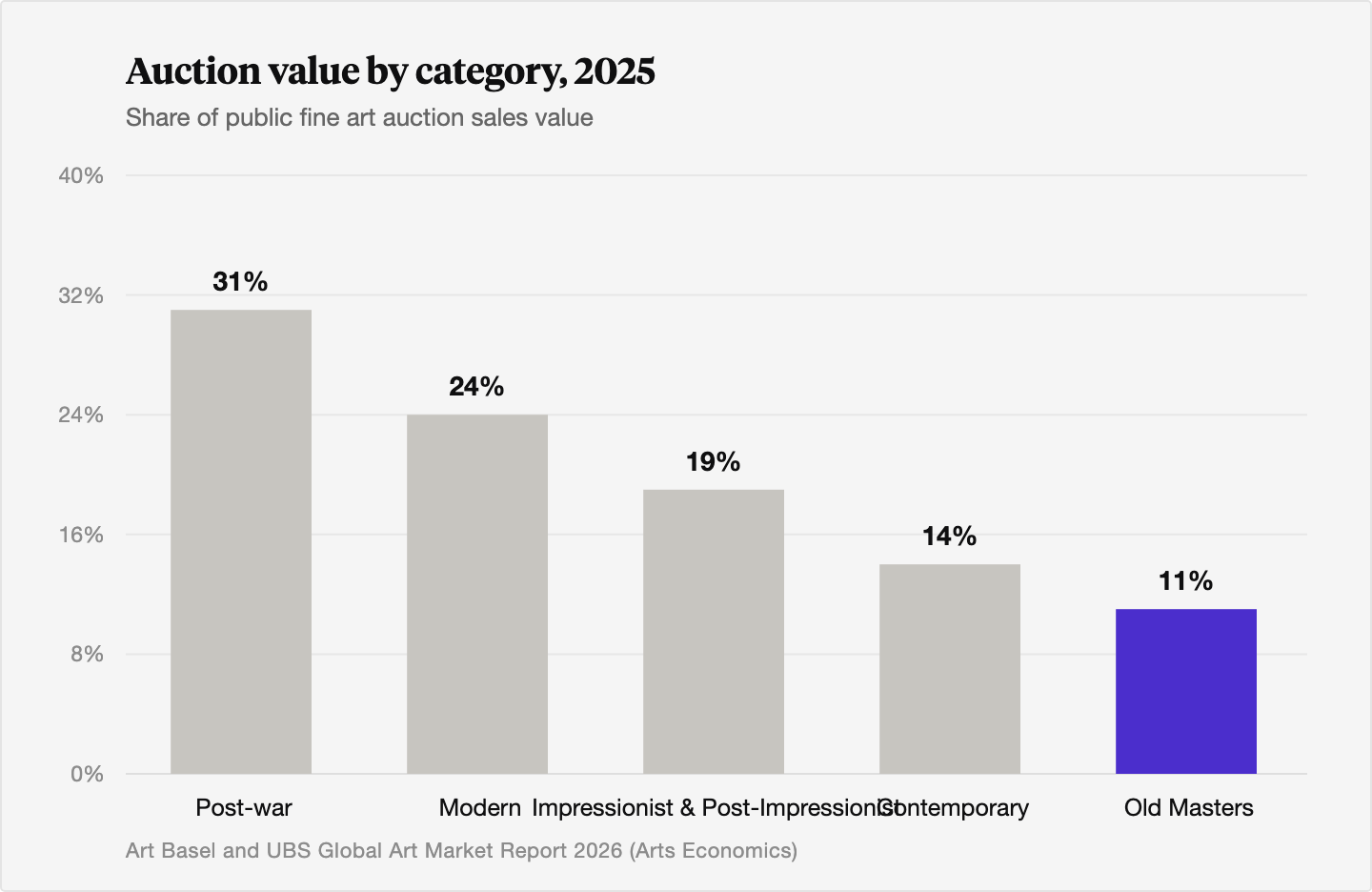
Old Masters refers to European paintings made roughly from the 13th century to about 1800, the era before modern art begins. It is the category of Leonardo, Rembrandt, Rubens, Botticelli, and Vermeer, the names most people picture when they hear the words "great painting." Yet in 2025 the wider Old Masters category accounted for about 11% of public auction value, behind post-war, modern, and Impressionist art [1][2]. The most expensive painting ever sold at auction is an Old Master, Leonardo's Salvator Mundi at $450.3 million, and the category still trades less in a full year than the post-war and contemporary segment turns over in a single strong evening sale [3]. For an investor, this gap between prestige and liquidity is the whole point. The qualities that make a market investable, depth, turnover, and a reliable price history, sit mostly in the modern and post-war segments, not in the oldest one.
What You Need to Know
- Old Masters span roughly five centuries of European painting and are defined by the era, not a style. The conventional range runs from the 13th century to about 1800, ending where modern art begins. It is the most historically prestigious category in the market.
- It is one of the smallest segments by value. Old Masters were about 11% of public fine art auction sales in 2025, versus 31% for post-war and 24% for modern art [1][2]. In 2022, before a partial rebound, the figure was under 5% of a $7.5 billion auction market [4].
- Supply is the binding constraint. Most great Old Masters already hang in museums, permanently off the market. One adviser estimates perhaps 200 top-quality works remain in private hands, and that number keeps falling [5].
- Attribution is the central risk. The difference between an autograph work and a workshop piece can be tens of millions of dollars, and the Salvator Mundi debate shows that even a $450 million painting can carry an unresolved label [3][6].
- The category is recovering off a low base. Old Masters rose about 30% in 2025 after falling 25% to roughly $803 million in 2024, a 15-year low [1][2]. A rebound from a trough is not the same as deep, repeatable liquidity.
1. What "Old Masters" actually means
Old Masters is a period label, not a movement. The convention covers European painting from roughly the 13th century to about 1800, the long stretch from late medieval altarpieces through the Renaissance, the Baroque, and into the 18th century, ending where modern art begins around the 1860s. For the segment that follows it, see our explainer on what modern art is and how its 1860 to 1970 market works.
The names are the ones a museum visitor already knows. Leonardo da Vinci, Rembrandt van Rijn, Peter Paul Rubens, Sandro Botticelli, Johannes Vermeer, Caravaggio. These are the artists who define the Western canon. That cultural weight is exactly why the paradox is worth examining. The most prestigious art in the world is also the part of the market that trades the least.
A second feature of the period matters for investors: most of these artists ran workshops. Assistants prepared grounds, blocked in backgrounds, and produced secondary versions of popular compositions [6]. That studio system is the root of the attribution problem we get to in section 3.
2. Why Old Masters are such a small share of the market
Old Masters were about 11% of public fine art auction sales in 2025, according to the Art Basel and UBS Global Art Market Report 2026, compiled by Dr. Clare McAndrew of Arts Economics [1][2]. By comparison, post-war art was about 31% of fine art auction value, modern art about 24%, and Impressionist and Post-Impressionist work about 19% [2]. The oldest category sits at the bottom of the table.
It was smaller still before a recent bounce. In 2022 the Old Masters auction market was about $369 million, under 5% of a roughly $7.5 billion total, while post-war and contemporary art made up close to 45% of the value [4]. To size the gap a different way: a single Klimt, Portrait of Elisabeth Lederer, sold for $236.4 million at Sotheby's in November 2025, more than the entire Old Masters auction category turned over in 2024 [7].
The reasons are structural, and they compound.
3. Attribution and authentication risk
In most of the market, you know who made the work. In Old Masters, the maker is often the question. Because these artists ran workshops, a single composition can exist as an autograph painting by the master, a version finished by assistants, a studio copy, and a later follower's imitation. The price difference between those labels can be enormous. A work reclassified from "workshop of" to "autograph" can rise in value many times over, and the reverse is just as true [6].
The Salvator Mundi is the clearest case. It sold at Christie's in November 2017 for $450.3 million, the highest auction price ever paid for any artwork, on the strength of a Leonardo attribution [3]. Yet the painting is heavily restored, its early history is incomplete, and scholars remain split on how much of it Leonardo actually painted [3][6]. In recent years the Prado in Madrid recategorized the work in a way many read as a step back from a full Leonardo attribution, the most cautious signal yet from a major museum [3]. The painting has not been shown publicly since 2017 [3]. When the most expensive painting on earth still carries an unsettled label, the authentication risk in the rest of the category is not abstract.
For how serious buyers manage exactly this kind of risk, with technical imaging, provenance research, and condition reports, see what institutional due diligence looks like for art investments.
4. Condition and conservation
Old Masters are centuries old, and time leaves marks. Many have been relined, cleaned, retouched, and revarnished, sometimes repeatedly. Overcleaning can strip the thin glazes a painter used to build depth, leaving a surface flat and dull. Overpaint from an earlier restoration can hide damage or, worse, hide how much of the original is gone [6]. Two paintings by the same hand, in the same subject, can carry very different values once a conservator's report is in.
This adds a layer of homework that newer art rarely needs. A buyer is underwriting not just the attribution but the physical object after 300 or 400 years of handling. The cost and uncertainty of that work narrow the pool of people willing to do it.
5. Thin liquidity and a shrinking buyer base
Supply is the first constraint. Most of the great Old Masters are already in public collections, where they stay. Owners donate works to museums in lieu of inheritance taxes or as gifts, and once a painting enters a permanent collection it almost never returns to the market [5]. The art adviser Todd Levin has estimated that perhaps no more than 200 great-quality Old Masters remain in private hands, with that supply under continual attrition [5]. This is the same dynamic we describe across the market, where collectors donate to museums and works leave the market forever. In Old Masters it has simply run longer, so the privately held pool is thinner.
Demand is the second constraint, and it has been weakening. The traditional Old Masters buyer skews older and wealthy, and the trade has struggled to bring in younger collectors [5]. Part of the reason is education. In the United States, undergraduate degrees in the classic humanities fell by almost a third between 2012 and 2022, and in the United Kingdom art-history undergraduate numbers dropped 28.5% between 2009 and 2019 [5]. Fewer people are trained to tell a pupil's hand from the master's. As the art adviser Hugo Nathan of Beaumont Nathan put it, "The connoisseurship isn't there. If you have to explain that this picture is by a pupil of so-and-so, forget it" [5].
Thin supply plus a narrowing buyer base produces low turnover and uneven sales. At the December 2022 London sales, 40% of works in a Sotheby's day sale failed to find a buyer [4]. A market where four in ten lots can go unsold is hard to transact in at scale.
6. The price gap versus modern and contemporary
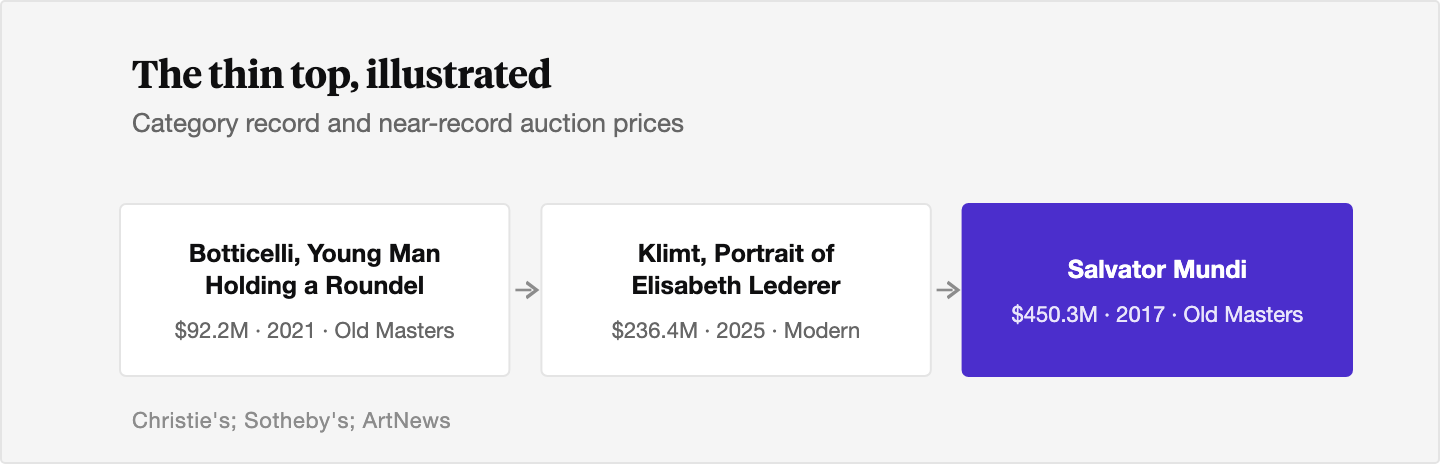
The clearest way to see the divergence is to line up the records. The most expensive Old Master ever sold at auction is the Salvator Mundi at $450.3 million in 2017 [3]. After that the numbers fall off sharply. Botticelli's Young Man Holding a Roundel made $92.2 million at Sotheby's in 2021, then a record for any work sold by the house in the category [8]. Rubens' Massacre of the Innocents, which set the Old Masters auction record in 2002, sold for £49.5 million [9]. These are large numbers, but the depth behind them is shallow. A handful of trophies carry the category.
Now compare the modern and contemporary records, which arrive in clusters rather than as isolated peaks. The Klimt at $236.4 million in November 2025 became the most valuable modern work ever sold at auction and the second-most-expensive work of any kind, just behind the Salvator Mundi [7]. The post-war and contemporary segment routinely produces $100 million-plus results and trades enough volume to support repeat sales of the same works. For why these two categories rarely move together, see when markets diverge: why contemporary art and Old Masters don't move together. For the full ranking of the highest prices on record, see the most expensive paintings ever sold, 2026 ranked list.
In our own segmentation of long-run appreciation, the oldest art has historically appreciated the least, with contemporary work leading, then modern, then Impressionist, and Old Masters at the bottom. [NEEDS INTERNAL REVIEW: confirm the segment level appreciation rates before publishing specific figures. Working estimates were contemporary roughly 12% to 13% a year, modern 8% to 9%, Impressionist 6% to 7%, and Old Masters 1% to 2%, but these segment CAGRs require Research and Compliance sign off.] Our best hypothesis is that appreciation follows fashion, and fashion moves generationally. Someone spending $10 million on a painting today is more likely to want a Basquiat above the sofa than a Rembrandt. Past performance is not predictive of future results, and these figures describe the market for whole works, not any specific painting.
7. Where the opportunity and the risk actually sit
There is a case for the category, and it is honest to state it. Old Masters are recovering off a low base. The segment rose about 30% in 2025 after a 25% fall to roughly $803 million in 2024, which was a 15-year low [1][2]. At the very top, demand is real: museums and a small group of serious collectors still compete hard for the best historical works, even as the middle of the market struggles [5]. A genuinely scarce, fully autograph, well-preserved masterpiece by a canonical name will likely always find a buyer.
The risk sits everywhere below that top tier. The middle market is illiquid and out of fashion. Attribution can move against you. Condition can surprise you. And turnover is low enough that you may wait years for the right buyer, or accept a discount to sell at all. A rebound from a trough is encouraging, but it does not turn a thin market into a deep one.
8. What this means for treating art as an asset
This is where the segmentation matters for an investor rather than a collector. Three qualities make any asset workable as an investment: depth (enough buyers and sellers to transact without moving the price), liquidity (the ability to exit in a reasonable time at a fair value), and a reliable price history (enough repeat transactions to measure return). Old Masters are weak on all three. The pool is small, sales are sporadic, and many works trade so rarely that there is little clean data to build a return series from.
The modern and post-war segments are stronger on each. They trade more often, in more places, with more buyers, which is what lets us build repeat-sale indices the way Robert Shiller built the Case-Shiller home-price index, tracking the same work across multiple sales to isolate price appreciation. When the same Warhol sells in 2018 and again in 2025, the change in price tells you something measurable. That measurability is far harder in a category where a comparable work might not have changed hands in a generation.
We say this plainly because the honest version is more useful than the flattering one. Old Masters are the most prestigious art in the world and, for now, among the least investable. The depth, liquidity, and price history that make art behave like an asset are concentrated in the newer segments. That is the reason our own focus sits there, and it is the reason the oldest market is also the quietest.
The Bottom Line
- Old Masters cover European painting from roughly the 13th century to about 1800 and are the most prestigious category in the art market.
- They are also among the smallest by value, about 11% of public auction sales in 2025, behind post-war, modern, and Impressionist art.
- Scarcity is the core constraint, with most great works permanently held in museums and perhaps 200 top examples left in private hands.
- Attribution and condition risk are unusually high, as the unresolved Salvator Mundi debate shows even at $450.3 million.
- Depth, liquidity, and a reliable price history, the qualities that make art investable, are concentrated in the modern and post-war segments rather than in Old Masters.
Sources
- Villa, Angelica. "Contemporary Art Market Declines For Fourth Straight Year, as Old Masters and Impressionist Works Rebound: Art Basel UBS Report." ARTnews, March 2026. https://www.artnews.com/art-news/news/contemporary-art-market-cooling-old-masters-report-1234777454/
- Art Basel and UBS. "Global sales rise 4% to $59.6 billion in 2025, amid ongoing market recalibration." Art Basel (The Art Basel and UBS Global Art Market Report 2026, by Dr. Clare McAndrew, Arts Economics), 2026. https://www.artbasel.com/stories/the-art-basel-and-ubs-global-art-market-report-2026
- "Salvator Mundi (Leonardo)." Wikipedia, accessed June 2026. https://en.wikipedia.org/wiki/Salvator_Mundi_(Leonardo)
- "Is the Old Master market dead?" Art History News (Bendor Grosvenor), January 30, 2023. https://arthistorynews.com/articles/3495_Is_the_Old_Master_market_dead
- Gerlis, Melanie. "Is the declining value of Old Masters due to a lack of education?" The Art Newspaper, March 11, 2025. https://www.theartnewspaper.com/2025/03/11/is-the-declining-value-of-old-masters-due-to-a-lack-of-education
- "Why Is the Salvator Mundi Called the World's Most Controversial Painting?" Encyclopaedia Britannica, accessed June 2026. https://www.britannica.com/story/why-is-the-salvator-mundi-called-the-worlds-most-controversial-painting
- Greenberger, Alex. "Klimt's Elisabeth Lederer Portrait Sells for $236.4 M. at Sotheby's." ARTnews, November 18, 2025. https://www.artnews.com/art-news/news/gustav-klimt-portrait-of-elisabeth-lederer-auction-record-1234762083/
- "Sandro Botticelli's Portrait of a Young Man Holding a Roundel Sells for Record $92.2 Million at Sotheby's New York." Sotheby's, January 28, 2021. https://www.sothebys.com/en/press/newsflash-sandro-botticelli
- "Massacre of the Innocents (Rubens)." Wikipedia, accessed June 2026. https://en.wikipedia.org/wiki/Massacre_of_the_Innocents_(Rubens)
- "The Most Expensive Old Masters Artworks Ever Sold at Auction." ARTnews, accessed June 2026. https://www.artnews.com/list/art-news/artists/most-expensive-old-masters-works-1234581432/
- "How healthy is the market for Old Masters?" Apollo Magazine, January 30, 2023. https://apollo-magazine.com/market-old-masters-blockbuster-exhibitions-contemporary/
- "$236.4 Million Klimt Portrait Sets Records as Sotheby's Inaugurates the Breuer." Sotheby's, November 2025. https://www.sothebys.com/en/articles/the-new-york-sales-november-2025-breuer-results
Disclosures
Investing involves risk. Past results are not indicative of future outcomes.
Masterworks is providing this communication as an agent for its issuer entities, not Masterworks Advisers. This material is produced by Masterworks for informational purposes only and does not constitute investment advice, a recommendation, or an offer or solicitation to buy or sell any security. Masterworks is not a licensed broker-dealer by the SEC or FINRA.
Masterworks can only make and accept sales after an offering statement has been filed, and "qualified", by the SEC. Any offers may be revoked before notice of qualification. Indications of interest involve no obligation. For further disclosure visit the offering documents filed with the SEC and Important Disclosures at masterworks.com/cd.
Forward-looking statements and internal estimates are based on assumptions that may prove incorrect, and actual outcomes may differ materially. Figures denoted in brackets are subject to confirmation. Investing in art and alternative assets involves risk, including loss of principal.
Art sales price data is comparative only. Each painting is unique and historical data is not a direct proxy for any specific painting or investment. Data represents whole art, not an investment into our offerings which includes fees and expenses. Any comparative images are not currently live offerings and are provided for educational purposes only.
Masterworks, LLC is located at 1 World Trade Center, 57th Floor, New York, NY 10007.