Masterworks Research · June 2026
What modern art means, the movements inside the period, and why Modern plus Post-War sits at the center of the blue-chip auction market.
Modern art is the work made from roughly the 1860s to about 1970, beginning with Impressionism and ending with high modernism's late chapters in Color Field, Pop, and Minimalism. The Museum of Modern Art dates the period from the 1880s to the 1970s; most market and academic conventions push the start back to the 1860s, when Manet and the Impressionists broke from the academies. Art made after that, from roughly 1970 forward, is classified as contemporary. The line matters for investors because Modern plus Post-War art, the older and more established end of the market, is the deepest and most institutionally validated segment of the global art trade. It carries the longest price history, the highest concentration of value, and most of the liquidity at the top of the market. This is the core market we study.
What You Need to Know
- Modern art has a defined window: roughly 1860 to 1970. It opens with Impressionism and runs through Post-Impressionism, Fauvism, Cubism, German Expressionism, Surrealism, Abstract Expressionism, Color Field, Pop, and Minimalism. Work after about 1970 is contemporary.
- Modern plus Post-War is the bulk of auction value. In 2025, Post-War art was 31% of public auction value and Modern art 24%, a combined 55%, with Impressionist and Post-Impressionist work adding another 19% (Art Basel and UBS Art Market Report 2026).
- The price benchmarks sit in this period. Klimt's Portrait of Elisabeth Lederer sold for $236.4 million in November 2025, the highest price ever for a work of Modern art and the second-highest at auction overall, behind Leonardo's $450.3 million Salvator Mundi.
- This segment is the deepest and most liquid. Sotheby's posted a single-night total of $706 million on November 18, 2025, the largest in its 281-year history, led by 24 Modern works that all sold.
- Depth and a long price history are why institutional capital concentrates here. A market with public sales going back generations supports the kind of analysis a serious allocator needs.
1. What defines modern art
Modern art is a period and a set of attitudes, not a single style. The Museum of Modern Art defines it as art made from the 1880s to the 1970s, a span shaped by the growth of cities, the rise of industry, and the spread of mass media (1). Most market practice and survey histories set the opening a generation earlier, in the 1860s, when Edouard Manet and the first Impressionists rejected the standards of the official salons (2).
The common thread is a break from older conventions. Modern artists abandoned the academies, religious and historical subject matter, and techniques like linear perspective, and turned instead to personal vision, the act of seeing, and eventually the nature of the work itself (1). The arc runs from painting light and atmosphere in the 1870s to pure abstraction and the reduced forms of Minimalism a century later.
For an investor the useful point is that "modern" is a bounded, well-documented era with a clear beginning and a clear end. That boundary is what makes the segment legible. We know who the artists are, we know roughly how many major works exist, and we have decades of public sales to study.
2. Modern art versus contemporary art: where the line falls
The split between modern and contemporary art is one of classification, and it sits at roughly 1970. Most art historians place the transition in the late 1960s or early 1970s, the end of modernism and the start of the contemporary period (2). Auction houses use a related but looser convention, often grouping "Post-War and Contemporary" together to cover the decades after 1945.
The distinction is worth getting right because it maps onto how the market is organized and how value behaves. The older the work, broadly, the more settled its reputation and the slower its long-run appreciation. We have found that appreciation tends to follow fashion, and fashion moves generationally: by our research, the more recently made segments have tended to appreciate faster over the long run, with Contemporary leading, then Modern, then Impressionist, then Old Masters. [NEEDS INTERNAL REVIEW: confirm the segment level appreciation rates before publishing specific figures. Working estimates were Contemporary roughly 12 to 13% a year, Modern 8 to 9%, Impressionist 6 to 7%, and Old Masters 1 to 2%, but these segment CAGRs require Research and Compliance sign off.] Past performance is not predictive of future results.
So the line is not academic. A buyer choosing between a 1960 canvas and a 1985 one is choosing between two different points on that curve.
3. The movements inside the period
The modern era contains the movements most investors can name, in a rough sequence. We cover several of these in dedicated pieces; here is the spine of the period.
Impressionism (1860s to 1880s). The starting point. Monet, Renoir, and their circle painted outdoors and captured fleeting light, breaking from the salons. We treat it as the original blue-chip art movement.
Post-Impressionism (1880s to 1900s). Van Gogh, Cezanne, Gauguin, and Seurat pushed past the Impressionists into structure and emotion. This is the bridge to modern art.
Fauvism (1905 to 1908). Matisse and a short-lived group of "wild beasts" used color as pure expression. A small, often underrated collecting category.
Cubism (1907 to 1920s). Picasso and Braque fractured the picture plane and remade what a painting could be. We cover how they reinvented painting and its market.
German Expressionism (1905 to 1930s). Kirchner, Nolde, and others gave the period its raw, anxious edge, a market with enduring strength.
Surrealism (1920s to 1940s). Dali, Magritte, Miro, and Ernst mined the unconscious. The movement still commands top prices.
Abstract Expressionism (1940s to 1950s). Pollock, Rothko, de Kooning, and the New York School. This is how America became the center of the art world.
Color Field (1950s to 1960s). Rothko, Newman, and others reduced painting to fields of pure color, a market for color itself.
Pop Art (late 1950s to 1960s). Warhol, Lichtenstein, and the turn to consumer imagery, from soup cans to the auction block.
Minimalism (1960s). Judd, Stella, Flavin, and the stripping away of everything but the object. Minimalism is why less commands more at auction.
That sequence, from Monet to Judd, is the modern century. Past about 1970, the story becomes contemporary.
4. Why Modern plus Post-War is the deepest segment
Here is the part that matters for capital. In 2025, public auction sales of art totaled $20.7 billion, up 9% on the prior year (3). Inside that figure, the older sectors dominate. Post-War art alone was 31% of auction value, roughly $3.1 billion. Modern art was 24%, about $2.4 billion, and posted a 9% rise after three years of decline. Impressionist and Post-Impressionist work added a 19% share and surged 47% year on year. Old Masters made up another 11% (3).
Add the modern-era sectors together and they account for the clear majority of auction value. Contemporary art, by contrast, held about a 14% share and was roughly stable.
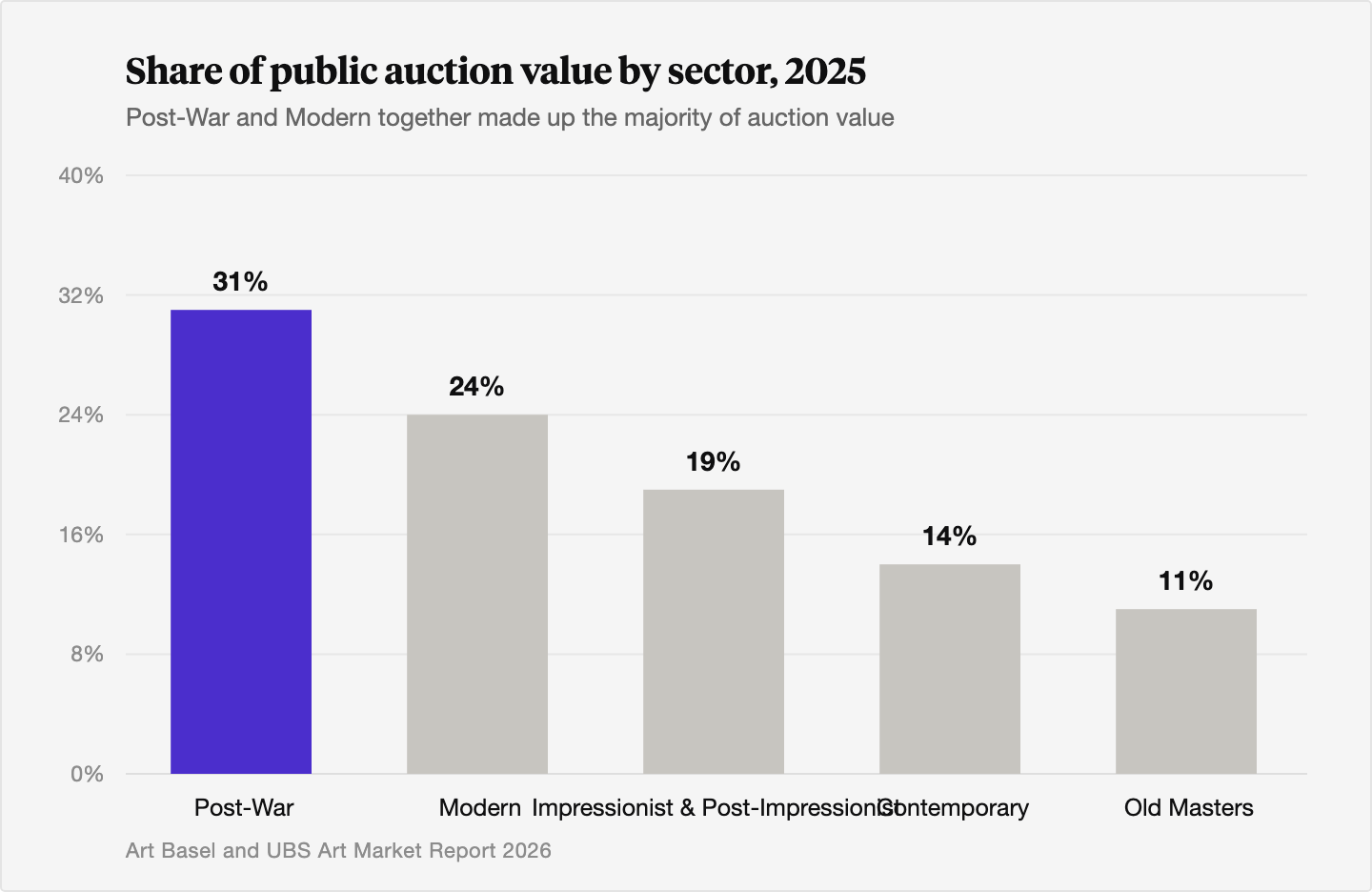
That concentration is not a one-year accident. It reflects where the canon sits and where the largest collections are built. When a sector this established posts double-digit value growth, it tells us the depth is real, not a fad.
5. Why this is the most liquid corner of an illiquid market
Art is an illiquid asset class. Within it, the modern and post-war segment is where liquidity is highest, because the works are the most widely recognized and the buyer pool is the largest. The clearest recent evidence is the night of November 18, 2025, when Sotheby's posted $706 million in sales in a single evening, the largest in its 281-year history (4). All 24 works in the Leonard Lauder collection sold, totaling $527.5 million and beating the high estimate, with 83% of works clearing above their high estimates and strong bidding from Asia (4).
Liquidity also shows up at the top of the price ladder. In 2025, fine-art lots above $1 million rose 21% in value with 15% more transactions, and lots above $10 million grew 30% in value. All ten of the year's highest-priced lots sold in New York (3).
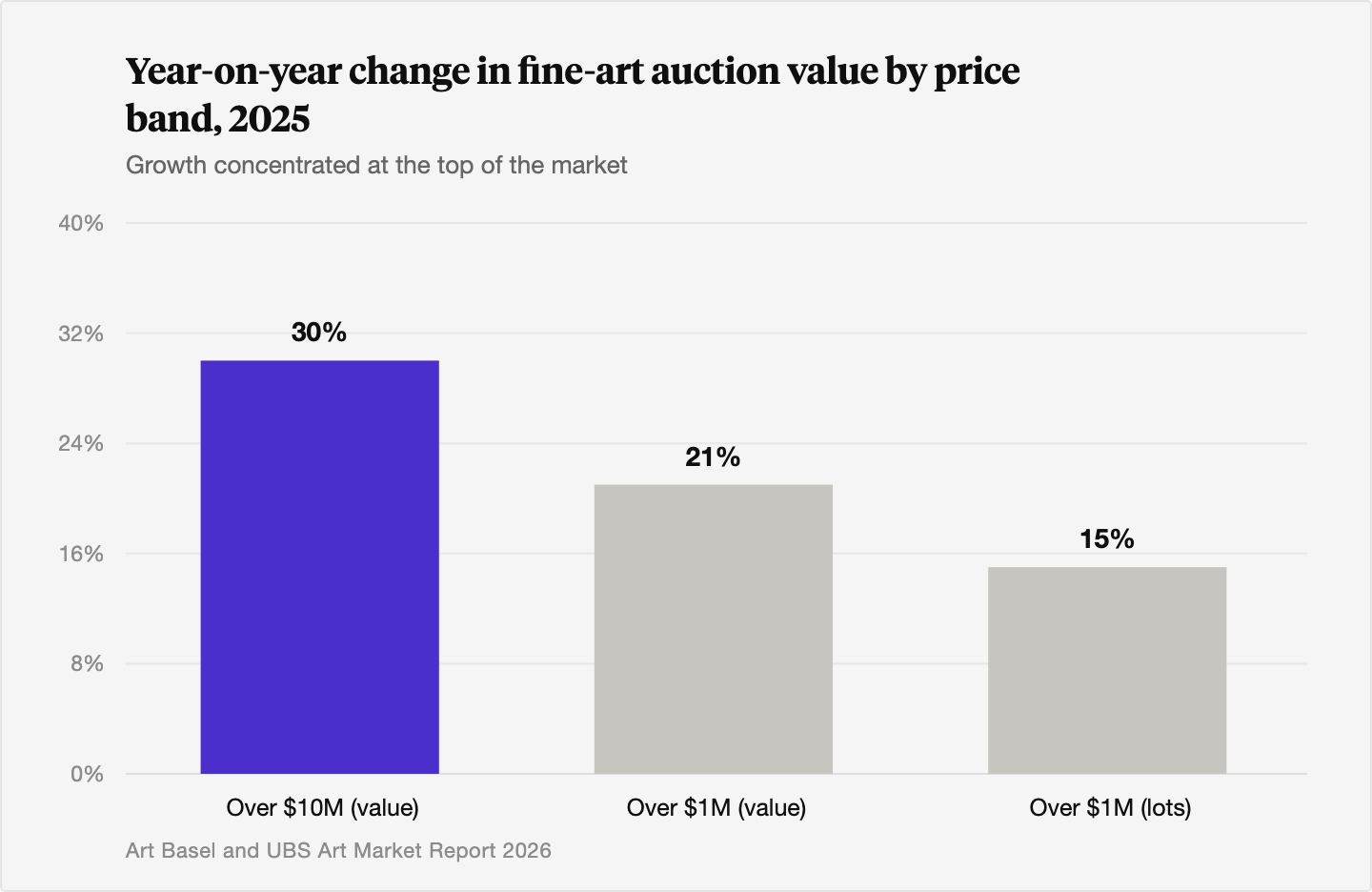
Depth at the top is what an institutional buyer actually needs. A market where a single $200 million work can change hands in twenty minutes of bidding is a market where a serious position can eventually be exited.
6. The price benchmarks all live in this period
The reference prices that define the high end of the art market sit almost entirely inside the modern century. Consider the ladder:
Klimt's Portrait of Elisabeth Lederer, painted from 1914 to 1916, sold for $236.4 million at Sotheby's in November 2025, the highest price ever for a work of Modern art and the second-highest at auction overall (5). The only work above it is Leonardo da Vinci's Salvator Mundi at $450.3 million in 2017, an Old Master and an outlier (6). Picasso's Les Femmes d'Alger reached $179.4 million in 2015, and his Femme a la montre brought $139.4 million in 2023 (7). Warhol's Shot Sage Blue Marilyn, from 1964, sold for $195 million in May 2022, the most expensive 20th-century work at auction (8). Basquiat's Untitled, painted in 1982, sold for $110.5 million in May 2017 (9).
These are not abstract numbers. Klimt, Picasso, Warhol, Basquiat: the names that set the ceiling are the names inside the modern and post-war canon. When a record like the Klimt resets the top, it tends to pull up the value of comparable works beneath it. That is a useful dynamic for anyone holding quality in the same tier.
7. Why institutional capital concentrates here
Put the pieces together and the logic is straightforward. The modern and post-war segment offers three things a serious allocator looks for. It has depth, the majority of auction value sits here. It has liquidity, the recognized names trade in size and clear estimates even in a recovering market. And it has a long price history, public auction records that stretch back generations, which is what makes analysis possible at all.
The contrast with the contemporary market is instructive. Contemporary art has grown enormously, the segment expanded roughly 1,800% in value since 2000 by one count, with more than 33,000 artists selling at auction in 2023 and 2024 (10). That growth is real, and it is also where the most volatility and the least price history live. The further back a market's records run, the more confidently it can be modeled.
This is the core market Masterworks studies. We built our index using a repeat-sale method, the same approach Robert Shiller used to track home prices, which works only when the same asset trades more than once over time. The modern and post-war market, with its long public record and its repeat sales of major works, is exactly the kind of market that method can read. That is why the analytical attention, ours and the wider institution's, concentrates here.
The Bottom Line
- Modern art is the work made from roughly 1860 to 1970, from Impressionism through Minimalism. Work after about 1970 is contemporary.
- The period contains the movements most investors can name, in sequence from Impressionism, Post-Impressionism, Fauvism, Cubism, and German Expressionism to Surrealism, Abstract Expressionism, Color Field, Pop, and Minimalism.
- Modern plus Post-War art is the largest share of public auction value, a combined 55% in 2025, with Impressionist and Post-Impressionist work adding another 19%.
- The defining price benchmarks, from the $236.4 million Klimt to the $195 million Warhol, sit inside this period.
- Depth, liquidity, and a long price history are why institutional capital concentrates in this segment, and why it is the core market we study. Past performance is not predictive of future results.
Sources
- Museum of Modern Art. "Modern art." MoMA Learning, accessed June 2026. https://www.moma.org/collection/terms/modern-art
- Wikipedia. "Modern art." Accessed June 2026. https://en.wikipedia.org/wiki/Modern_art
- Art Basel and UBS. "The Art Basel and UBS Global Art Market Report 2026" (Arts Economics, Dr. Clare McAndrew). Art Basel, 2026. https://www.artbasel.com/stories/the-art-basel-and-ubs-global-art-market-report-2026
- Artnet News. "Records Fall During $706 Million Night at Sotheby's, Turbocharged by Blue-Chip Lauder Trove." November 2025. https://news.artnet.com/art-world/records-fall-during-706-million-night-at-sothebys-turbocharged-by-blue-chip-lauder-trove-2714943
- ARTnews. "Klimt's Elisabeth Lederer Portrait Sells for $236.4 M. at Sotheby's." November 2025. https://www.artnews.com/art-news/news/gustav-klimt-portrait-of-elisabeth-lederer-auction-record-1234762083/
- Wikipedia. "Salvator Mundi (painting)." Accessed June 2026. https://en.wikipedia.org/wiki/Salvator_Mundi_(painting)
- CBS News. "Picasso's 'Femme a la montre' sells for more than $139 million at auction." November 2023. https://www.cbsnews.com/news/picasso-painting-femme-a-la-montre-mistress-139-million-sothebys-auction-second-most-expensive-artwork/
- The Art Newspaper. "Warhol's Blue Marilyn sells for record-smashing $195m at Christie's." May 2022. https://www.theartnewspaper.com/2022/05/10/warhols-blue-marilyn-195m-christies-new-york-ammann-collection
- NPR. "At $110.5 Million, Jean-Michel Basquiat's Painting Becomes Priciest U.S. Artwork Ever Sold." May 2017. https://www.npr.org/sections/thetwo-way/2017/05/19/529096175/at-110-5-million-basquiat-painting-becomes-priciest-work-ever-sold-by-a-u-s-arti
- PR Newswire. "Artprice by Artmarket's 2024 Contemporary Art Market Report." October 2024. https://www.prnewswire.com/news-releases/artprice-by-artmarkets-2024-contemporary-art-market-report-coinciding-with-frieze-london-and-art-basel-paris-thoroughly-explores-a-market-that-has-grown-1-800-since-2000--confirming-that-art-is-a-safe-haven-in-times-of-major-c-302270474.html
- Smithsonian Magazine. "Watch the Record-Breaking Auction of This Gustav Klimt Portrait." November 2025. https://www.smithsonianmag.com/smart-news/watch-the-record-breaking-auction-of-this-gustav-klimt-portrait-which-just-became-the-second-most-expensive-painting-ever-sold-180987723/
- Artnet News. "Sotheby's Sold $706 Million of Art in 3 Hours. Here's a Look at the Numbers." November 2025. https://news.artnet.com/market/sothebys-leonard-lauder-contemporary-by-the-numbers-2715607
Disclosures
Investing involves risk. Past results are not indicative of future outcomes.
Masterworks is providing this communication as an agent for its issuer entities, not Masterworks Advisers. This material is produced by Masterworks for informational purposes only and does not constitute investment advice, a recommendation, or an offer or solicitation to buy or sell any security. Masterworks is not a licensed broker-dealer by the SEC or FINRA.
Masterworks can only make and accept sales after an offering statement has been filed, and "qualified", by the SEC. Any offers may be revoked before notice of qualification. Indications of interest involve no obligation. For further disclosure visit the offering documents filed with the SEC and Important Disclosures at masterworks.com/cd.
Forward-looking statements and internal estimates are based on assumptions that may prove incorrect, and actual outcomes may differ materially. Figures denoted in brackets are subject to confirmation. Investing in art and alternative assets involves risk, including loss of principal.
Art sales price data is comparative only. Each painting is unique and historical data is not a direct proxy for any specific painting or investment. Data represents whole art, not an investment into our offerings which includes fees and expenses. Any comparative images are not currently live offerings and are provided for educational purposes only.
Masterworks, LLC is located at 1 World Trade Center, 57th Floor, New York, NY 10007.