Masterworks Research · June 2026
It is the single most powerful input in any valuation, it moves with interest rates, and the assets it punishes hardest are the ones whose payoff sits furthest in the future. Here is how it works, and where art sits in the picture.
The discount rate is the annual rate of return used to convert a future dollar into what it is worth today, and it is the hinge on which almost every valuation turns. The math is one line: the present value of a future cash flow equals that cash flow divided by one plus the rate, raised to the number of years away [1][2]. The rate itself is built as the risk-free rate plus risk premia, so when interest rates move, the discount rate moves with them, and valuations move a lot [1][3]. For investors, this is the quiet engine behind most of what happened to portfolios from 2022 onward. A higher discount rate does the most damage to long-duration assets, the ones whose cash flows arrive years out, and it reshapes the relative case for every asset that competes with bonds, including real assets like art.
What You Need to Know
- The discount rate is just the price of waiting, plus the price of risk. Present value equals a future cash flow divided by (1 + r) raised to the number of years, so a $100 payment in one year discounted at 10% is worth $90.91 today, and the same $100 in 30 years is worth $5.73 [2]. The rate r is the risk-free rate plus an equity risk premium and any other premia the cash flow's risk demands [1][3].
- Small changes in the rate produce large changes in value. In a constant-growth dividend model with a 3% growth rate, moving the discount rate from 8% to 9% cuts the value by 16.7%, and moving it from 8% to 7% raises it by 25% [1]. The closer the rate sits to the growth rate, the more violent the swing.
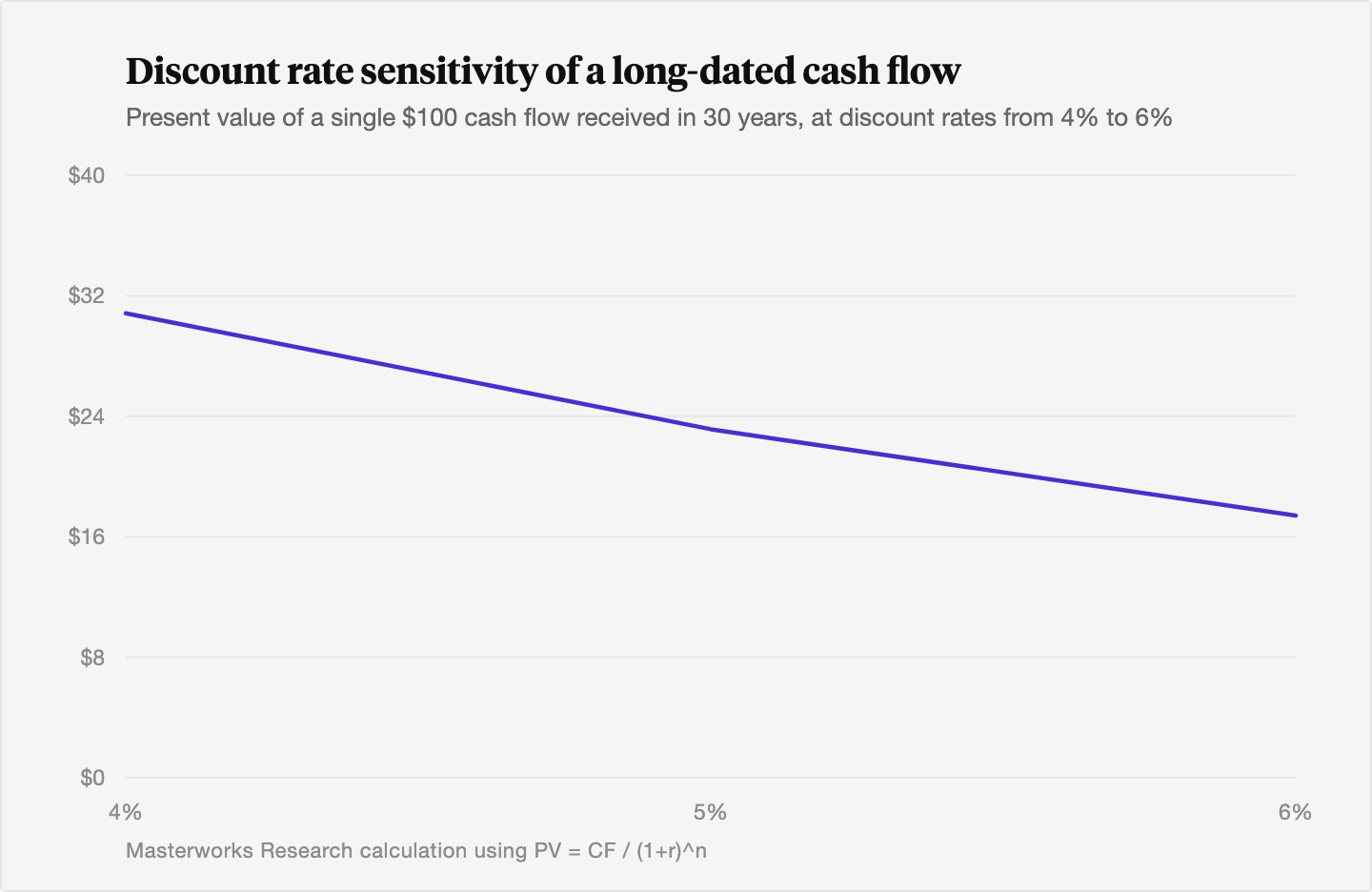
- Long-dated cash flows are the most rate-sensitive. A single $100 payment 30 years out loses about a quarter of its present value when the rate rises from 5% to 6%, while a near-term payment barely moves [1]. This is duration, and it is why high-growth equities and long-maturity bonds reprice hardest when rates rise.
- 2022 was a live demonstration. The Fed took its target range from near zero to 4.25%-4.50% in a single year, the Nasdaq Composite fell about 33%, long-duration Treasuries fell roughly 31%, and the core US bond index fell about 13%, its worst year on record [4][5][6]. The discount rate, not earnings, did most of that.
- Art has no cash flows to discount, so the channel is indirect. A painting pays no dividend or coupon, so a discounted cash flow model does not apply [7]. Its value rests on scarcity and on demand from the wealthy, which means rates reach it through the opportunity cost of capital and collector wealth rather than through a denominator. Contemporary art has shown low correlation to equities and near-zero correlation to bonds, which is the property that makes it useful in a portfolio [7][8]. Past performance is not predictive.
1. What the discount rate is, in one line of math
Start with the only equation that matters here. The present value of a future cash flow is that cash flow divided by one plus the discount rate, raised to the number of years until you receive it [1][2]:
PV = CF / (1 + r) ^ n
That is the whole engine. A dollar in the future is worth less than a dollar today, because today's dollar can be invested to earn a return, so future money has to be marked down to compare it with money in hand [2]. The rate r is how steeply you mark it down.
Take a single $100 payment and a 10% discount rate. If you receive that $100 one year from now, its present value is 100 divided by 1.10, or $90.91 [1]. If you receive the same $100 thirty years from now, its present value is 100 divided by 1.10 raised to the 30th power, which is about $5.73 [1]. Same cash, same currency. The only thing that changed is how long you wait, and the wait erased 94% of the value.
When you value a whole business or a whole index, you do this for every future year and add up the discounted pieces. A discounted cash flow model is nothing more than that sum [2]. So is a bond price. So is the back-of-the-envelope number an investor runs in their head when they decide what a stream of future rent or dividends is worth today. The discount rate is the input that converts the future into the present, and that is why it touches everything.
2. Where the rate comes from: the risk-free rate plus risk premia
The discount rate is not pulled from the air. It is built, and the foundation is the risk-free rate: the yield on a government security with essentially no default risk, which for US dollar valuations is usually the 10-year Treasury [3]. On January 1, 2026, that yield was 4.18% [9]. On top of the risk-free rate you stack premia for the risks the specific cash flow carries [1][3].
For equities, the standard build is the risk-free rate plus the equity risk premium, scaled by how sensitive the stock is to the broad market. The equity risk premium is the extra return investors demand for holding stocks rather than Treasuries. Aswath Damodaran of NYU Stern, who publishes the most widely cited estimate, put the implied US equity risk premium at 4.23% at the start of 2026, near its post-1960 average of roughly 4% to 5% [9][10]. Put those together and a typical cost of equity lands near 8% to 10%, depending on the company.
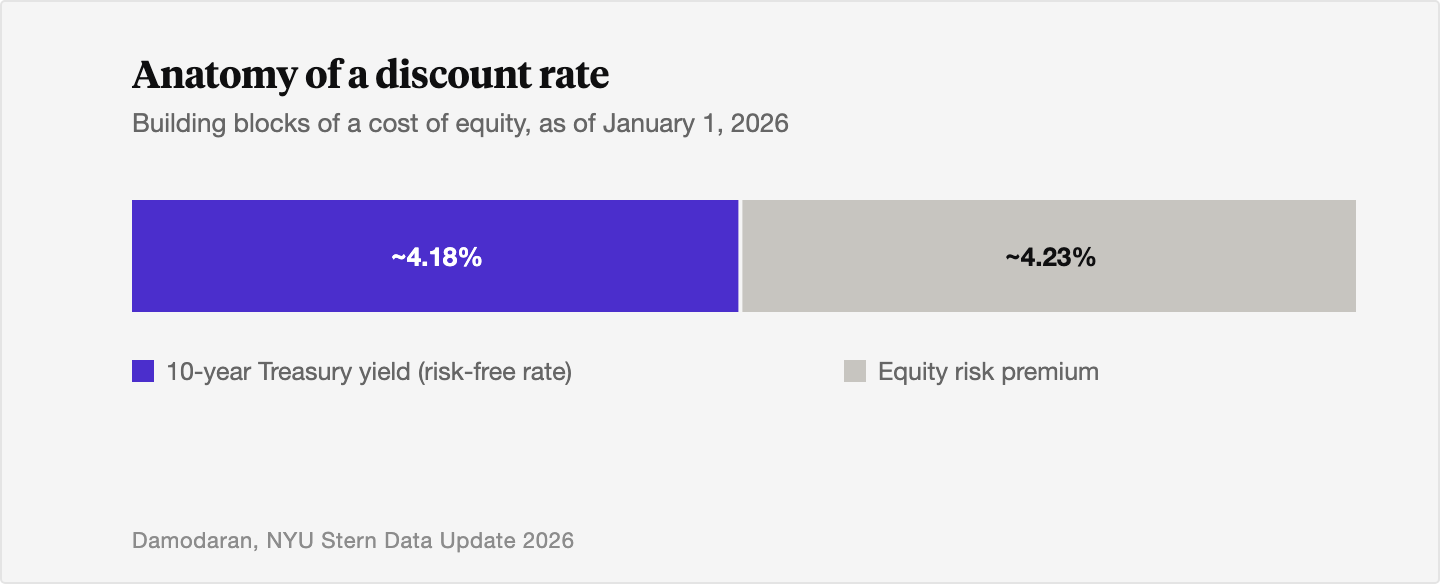
This construction is what explains the transmission mechanism. When the Federal Reserve changes policy and Treasury yields move, the bottom block of the stack moves, and the entire discount rate moves with it, even if nothing about the underlying business has changed [3]. A stock whose cost of equity was 9% when the risk-free rate was 4% becomes a 10% cost-of-equity stock if the risk-free rate rises to 5% and the premium holds. We will see in section 4 how large that looks in practice.
3. Why small changes in the rate cause large swings in value
A change in the discount rate that sounds trivial, one percentage point, can move a valuation by double digits. The reason is the shape of the math.
Consider the constant-growth dividend model, often called the Gordon growth model, which values a stream of dividends growing forever at a steady rate. The value today equals next year's dividend divided by the discount rate minus the growth rate [1]. Take a $5 dividend growing at 3% a year. At an 8% discount rate, the value is 5 divided by (0.08 minus 0.03), which is $100. Raise the rate by a single point to 9%, and the value falls to 5 divided by 0.06, or $83.33. That one point of discount rate erased 16.7% of the value [1]. Cut the rate instead, from 8% to 7%, and the value jumps to $125, a 25% gain [1].
The effect is not symmetric, and it is not linear. The denominator is the discount rate minus the growth rate, so when the two are close, a small move in the rate is a large move in the gap, and the value whips around. This is why the most expensive, fastest-growing assets are also the most fragile when rates move. Their value lives in a denominator that is already thin.
The lesson for any valuation is to treat the discount rate as the assumption that deserves the most scrutiny. Analysts run sensitivity tables on it for a reason. Move the rate half a point in either direction and you often learn that the entire investment case was resting on a number you assumed rather than knew.
4. Long-duration assets: why the future-heavy ones get hit hardest
The 30-year example in the last section was not arbitrary. The further out a cash flow sits, the more a change in the rate compounds against it, because the rate is raised to the power of the number of years [1]. That property has a name borrowed from the bond market: duration.
A bond's duration is the present-value-weighted average time until you get paid. A 30-year zero-coupon bond pays nothing until the very end, so its duration is long and its price is extremely sensitive to yield changes. A 2-year note pays soon, so its duration is short and its price barely flinches when rates move [4]. The same logic applies to equities. A mature, high-dividend company that returns cash now behaves like a short-duration bond. A high-growth company that reinvests everything and promises large profits a decade out behaves like a long-duration, almost zero-coupon instrument [4]. When the discount rate jumps, the long-duration names get smashed hardest, because almost all of their value is in those far-off, heavily discounted years.
2022 turned this from theory into a headline. The Fed raised its target range from near zero in March to 4.25%-4.50% by December, including four consecutive 0.75-point hikes [5]. That 400-plus basis point jump in the risk-free rate flowed straight into discount rates across every asset. The result sorted almost perfectly by duration. The Nasdaq Composite, heavy with long-duration growth stocks, fell about 33%, while the broader S&P 500 fell about 19% [5]. Long-duration Treasuries, proxied by the 20-plus year segment, fell roughly 31% [6]. Even the core US Aggregate Bond Index, normally the ballast in a portfolio, fell about 13%, its worst calendar year on record [6]. Many unprofitable, profit-tomorrow tech names lost 60% to 80% from their 2021 highs [4].
Most of that was not a collapse in earnings. Revenue at many of those companies kept growing. It was the denominator. When the rate you divide by goes up by a third, the present value of cash flows you will not see for a decade falls hard, and the price follows.
5. The regime shift: from cheap money to higher-for-longer
Step back from any single year and the bigger story is a change in regime. For most of the 2010s, the policy rate sat near zero, real yields were often negative, and discount rates were low, which inflated the value of anything with long-dated cash flows [3]. That era is over.
As of mid-2026, the federal funds target range sits at 3.50%-3.75%, with the Federal Reserve on hold through several consecutive meetings and the 10-year Treasury trading in the mid-4% range [11]. Market pricing and the Fed's own projections lean toward holding rates here, with some probability of a hike rather than a quick return to zero [11]. The working assumption among most strategists is no return to the pre-2020 low-rate regime, but a higher-for-longer plateau instead [11].
A higher baseline discount rate has a structural effect, not just a cyclical one. It compresses the fair-value multiple investors will pay for long-duration cash flows, which is why valuations across growth equity, venture, and rate-sensitive real estate look different now than they did in 2019 [11]. It also raises the opportunity cost of holding any asset that produces no income, because the safe yield you forgo by holding it is no longer near zero. That opportunity cost is what connects this regime shift to art.
6. Where art and real assets fit in a rates-driven world
Art does not play by the rules of the previous five sections. A painting pays no dividend, no coupon, and no rent. There is no cash flow to put in the numerator, so a discounted cash flow model simply does not apply to it [7]. You cannot value a Basquiat the way you value a stock or a bond, because there is nothing to discount.
What does set the price, then? Two things. Scarcity, because the supply of work by a given major artist is fixed and tends to shrink as pieces move permanently into museums. And demand from the very wealthy, because a serious collection runs into the tens of millions, so the marginal buyer is effectively the top fraction of a percent of the wealth distribution [7]. We tend to think of art prices as a call option on the top 1%. That is the mechanism, and it has nothing to do with a denominator.
So how do rates reach art at all? Indirectly, through two channels rather than through valuation math [7]. The first is opportunity cost. When safe yields are high, the cash you give up to hold a non-income asset is larger, so a purely financial buyer demands more expected appreciation to justify the hold. The second, and larger, is wealth and liquidity. Art buyers are concentrated in equities, private companies, and real estate, so the same rate increases that pressure those assets can soften the wealth and confidence behind top-end bids. The 2022-2023 slowdown in auction volumes lined up with exactly that tightening [7].
The property that earns art a place in this conversation is its correlation, which we have written about in our work on art as an alternative allocation. Across the major studies, fine art shows low to moderate correlation to equities, often in the 0.1 to 0.4 range, and correlation near zero to government bonds [7][8]. Because art has no cash flows, it carries none of the mechanical duration risk that crushed bonds and growth stocks in 2022 [7]. That is the whole point of a diversifier. It is an asset largely indifferent to the forces driving everything else, which we explore against equities specifically in art vs stocks over the last 30 years. In a higher-for-longer regime that pressures the present value of financial assets, the case for holding something that moves to its own rhythm gets stronger, a theme we develop in why art belongs in the hard-asset conversation.
We are careful not to oversell this. Art is illiquid, carries high transaction and holding costs, has no income, and shows wide dispersion across artists and segments [7][8]. The low correlation is real, but it partly reflects how slowly art prices are observed, since sales and appraisals lag public markets. And because art has no cash flows to discount, it also has no DCF floor to catch it on the way down, so it leans entirely on demand from the wealthy continuing to show up. We treat it as a long-term, illiquid, modest allocation, which is why the holding period matters as much as the entry, a point we make in why patience is rewarded in art markets. Past performance is not predictive of future results, and the correlation that has held historically may not hold in every future stress.
The Bottom Line
- The discount rate converts future cash flows into present value, and it is built as the risk-free rate plus risk premia, so it moves whenever interest rates move.
- Small changes in the rate cause large changes in value, because the rate compounds over time and because, in growth models, it sits close to the growth rate in a thin denominator.
- Long-duration assets, whose cash flows arrive years out, are the most sensitive to rate changes, which is why growth stocks and long bonds fell hardest in 2022 while earnings held up.
- A higher-for-longer rate regime structurally lowers the multiple investors pay for long-dated cash flows and raises the opportunity cost of holding income-free assets.
- Art has no cash flows to discount, so rates reach it indirectly through opportunity cost and collector wealth, and its low correlation to stocks and bonds is the property that can make it a useful diversifier. Past performance is not predictive.
Sources
- Wall Street Prep. "Discount Rate: Definition, Formula and Calculation." Wall Street Prep, 2025. https://www.wallstreetprep.com/knowledge/discount-rate/
- Investopedia. "Time Value of Money: What It Is and How It Works." Investopedia, 2025. https://www.investopedia.com/terms/t/timevalueofmoney.asp
- DHJJ. "Understanding the Discount Rate in Business Valuation." DHJJ Financial Advisors, 2025. https://dhjj.com/understanding-the-discount-rate-in-business-valuation/
- Alpha Architect. "Equity Duration: A Primer on the Interest-Rate Sensitivity of Stocks." Alpha Architect, 2024. https://alphaarchitect.com/equity-duration/
- University of Michigan Ross School of Business. "Duration." Tozzi Center research note, 2024. https://www.bus.umich.edu/facultyresearch/researchcenters/centers/tozzi/duration.pdf
- ScienceDirect. "Equity duration and the term structure of expected returns." Journal of Financial Economics, 2025. https://www.sciencedirect.com/science/article/pii/S0304405X25001229
- Deloitte and ArtTactic. "Art & Finance Report 2025 (9th edition)." Deloitte Private, 2025. https://www.deloitte.com/lu/en/services/consulting-financial/research/art-finance-report.html
- Deloitte. "Art and Finance." Deloitte Luxembourg, 2025. https://www.deloitte.com/lu/en/services/consulting-financial/services/art-and-finance.html
- Damodaran, Aswath. "Data Update 2 for 2026: A Testing Year (2025) for US Equities." Musings on Markets (Substack), January 2026. https://aswathdamodaran.substack.com/p/data-update-2-for-2026-a-testing
- Damodaran, Aswath. "Historical Implied Equity Risk Premiums for the US (1960-2025)." NYU Stern, updated January 2026. https://pages.stern.nyu.edu/~adamodar/New_Home_Page/datafile/histimpl.html
- U.S. Bank. "Federal Reserve recalibrates interest rate policy." U.S. Bank Wealth Management, June 2026. https://www.usbank.com/investing/financial-perspectives/market-news/federal-reserve-interest-rate.html
- J.P. Morgan Global Research. "Will the Fed cut rates again?" J.P. Morgan, 2026. https://www.jpmorgan.com/insights/global-research/economy/fed-rate-cuts
- Damodaran, Aswath. "Equity Risk Premiums: Data, Updates and Papers." NYU Stern, June 2026. https://pages.stern.nyu.edu/~adamodar/
- Valutico. "Understanding the Discount Rate." Valutico, 2025. https://valutico.com/understanding-the-discount-rate/
Disclosures
Investing involves risk. Past results are not indicative of future outcomes.
Masterworks is providing this communication as an agent for its issuer entities, not Masterworks Advisers. This material is produced by Masterworks for informational purposes only and does not constitute investment advice, a recommendation, or an offer or solicitation to buy or sell any security. Masterworks is not a licensed broker-dealer by the SEC or FINRA.
Masterworks can only make and accept sales after an offering statement has been filed, and "qualified", by the SEC. Any offers may be revoked before notice of qualification. Indications of interest involve no obligation. For further disclosure visit the offering documents filed with the SEC and Important Disclosures at masterworks.com/cd.
Forward-looking statements and internal estimates are based on assumptions that may prove incorrect, and actual outcomes may differ materially. Figures denoted in brackets are subject to confirmation. Investing in art and alternative assets involves risk, including loss of principal.
Art sales price data is comparative only. Each painting is unique and historical data is not a direct proxy for any specific painting or investment. Data represents whole art, not an investment into our offerings which includes fees and expenses. Any comparative images are not currently live offerings and are provided for educational purposes only.
Masterworks, LLC is located at 1 World Trade Center, 57th Floor, New York, NY 10007.