Masterworks Research · June 2026
What the efficient frontier is, how a low-correlation asset can push it outward, and the estimation error that makes naive optimizers overstate the gain.
The efficient frontier is the set of portfolios that deliver the highest expected return for each level of risk, drawn as a curve with risk (standard deviation) on the horizontal axis and expected return on the vertical axis. It comes from work Harry Markowitz published in 1952, and the central insight is that the risk of a portfolio depends not just on the risk of each holding but on how those holdings move together [1][2]. For an investor, the practical takeaway is direct: adding an asset whose returns are largely uncorrelated with the rest of the portfolio can push the whole frontier up and to the left, which means more return for the same risk, or the same return for less. That is the appeal of art as a portfolio holding, and it is also where the math quietly misleads people if they feed it the wrong inputs.
What You Need to Know
- The frontier is a trade-off curve, not a single best portfolio. Markowitz showed that for any target return there is a minimum-variance mix, and the set of those mixes forms the efficient frontier [1]. Where you sit on it is a choice about how much risk you want.
- Correlation, not just return, moves the curve. A 1952 result that won the 1990 Nobel Prize: combining assets that do not move in lockstep lowers portfolio variance more than averaging their individual risks would suggest [2][3]. The lower the correlation, the more the frontier bows outward.
- Mean-variance optimizers maximize errors as readily as returns. Because the inputs are estimates, the optimizer piles weight onto whatever asset has the most flattering, and most error-prone, numbers. Richard Michaud called this "error maximization" [4][5].
- Appraisal-based art indices understate true volatility. Smoothed valuations show low measured risk and near-zero correlation, which a naive optimizer reads as a free lunch and overweights. De-smoothing the series raises both volatility and correlation [6][7].
- Selection-corrected inputs cut art's measured edge sharply. One study found that correcting for the bias in which paintings come back to auction lowered art's average annual index return from 8.7% to 6.3% and its Sharpe ratio from 0.27 to 0.11 [8]. Use the corrected numbers, not the headline ones.
1. What the efficient frontier actually is
Start with the picture, because the whole idea is geometric. Plot every portfolio you could build from a set of assets, with risk on the x-axis and expected return on the y-axis. Most of those portfolios are inefficient. For a given level of risk, some other mix offers more return, and for a given return, some other mix carries less risk. Strip those out and you are left with an upper-left boundary: the set of portfolios where you cannot get more return without taking more risk [9]. That boundary is the efficient frontier.
Markowitz formalized this in "Portfolio Selection," published in the Journal of Finance in March 1952 [1]. The work was the foundation of what became modern portfolio theory, and it earned him a share of the 1990 Nobel Memorial Prize in Economic Sciences alongside Merton Miller and William Sharpe [2]. The conceptual jump was treating risk and return as co-equal decision variables. Before Markowitz, an investor picked good securities. After him, an investor picked a good portfolio, and the difference is the math of how holdings interact.
One portfolio on that curve gets a special name. If you add a risk-free asset, the portfolio where a line from the risk-free rate just touches the frontier is the tangency portfolio, and it is the mix that maximizes the Sharpe ratio, the excess return earned per unit of risk [9]. We wrote about that ratio in detail in our piece on the Sharpe ratio and risk-adjusted returns. For the purposes of the frontier, the tangency portfolio is the answer to the question this article asks: it is the highest return-per-unit-of-risk combination available from a given set of assets.
2. Why correlation, not direction, moves the curve
Diversification does not require an asset that rises when stocks fall, which is the part most investors find counterintuitive. It requires an asset that is largely indifferent to whatever is driving stocks. The benefit comes from low correlation, and it shows up directly in the geometry of the frontier.
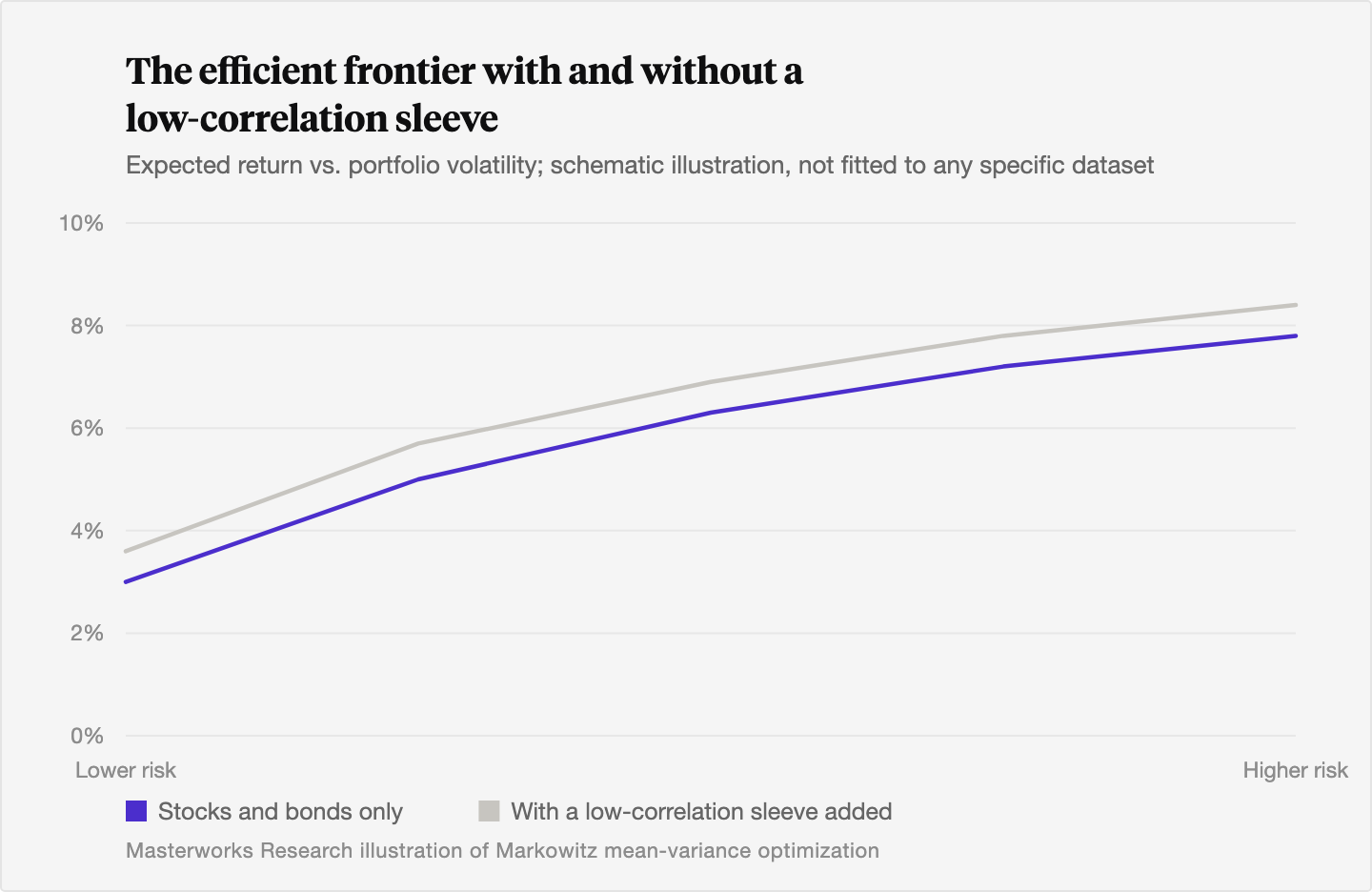
The mechanism is in the variance math. When you combine two assets, the portfolio variance includes a term for how the two move together. If they are perfectly correlated, that term is at its maximum and you get no diversification benefit, the combined risk is just the weighted average. As correlation falls, the cross-term shrinks, and the portfolio risk drops below that weighted average. At zero correlation the effect is meaningful, and at negative correlation it is larger still [10]. The lower the correlation, the more the efficient frontier bows up and to the left, which is the visual signature of more return per unit of risk.
This is why we describe art the way we do. Across studies, fine art's correlation to developed-market equities has been measured at or near zero, in one widely cited dataset roughly -0.04 over 1985 to 2021, with low single-digit correlation to bonds [11]. Whether the asset is art, certain commodities, or another genuinely independent return stream, the lesson is the same. An asset earns its place on the frontier through its correlation, not its direction.
3. How adding a low-correlation asset pushes the frontier outward
Take a conventional stock-and-bond portfolio and add a small slice of something that moves on its own clock, and the optimizer now has a new way to spend risk. Because the new asset's returns do not track the existing holdings, a modest allocation lowers the volatility of the whole portfolio without giving up much expected return, or it lets you reach for more expected return at the same volatility. Either way, the achievable set of portfolios expands. The frontier you could reach before is now strictly inside the frontier you can reach today.
The size of the shift depends on three inputs: the asset's expected return, its volatility, and above all its correlation with what you already own. A low-correlation asset with even a modest expected return can move the curve more than a high-return asset that is tightly correlated with stocks, because the second one adds return and risk together while the first one adds return and diversification. This is the formal version of an argument we make in our advisor-facing piece on art as an alternative allocation: the case for a small sleeve rests on independence, not on art beating equities in any given year.
The drawdown channel is the same idea seen from the loss side. An allocation that does not fall when equities fall shortens and shallows the portfolio's worst stretches, which is the practical payoff of an outward-shifted frontier. We took that apart with the data in art's impact on portfolio drawdowns. The frontier is the theory. The drawdown record is what the theory looks like in a bad year.
4. The catch: optimizers maximize estimation error
The efficient frontier is built from three sets of inputs: expected returns, volatilities, and correlations. None of these is known. All of them are estimated from history, and history is a noisy sample. The optimizer does not know which inputs are reliable. It simply pushes weight toward whatever asset shows the highest estimated return, the lowest estimated volatility, and the most negative estimated correlation, which are precisely the assets most likely to be carrying large estimation errors in a favorable direction.
Richard Michaud described this in 1989 as the "Markowitz optimization enigma," and the blunt version is that mean-variance optimization behaves as an estimation-error maximizer [4]. Because of that property, the optimized portfolio's projected performance is an optimistically biased estimate of what it will actually do [5]. The frontier you compute looks better than the frontier you will live. Practitioners respond with constraints on position sizes, with shrinkage of the inputs toward more conservative values, and with resampling methods that average across many simulated input sets to find portfolios that hold up across the noise rather than sitting on a knife-edge optimum [5].
There is a second limit worth stating plainly. Mean-variance optimization assumes risk is fully captured by variance, which holds cleanly only if returns are normally distributed. Real asset returns, including art, have fatter tails and occasional large jumps, so variance understates the chance of a severe loss. The frontier is a useful map. It is not the territory.
5. Putting art on the frontier, honestly
Art is exactly the kind of asset a naive optimizer falls in love with for the wrong reasons, which is why the discipline matters most here.
Most art indices are built from appraisals or from repeat sales that are reported infrequently, and that structure smooths the return series. Smoothing spreads sharp price moves across several reporting periods, which shows up statistically as high autocorrelation, where this period's reported return depends heavily on last period's [6]. The visible consequence is a series that looks far less volatile than the underlying market, with correlation to stocks that looks lower than it truly is. An optimizer fed those smoothed numbers sees low risk and near-zero correlation, reads a near free lunch, and overweights art accordingly. The standard fix is to de-smooth the series using an autocorrelation model, which raises measured volatility, deepens the implied drawdowns, and pulls correlations back toward the levels you would expect from a market that trades alongside the wealth of its buyers [6][7].
The second correction is for selection. Paintings do not come back to auction at random. Works that have done well are more likely to be resold, and works sitting on a loss tend to stay off the market, so a repeat-sale index oversamples winners. Korteweg, Kraussl, and Verwijmeren studied 32,928 paintings that sold more than once between 1960 and 2013 and found exactly this pattern. Correcting for it cut the average annual index return from 8.7% to 6.3% and the Sharpe ratio from 0.27 to 0.11 [8]. Korteweg, Kraussl, and Verwijmeren conclude that a broad, undifferentiated portfolio of paintings is not an attractive standalone investment, though targeting specific styles or top-selling artists can add value [8]. An earlier dataset of more than a million auction records put long-run real art appreciation at roughly 4% a year from 1951 to 2007, a moderate number once the survivorship and selection adjustments are made [12].
So what should an investor actually feed the optimizer? Use de-smoothed volatility, not the appraisal number. Use selection-corrected returns, not the headline index. Use a correlation estimate that survives de-smoothing rather than the artificially low raw figure. When you do, art still tends to shift the frontier outward, because the diversification benefit survives even after the inputs are made honest. The shift is just smaller than the naive math claims, and that smaller, defensible shift is the one to build on. None of this is a forecast. Past performance is not predictive of future results, and the relevant comparison is whole-artwork index data, not a return on any specific work or offering.
6. Where the analytical edge comes from
The reason we can talk about de-smoothing and selection correction with any specificity is that we built the data to do it. When we started, there was no reliable index for the art market, so we assembled a database of repeat sales from decades of auction records and constructed the Masterworks Post-War and Contemporary Art Index using the repeat-sale methodology Robert Shiller pioneered for home prices. That approach tracks the same work across multiple sales rather than averaging a basket of different ones, which isolates real price change.
A repeat-sale index does not escape the selection problem on its own, which is why we treat the academic corrections above as the baseline, not an afterthought. The honest input is the one worth optimizing against. For a broader read on how art has actually compared with equities over a long window, with the same caveats applied, see our piece on art versus stocks over the last 30 years. And for context on market scale, global art sales reached an estimated $59.6 billion in 2025, up 4% after two down years, which is a real and liquid enough market to study, though small next to public equities [13].
The Bottom Line
- The efficient frontier is the curve of portfolios that give the most expected return for each level of risk, and the tangency portfolio on it is the mix that maximizes return per unit of risk.
- An asset earns its spot on the frontier through low correlation with what you already own, which pushes the whole curve up and to the left.
- Mean-variance optimization maximizes estimation error along with return, so unconstrained optimized portfolios tend to disappoint relative to their projections.
- Appraisal-based art indices understate true volatility and correlation, so a naive optimizer overstates art's diversification benefit unless the inputs are de-smoothed.
- Selection-corrected research cut art's measured annual return from 8.7% to 6.3% and its Sharpe ratio from 0.27 to 0.11, and those corrected inputs are the ones to optimize against.
- A small art sleeve can still shift the frontier outward after honest inputs, but the gain is more modest than the raw numbers suggest, and past performance is not predictive of future results.
Sources
- Markowitz, Harry. "Portfolio Selection." The Journal of Finance, Vol. 7, No. 1, March 1952, pp. 77-91. https://en.wikipedia.org/wiki/Markowitz_model
- The Nobel Prize. "The Sveriges Riksbank Prize in Economic Sciences in Memory of Alfred Nobel 1990." Accessed June 2026. https://www.nobelprize.org/prizes/economic-sciences/1990/summary/
- Global Advisors. "Modern Portfolio Theory: Mean-Variance Analysis and the Efficient Frontier." August 21, 2025. https://globaladvisors.biz/2025/08/21/term-modern-portfolio-theory-mean-variance-analysis-and-the-efficient-frontier/
- Michaud, Richard O. "The Markowitz Optimization Enigma: Is 'Optimized' Optimal?" Financial Analysts Journal, 1989. https://www.researchgate.net/publication/314444182_The_Markowitz_Optimization_Enigma_is_'Optimized'_Optimal
- Michaud, Richard O. and Robert Michaud. "Estimation Error and Portfolio Optimization: A Resampling Solution." New Frontier Advisors, 2005. https://newfrontieradvisors.com/media/rxbld4hq/estimation-error-and-portfolio-optimization-12-05.pdf
- Portfolio Optimizer. "Combating Volatility Laundering: Unsmoothing Artificially Smoothed Returns." Accessed June 2026. https://portfoliooptimizer.io/blog/combating-volatility-laundering-unsmoothing-artificially-smoothed-returns/
- Couts, Spencer and Andrei S. Goncalves. "Unsmoothing Returns of Illiquid Assets." W. P. Carey School of Business, 2019. https://wpcarey.asu.edu/sites/g/files/litvpz246/files/2021-11/andrea_rossi_seminar_paper_november_1_2019.pdf
- Korteweg, Arthur, Roman Kraussl, and Patrick Verwijmeren. "Does It Pay to Invest in Art? A Selection-Corrected Returns Perspective." The Review of Financial Studies, Vol. 29, No. 4, 2016, pp. 1007-1038. https://academic.oup.com/rfs/article-abstract/29/4/1007/1896045
- Wikipedia. "Efficient frontier." Accessed June 2026. https://en.wikipedia.org/wiki/Efficient_frontier
- Fidante. "Correlation and the power of diversification." Accessed June 2026. https://www.fidante.com/eu/insights/correlation-and-power-diversification
- Deloitte and ArtTactic. "Art & Finance Report 2025." 2025. https://arttactic.com/reports/deloitte-and-arttactic-or-art-and-finance-report-2025
- Renneboog, Luc and Christophe Spaenjers. "Buying Beauty: On Prices and Returns in the Art Market." Management Science, 2013. https://pubsonline.informs.org/doi/10.1287/mnsc.1120.1580
- Art Basel and UBS. "The Art Basel and UBS Global Art Market Report 2026," by Dr. Clare McAndrew. March 2026. https://theartmarket.artbasel.com/
- Corporate Finance Institute. "Efficient Frontier: Overview, How It Works, Example, Significance." Accessed June 2026. https://corporatefinanceinstitute.com/resources/career-map/sell-side/capital-markets/efficient-frontier/
Disclosures
Investing involves risk. Past results are not indicative of future outcomes.
Masterworks is providing this communication as an agent for its issuer entities, not Masterworks Advisers. This material is produced by Masterworks for informational purposes only and does not constitute investment advice, a recommendation, or an offer or solicitation to buy or sell any security. Masterworks is not a licensed broker-dealer by the SEC or FINRA.
Masterworks can only make and accept sales after an offering statement has been filed, and "qualified", by the SEC. Any offers may be revoked before notice of qualification. Indications of interest involve no obligation. For further disclosure visit the offering documents filed with the SEC and Important Disclosures at masterworks.com/cd.
Forward-looking statements and internal estimates are based on assumptions that may prove incorrect, and actual outcomes may differ materially. Figures denoted in brackets are subject to confirmation. Investing in art and alternative assets involves risk, including loss of principal.
Art sales price data is comparative only. Each painting is unique and historical data is not a direct proxy for any specific painting or investment. Data represents whole art, not an investment into our offerings which includes fees and expenses. Any comparative images are not currently live offerings and are provided for educational purposes only.
Masterworks, LLC is located at 1 World Trade Center, 57th Floor, New York, NY 10007.