
Masterworks Research · June 2026
What hedge funds actually do, what they charge, who is allowed in, and how a low correlation alternative like art sits next to them in a portfolio.
A hedge fund is a pooled, privately offered investment fund that uses a wider set of tools than a mutual fund, including short selling, leverage, derivatives, and concentrated positions, in pursuit of returns that do not simply track the stock market. In the United States it is sold only to wealthy and institutional investors, it charges a performance fee on top of a management fee, and it is far less regulated than a public fund. The industry now manages more than $5 trillion across thousands of funds. For an investor weighing alternatives, the useful question is not whether hedge funds are good or bad, it is what job they are meant to do in a portfolio, and that job is the same one a small art allocation is meant to do: return streams that are largely indifferent to whatever is moving stocks and bonds.
What You Need to Know
- A hedge fund is defined by structure, not by one strategy. It is a private pool that can go long and short, use leverage and derivatives, and limit who can buy in. The four core strategy families are long/short equity, global macro, event driven, and relative value [1][3].
- The "2 and 20" fee model is now a reference point, not the market average. A 2% management fee plus a 20% performance fee was the standard. Average management fees have fallen to roughly [1.3% to 1.4%] and performance fees into the mid teens, with high water marks and hurdle rates common [5][8].
- Access is gated by law. Most funds accept only accredited investors (income over $200k individual or $300k joint, or net worth over $1 million excluding the primary home) and many require qualified purchaser status, meaning at least $5 million in investments [11][12][14].
- The average fund is built to diversify, not to beat the S&P 500. The HFRI Fund Weighted Composite returned roughly 9.5% to 10% in 2024 against an S&P 500 total return near 25%. Dispersion between the best and worst funds is wide, so manager selection matters as much as the strategy [16][17].
- Art does a similar diversification job for non billionaires. Blue chip art has shown near zero correlation to equities, and fractional, securitized access has lowered the entry point well below a hedge fund minimum [21][22]. Past performance is not predictive.
1. What a hedge fund actually is
Start with the structure, because the structure is the whole thing. A hedge fund is a private pool of capital, usually organized as a limited partnership, that is sold under an exemption from public registration and is therefore allowed to do things a mutual fund cannot. It can short stocks, borrow to amplify positions, trade derivatives, hold illiquid assets, and concentrate in a handful of ideas. In exchange for that freedom it accepts a much smaller, wealthier investor base and lighter ongoing disclosure [3][6].
The word "hedge" is now mostly historical. The first hedge fund, run by Alfred Winslow Jones in 1949, paired long stock positions with short ones to hedge out market direction and isolate stock picking. Many funds today take large directional bets and hedge very little. What survives from the original idea is the toolkit, the ability to profit when prices fall as well as when they rise, and the fee model that rewards the manager for the result.
Think of it the way you would think of any other allocation. An investor putting money in a hedge fund is not buying the market. They are buying a manager's skill at running a specific strategy, net of high fees, with money they cannot pull out on short notice. That is a different trade than buying an index fund, and it is the same kind of trade, in spirit, as buying an alternative asset that runs on its own clock.
2. The four core strategy families
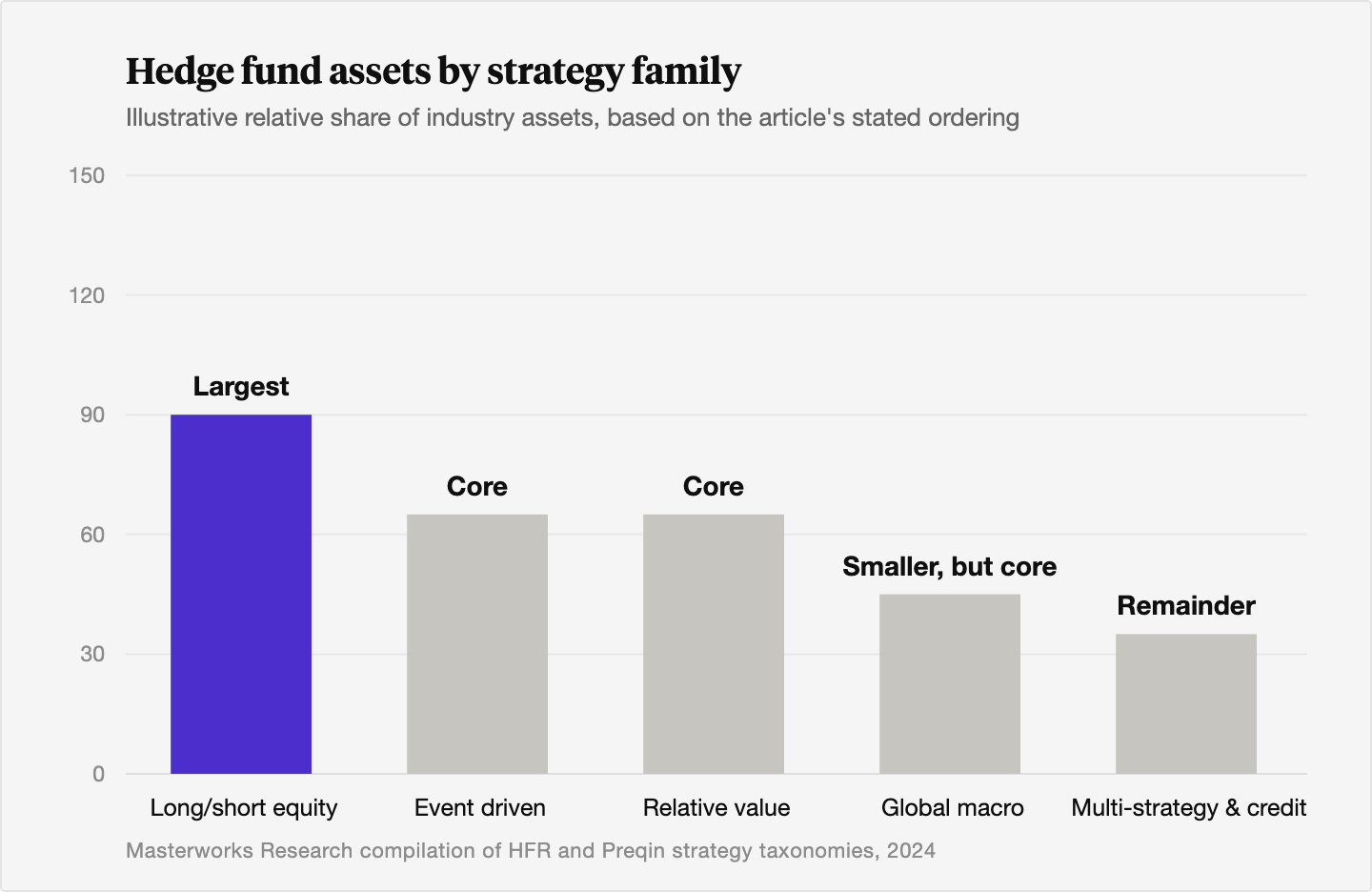
Most hedge fund capital sits in four strategy buckets. Long/short equity is the largest, followed by event driven and relative value, with global macro a core but smaller share [1][6]. Here is what each one is actually doing.
Long/short equity. The manager buys stocks they think are underpriced and shorts stocks they think are overpriced, often inside the same sector. Returns are meant to come from stock selection rather than from the market going up. Net exposure can run anywhere from market neutral, where longs and shorts roughly cancel, to net long [1][4]. This is the most common strategy and the most intuitive: it is active stock picking with the ability to bet against a name, not just for it.
Global macro. The manager takes positions across asset classes, equities, bonds, currencies, and commodities, based on a top down read of interest rates, inflation, policy, and geopolitics. Macro funds trade heavily in futures, options, and swaps, and they split into discretionary (a portfolio manager's judgment) and systematic (rules and models) [1][3][4]. Macro can be the most volatile family, and it is the one that tends to do well precisely when equity markets are in distress.
Event driven. The manager trades the securities of companies going through a specific corporate event: a merger, a spin off, a bankruptcy, a restructuring [1][3]. The two best known sub strategies are merger arbitrage, where the fund buys the target and often shorts the acquirer to capture the spread between the current price and the deal price, and distressed, where the fund buys the debt of troubled companies at a discount to par and bets on the recovery [4]. The risk is concentrated in the event itself: a deal that breaks, a court ruling that goes the wrong way.
Relative value. The manager exploits small price gaps between closely related securities while trying to hedge out broad market direction [1][2]. Fixed income arbitrage trades mispricings along the yield curve or between bonds and futures. Convertible arbitrage goes long a convertible bond and shorts the underlying stock to isolate the embedded option [4][8]. These strategies aim for many small, steady profits, and the catch is in the tail: because the edges are thin, managers use leverage, and leverage is what turned a relative value blowup into the 1998 collapse of Long Term Capital Management.
3. The "2 and 20" fee model, and why it has shrunk
The classic hedge fund fee is "2 and 20": a 2% annual management fee charged on assets no matter what, plus a 20% performance fee charged on profits [5][7][9]. Two features make the performance fee less aggressive than it sounds.
A high water mark means the manager earns the performance fee only on gains above the fund's previous peak value. If a fund rises to 120, falls to 100, and recovers, the manager collects nothing on the climb back to 120, only on new gains above it [5][7]. A hurdle rate sets a minimum return that must be cleared before any performance fee applies, sometimes tied to a cash benchmark. A hard hurdle charges the fee only on returns above the hurdle. A soft hurdle charges it on the whole return once the hurdle is met [5][8].
Here is the part that matters for an investor doing the math today: 2 and 20 is now closer to a reference point than a market average. Preqin reported the industry average had already drifted to roughly 1.5% management and 19% performance by 2019, and survey data put average management fees near [1.27% to 1.37%] by 2020 [5][8]. Public commentary and law firm surveys point to continued compression, with management fees commonly summarized around [1.3% to 1.4%] and performance fees in the mid teens by the mid 2020s [5][8]. Founder share classes and tiered structures, for example a "1.5 and 10" early investor class, have pulled the average down further [9].
A note on how we read fees. The headline rate is only half the story. A 1.5% management fee on capital you cannot withdraw for a year, plus a 17% cut of the upside, is a high bar for net performance to clear. The fee is the reason the average matters less than the manager: an expensive fund that lags is worse than an index fund, and an expensive fund that delivers uncorrelated returns can still earn its keep. The fee structure forces the question we ask of any alternative, which is whether the after fee, after liquidity return justifies the access cost.
4. Who is allowed to invest
In the United States, hedge funds are sold under exemptions that exist precisely so the fund can avoid registering as a public investment company. Those exemptions restrict who can buy in [11][14].
Accredited investor. Most funds offered under Regulation D require investors to be accredited under SEC Rule 501(a). For an individual that means income over $200,000 (or $300,000 jointly with a spouse) in each of the last two years with the expectation of the same this year, or a net worth over $1 million excluding the value of the primary residence [11][13]. A 2020 SEC amendment added sophistication based paths that do not depend on wealth at all, including holders in good standing of the Series 7, Series 65, or Series 82 licenses, and "knowledgeable employees" of a private fund [12][11].
Qualified purchaser. A higher bar applies to many larger funds. A qualified purchaser is generally an individual or family company that owns at least $5 million in investments, or an institution that invests at least $25 million on a discretionary basis [12][14]. This is a tougher and narrower test than accredited status, because it counts investable assets rather than net worth.
Why the two fund types differ. A fund relying on Section 3(c)(1) of the Investment Company Act may accept up to 100 beneficial owners, who in practice are accredited investors. A fund relying on Section 3(c)(7) must take only qualified purchasers, and can have a larger investor base, with practical caps tied to a separate Exchange Act registration trigger near 2,000 holders of record [14]. The result, in plain terms: the better a fund is at attracting capital, the wealthier its investors usually have to be. For most people, the barrier to a hedge fund is not the strategy or the fee. It is eligibility.
5. The honest performance reality
The most common misconception about hedge funds is that they are supposed to beat the stock market. The average fund usually does not, especially in a long bull market, and that is by design. In 2024 the HFRI Fund Weighted Composite Index returned roughly 9.5% to 10% while the S&P 500 delivered a total return near 25% [16][17]. A casual reading calls that a failure. A correct reading notes that the funds leading those 2024 gains were the uncorrelated macro and relative value strategies, the ones meant to hold up when equities do not [16].
The headline average also hides enormous dispersion. In one HFR monthly reading the top decile of funds rose 5.5% while the bottom decile fell 7.4%, a spread of nearly 13 percentage points in a single month [16]. The "average hedge fund return" is therefore a weak guide to what any one investor experiences. Manager selection, the same skill problem an art investor faces in choosing the right artist market, drives most of the outcome.
What the category does offer is scale and persistence. Industry capital reached about $4.46 trillion entering the fourth quarter of 2024 and crossed $5 trillion for the first time by early 2026, a record by HFR's count [16][18]. The HFRI composite then posted roughly 12.6% for full year 2025, with strategy returns ranging from about 7.2% to 17.3% [15]. Allocators keep funding the category not because it reliably outruns the S&P 500, but because, at its best, it delivers a return stream that does not move in lockstep with everything else they own. Past performance is not predictive, and a fund that lagged the index last year may lag it again.
6. Where art fits alongside hedge funds
Hedge funds and a small art allocation are two answers to the same portfolio question: how do you own something that is largely indifferent to the forces driving stocks and bonds? On four practical dimensions, the comparison is instructive.
Correlation. This is the shared rationale. Studies from Citi, Deloitte, and academic repeat sale research, along with our own index work, put blue chip and contemporary art's correlation to the S&P 500 near zero over long periods [21][22]. That is the same uncorrelated property allocators pay hedge fund fees to access. The difference is that an art allocation gets there through a real asset with continuously shrinking supply rather than through a trading strategy, so the diversification does not depend on a manager being right about a deal or a rate move. We have written separately on how this plays out over a full equity cycle in art vs stocks over the last 30 years and on art's impact on portfolio drawdowns.
Liquidity. Here hedge funds win on flexibility. Most allow periodic redemptions on a set schedule, monthly or quarterly, subject to notice periods and occasional gates [22]. A single painting is structurally illiquid, closer to private equity or real estate, with a time to cash measured in months and high transaction costs at sale [22]. An investor should treat both as long horizon, but art is the more patient of the two.
Fees. Both carry real costs that have to be netted out. Hedge funds layer a management fee and a performance fee, commonly around [1.3% to 1.4%] and the mid teens today [5][8]. Securitized art access carries its own management and sale fees, which investors should read in the offering documents. In both cases the honest test is the after fee, after liquidity return, not the gross number in a marketing chart.
Access. This is the sharpest contrast. A hedge fund generally requires accredited investor status, and the better funds require qualified purchaser status with $5 million in investments [11][14]. Direct ownership of a blue chip work has historically required a multi million dollar outlay and a billionaire's collection to make it a sensible 5% allocation. Fractional and securitized structures changed that math by placing a single artwork in a vehicle and offering small shares of it, which lowers the entry point and lets an investor diversify across works [21][22]. We built our business around making this asset class available to more than the top 0.01%, and we are direct about the fees and risks that come with it. For advisors thinking about where this sits in a client portfolio, we lay out the case in art as an alternative allocation, a framework for advisors, and for the venture comparison many allocators reach for, see art vs venture capital risk return profiles for HNW investors. This is general education, not a recommendation, and art carries its own risks including illiquidity and loss of principal. Past performance is not predictive.
The Bottom Line
- A hedge fund is defined by its structure, a private, lightly regulated pool that can short, borrow, and use derivatives, and it is sold only to wealthy and institutional investors.
- The four core strategy families are long/short equity, global macro, event driven, and relative value, and they carry very different risk profiles.
- The "2 and 20" fee has compressed toward roughly [1.3% to 1.4%] management and mid teens performance, usually with high water marks and hurdle rates.
- Eligibility, not strategy, is the real barrier for most people, because accredited investor and qualified purchaser rules wall off the category.
- The average fund is built to diversify rather than to beat the S&P 500, and a small art allocation pursues the same low correlation goal through a real asset, now accessible fractionally. Past performance is not predictive.
Sources
- Preqin. "Hedge Fund Strategies." Preqin Academy, accessed June 2026. https://www.preqin.com/academy/lesson-3-hedge-funds/hedge-fund-strategies
- Franklin Templeton. "Hedged Strategies." Franklin Templeton, accessed June 2026. https://www.franklintempleton.lu/our-funds/capabilities/alternatives/categories/hedged-strategies
- Aurum. "Hedge Fund Strategy Definitions." Aurum, 2024. https://www.aurum.com/hedge-fund-strategy-definitions/
- Street of Walls. "Hedge Fund Strategies." Street of Walls, accessed June 2026. https://www.streetofwalls.com/finance-training-courses/hedge-fund-training/hedge-fund-strategies/
- Preqin. "Hedge Fund Fees: Types and Structures." Preqin Academy, accessed June 2026. https://www.preqin.com/academy/lesson-3-hedge-funds/hedge-fund-fees-types-and-structures
- LGT Capital Partners. "Hedge Fund Strategies: An Introduction." LGT Capital Partners, April 2024. https://www.lgtcp.com/files/2024-04/lgt_capital_partners_-_hedge_fund_strategies_introduction_-_2024_en.pdf
- Corporate Finance Institute. "2 and 20 (Hedge Fund Fees)." Corporate Finance Institute, accessed June 2026. https://corporatefinanceinstitute.com/resources/career-map/sell-side/capital-markets/2-and-20-hedge-fund-fees/
- K&L Gates. "Understanding Hedge Fund Fees." K&L Gates Presentation, 2020. https://files.klgates.com/files/185311_peterman_presentation_one.pdf
- Investopedia. "Two and Twenty." Investopedia, accessed June 2026. https://www.investopedia.com/terms/t/two_and_twenty.asp
- U.S. Securities and Exchange Commission. "Accredited Investors, Updated Investor Bulletin." Investor.gov, accessed June 2026. https://www.investor.gov/introduction-investing/investing-basics/glossary/accredited-investors
- U.S. Securities and Exchange Commission. "Accredited Investors." SEC.gov, Capital Raising Building Blocks, accessed June 2026. https://www.sec.gov/resources-small-businesses/capital-raising-building-blocks/accredited-investors
- Harvard Law School Forum on Corporate Governance. "SEC Expands Definition of Accredited Investor." Harvard Law, September 18, 2020. https://corpgov.law.harvard.edu/2020/09/18/sec-expands-definition-of-accredited-investor/
- Legal Information Institute. "17 CFR 230.501 (Rule 501)." Cornell Law School, accessed June 2026. https://www.law.cornell.edu/cfr/text/17/230.501
- U.S. Securities and Exchange Commission. "Assessing Accredited Investors Under Regulation D." SEC.gov, accessed June 2026. https://www.sec.gov/resources-small-businesses/capital-raising-building-blocks/assessing-accredited-investors-under-regulation-d
- Hedge Fund Research. "HFRI Indices: Family of Indices." HFR, accessed June 2026. https://www.hfr.com/family-indices/hfri/
- Hedge Fund Research. "Hedge Funds Gain in December as HFRI Macro, RV Arbitrage Lead Gains into 2025." HFR Market Commentary, January 8, 2025. https://www.hfr.com/media/market-commentary/hedge-funds-gain-in-december-as-hfri-macro-rv-arbitrage-lead-gains-into-2025/
- Hedge Fund Research. "HFRI Fund Weighted Composite Index." HFR, accessed June 2026. https://www.hfr.com/hfr-media/hfr_world/hfrifwc/
- Hedge Fund Research. "HFR Home." HFR, accessed June 2026. https://www.hfr.com
- Art Basel and UBS. "The Art Basel and UBS Global Art Market Report 2025." Art Basel, March 2025. https://www.artbasel.com/stories/the-art-basel-and-ubs-global-art-market-report-2025
- The Art Newspaper. "Art Basel and UBS Art Market Report 2025: Four Percent Growth." The Art Newspaper, March 12, 2026. https://www.theartnewspaper.com/2026/03/12/art-basel-ubs-art-market-report-2025-four-percent-growth
- Masterworks. "Why Art." Masterworks, accessed June 2026. https://www.masterworks.com/about/why-art
- Deloitte. "Art and Finance Report." Deloitte Luxembourg, accessed June 2026. https://www2.deloitte.com/lu/en/pages/art-finance/articles/art-finance-report.html
Disclosures
Investing involves risk. Past results are not indicative of future outcomes.
Masterworks is providing this communication as an agent for its issuer entities, not Masterworks Advisers. This material is produced by Masterworks for informational purposes only and does not constitute investment advice, a recommendation, or an offer or solicitation to buy or sell any security. Masterworks is not a licensed broker-dealer by the SEC or FINRA.
Masterworks can only make and accept sales after an offering statement has been filed, and "qualified", by the SEC. Any offers may be revoked before notice of qualification. Indications of interest involve no obligation. For further disclosure visit the offering documents filed with the SEC and Important Disclosures at masterworks.com/cd.
Forward-looking statements and internal estimates are based on assumptions that may prove incorrect, and actual outcomes may differ materially. Figures denoted in brackets are subject to confirmation. Investing in art and alternative assets involves risk, including loss of principal.
Art sales price data is comparative only. Each painting is unique and historical data is not a direct proxy for any specific painting or investment. Data represents whole art, not an investment into our offerings which includes fees and expenses. Any comparative images are not currently live offerings and are provided for educational purposes only.
Masterworks, LLC is located at 1 World Trade Center, 57th Floor, New York, NY 10007.


