Masterworks Research · June 2026
What the term covers, where the boundary actually sits, and why the definition decides what you are buying.
Contemporary art is the art of the recent past and the present, most often dated either from the end of the Second World War in 1945 or from around 1970, depending on who is drawing the line [1][4]. The art world uses both definitions at once, and the major auction houses fold the post-1945 material into a single commercial category they call Post-War and Contemporary [3]. For an investor the definition is not academic trivia. It decides which segment of the market you are buying into, and those segments behave very differently. Contemporary art has been the largest fine-art category at public auction and, in our estimates, the fastest-appreciating one over long periods. The boundary you draw determines whether you are buying a canonical Rothko, a speculative painting by an artist in their thirties, or something in between.
What You Need to Know
- There is no single agreed start date. Scholarship splits between post-1945 (the post-war definition) and post-1970 (the late-modern definition). Both are in active use, and museums like the Tate run the modern period to roughly the 1960s, with contemporary running from the 1960s and 1970s onward [4][5].
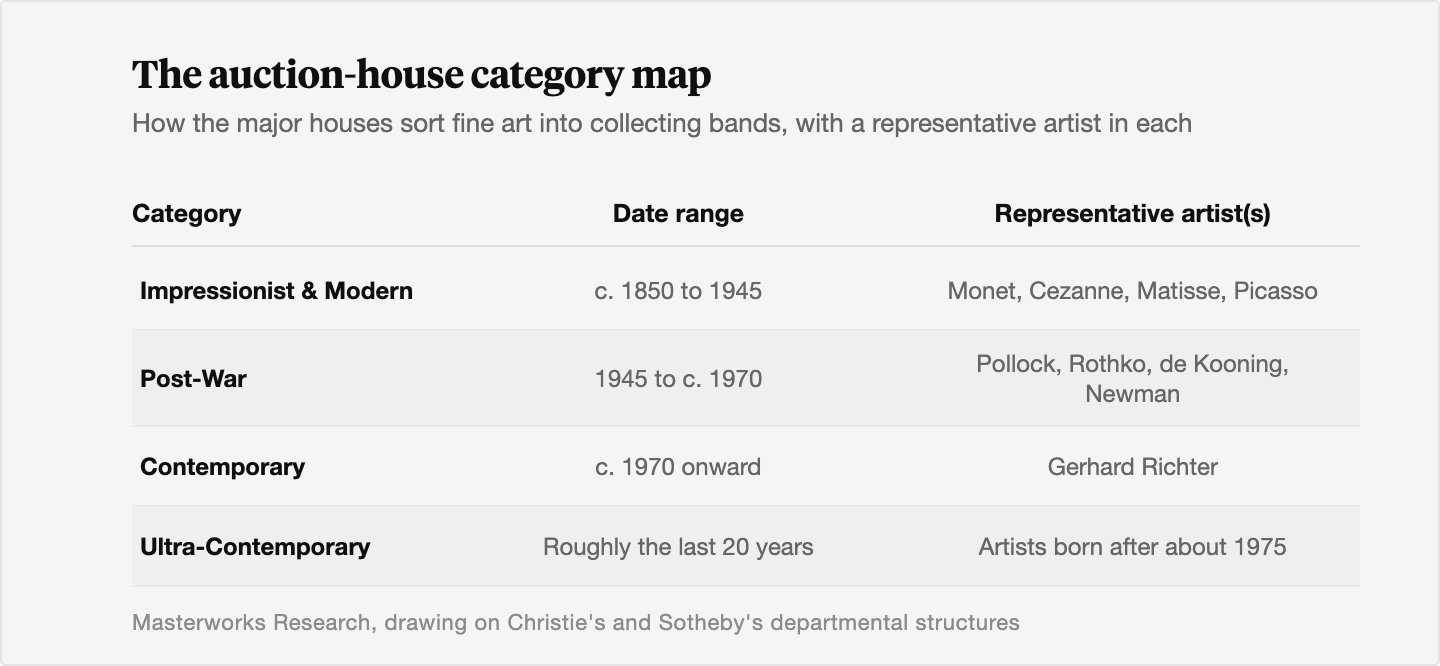
- The auction market draws cleaner lines than art history. Christie's, Sotheby's, and Phillips bundle "Post-War and Contemporary" as a department covering work made after 1945, with internal sub-bands around 1970 and a newer "ultra-contemporary" tag for roughly the last twenty years [3]. The label on the sale tells you which collecting community is bidding.
- Contemporary is the biggest slice of the auction market. Post-war and contemporary art accounted for roughly 31% of public auction sales value in 2025, the largest fine-art sector, ahead of Modern, Impressionist, and Old Masters [6].
- The segments compound at very different rates. Our published estimates put Contemporary (post-1970) at roughly 12 to 13% a year, Modern at 8 to 9%, Impressionist at 6 to 7%, and Old Masters at 1 to 2% [house data]. Past performance is not predictive, but the ordering has held in our data for years.
- The youngest edge is the riskiest. Ultra-contemporary work boomed in 2021 and 2022, then repriced sharply. Auction sales of works made in the previous twenty years fell to about $1.1 billion in 2024, down roughly 43% from 2021 [7]. The definition matters most precisely here.
1. What "contemporary art" actually means
Start with the honest answer. There is no universally agreed date when contemporary art begins. The art world runs two definitions side by side, and both are defensible.
The first is the post-war definition: contemporary art is everything made after 1945, picking up Abstract Expressionism in the late 1940s and 1950s as the opening chapter [1][4]. This is the usage you see in museum departments labelled "Modern and Contemporary" and in the French and German "art contemporain" tradition. The second is the late-modern definition: contemporary art begins around 1960 or 1970, with Minimalism, Conceptual Art, and the broader turn toward pluralism, and everything before that stays "modern" [4][5]. The reference works summarize the consensus as art created from the 1970s onward, while conceding that the definitions are imprecise and that some accounts reach back to the 1960s [4].
There is a third, looser use that matters as much as the first two. Contemporary art is sometimes just "the art of today," a rolling window of roughly the last twenty years or work by living artists [4]. That sounds harmless. It is the source of most of the confusion, because the window keeps moving. Work that felt contemporary in 1990 now reads as historical, and the category quietly pushes its own start date forward with each generation. Art historians call this the shifting-boundary problem, and the practical reason it exists is that "contemporary" means the present, and the present changes every year [5].
So when someone tells you a work is "contemporary," the useful follow-up is which definition they are using. The post-1945 reading and the post-1970 reading point at two different sets of artists, two different price levels, and two different risk profiles.
2. How contemporary art differs from Modern art
Modern art runs from roughly the 1860s, with Impressionism and the avant-gardes that followed, to somewhere between 1945 and 1970 [3][5]. The names are familiar: Monet, Cezanne, Matisse, Picasso, the Cubists, the Surrealists. Modern art is defined by formal innovation, the break with academic tradition, and a story of progress through successive movements.
Contemporary art, on either definition, is defined less by a shared style and more by pluralism. There is no single organizing "ism." The reference works describe it precisely that way, as a field distinguished by the lack of a uniform organizing principle [4]. Pop, Minimalism, Conceptual Art, Neo-Expressionism, the Young British Artists of the 1990s, and the global figurative painting of the 2010s all sit under the same roof, and they have very little in common stylistically.
Here is where the distinction stops being a museum-wall label and becomes an investing fact. The older art gets, the less it tends to appreciate, and most people assume the opposite. Our best hypothesis is that appreciation follows fashion, and fashion moves generationally. If you are going to spend ten million dollars on a painting for your own wall, you are more likely to want a Basquiat than a Rembrandt. That preference, repeated across thousands of collectors, is what the appreciation ladder reflects. We cover the full divergence in when contemporary art and Old Masters do not move together.
3. Post-War and Contemporary: the auction category that ignores the debate
Auction houses are commercial, so they cut through the scholarly debate with a working schema. Christie's, Sotheby's, and Phillips have long bundled the material into a single department called Post-War and Contemporary Art, covering work made after 1945 [3]. Inside that department there are two recognizable strata.
The "Post-War" stratum holds work executed after 1945 by the post-war canon: Pollock, Rothko, de Kooning, Newman in America, and Fontana, Burri, and the Zero group in Europe. The "Contemporary" stratum holds work from roughly 1970 onward, from the conceptual and minimal generations through to artists active today [3]. The houses periodically rebrand, splitting "20th Century" from "21st Century," but the internal date logic still orbits 1945 and 1970.
Two things follow for an investor. First, the label on the catalogue tells you which collecting community is in the room. A Rothko sold in a Post-War and Contemporary evening sale is being bid on by buyers of canonical post-war abstraction, a deep and established pool. Second, the category is not a guarantee of quality. The Contemporary stratum is the most heterogeneous part of the entire market. It holds both Gerhard Richter, whose market has decades of price support, and a figurative painter whose auction record is two years old. Same sale, very different assets.
4. Ultra-contemporary: the youngest and most volatile edge
"Ultra-contemporary" is a market term, not an art-historical one. Data providers and the auction houses use it for the youngest end of the contemporary market, generally artists born after about 1975 or work made in roughly the last twenty years [3].
This is the segment where the definition matters most, because it is where the behavior diverges most. Ultra-contemporary work had a sharp boom in 2021 and 2022. Then it repriced, hard. Sales of works made in the previous twenty years fell to about $1.1 billion in 2024, down roughly 43% from the 2021 peak [7]. One analysis found that auction sales for young contemporary artists at the three major houses contracted by about 71% between 2022 and 2024 [7]. As the market turned cautious, money flowed back toward established living artists like David Hockney and Ed Ruscha and away from the youngest names [7].
We have seen this pattern repeatedly. A young artist's auction market can surge when demand is speculative, and it is usually the first part of the market to reprice when conditions tighten. The youngest segment behaves like a momentum trade, driven by flipping and fast sentiment rather than the long-established resale demand that supports a Warhol or a Richter. That is not a reason to avoid contemporary art. It is a reason to know which stratum of it you are buying. The same word, "contemporary," covers a canonical asset and a speculative one. The 2021 boom and the 2023 to 2025 correction also map onto the broader rhythm we describe in how art market cycles work.
5. Why contemporary is the largest auction segment
For an investor evaluating a category, scale is the first question. Contemporary, in the broad post-war sense, is the largest one at public auction.
The global art market reached an estimated $59.6 billion in 2025, up about 4% on the year, after a 12% decline to $57.5 billion in 2024 [2][6]. Within public auction value, post-war and contemporary art was the biggest fine-art sector at roughly 31% of the total in 2025, ahead of Modern at around 24%, Impressionist and Post-Impressionist at around 19%, and Old Masters at around 11% [6]. Post-war art alone was the single largest band by value [6].
This is a $1.5 trillion asset class in private hands, and the comparison we use is venture capital and private equity at roughly $3.5 trillion. There are thousands of firms helping people allocate to venture and PE. The infrastructure for treating art as a serious asset class is far thinner. We think that gap, the inefficiency, is most of the opportunity. The fact that the largest, most liquid segment of the art market has historically been the contemporary one is part of why we built the firm's index around Post-War and Contemporary art in the first place.
6. Why the definitions matter for what you are buying
Put the pieces together and the practical lesson is simple. The boundary decides the asset.
Our published segment estimates put the appreciation ladder at roughly 12 to 13% a year for Contemporary (post-1970), 8 to 9% for Modern, 6 to 7% for Impressionist, and 1 to 2% for Old Masters [house data]. We treat those as estimates, not promises, and past performance is not predictive of future results. The ordering has held in our data for years, and it tracks the fashion thesis: the segment closest to the present has tended to compound fastest.
But "contemporary" is a wide tent, and the ladder describes the established part of it. A canonical post-war work and an ultra-contemporary painting share a department at Christie's and almost nothing else as investments. One has decades of repeat-sale data behind it. The other may have a price history measured in months. When you read that contemporary art appreciated at a given rate, the relevant question is which contemporary. The category's average is pulled in two directions at once.
This is why we anchor everything to the artist market rather than the sale label. The two-step process is choosing the artist market first, which is paramount, and then buying the best available example at a sensible price. The category tells you which room you are in. It does not tell you whether the specific work is a sound buy. For more on how the very top of the market behaves differently from the rest, see what blue-chip art actually means and our analysis of how works behave across the $100k, $1m, and $10m price tiers.
The Bottom Line
- Contemporary art has no single agreed start date. The two main definitions are post-1945 and post-1970, and the art world uses both at once, with the category's boundary quietly shifting forward over time.
- Modern art runs from roughly the 1860s to mid-century and is defined by formal innovation. Contemporary art is defined by pluralism and the absence of one dominant style.
- The auction houses bundle the material into a "Post-War and Contemporary" department covering work made after 1945, with internal bands around 1970 and a newer "ultra-contemporary" tag for the last twenty years.
- Post-war and contemporary art was the largest fine-art sector at public auction in 2025, at roughly 31% of value, and our estimates put contemporary as the fastest-appreciating long-run segment.
- The category label tells you which collecting community is bidding, not whether a specific work is a good investment. Ultra-contemporary work in particular has been far more volatile, falling roughly 43% from its 2021 peak by 2024.
Sources
- Carre d'Artistes. "History of Contemporary Art." Accessed June 2026. https://www.carredartistes.com/en-us/buy-art/history-of-contemporary-art
- Artsy. "5 Key Takeaways from Art Basel and UBS's The Art Market Report." Artsy, 2025. https://www.artsy.net/article/artsy-editorial-5-key-takeaways-art-basel-ubss-report-the-art-market-2025
- Christie's. "Post-War and Contemporary Art Department." Accessed June 2026. https://www.christies.com/en/departments/post-war-and-contemporary-art
- Wikipedia. "Contemporary art." Accessed June 2026. https://en.wikipedia.org/wiki/Contemporary_art
- Tate. "Blurring the Boundaries Between Art and Life in the Museum." Tate Papers, accessed June 2026. https://www.tate.org.uk/research/tate-papers/08/blurring-boundaries-between-art-and-life-in-the-museum
- Art Basel and UBS. "The Art Basel and UBS Global Art Market Report 2026." Art Basel, 2026. https://www.artbasel.com/stories/the-art-basel-and-ubs-global-art-market-report-2026?lang=en
- Bank of America Private Bank. "Art Market Fall Update." Bank of America, 2025. https://www.privatebank.bankofamerica.com/articles/art-market-fall-update.html
- Smarthistory. "Contemporary art, an introduction." Accessed June 2026. https://smarthistory.org/contemporary-art-an-introduction/
- Artprice by Artmarket. "The Contemporary Art Market Report 2025." Artprice, 2025. https://imgpublic.artprice.com/pdf/the-contemporary-art-market-report-2025.pdf
- Sotheby's. "The New York Sales November 2025: Breuer Results." Sotheby's, November 2025. https://www.sothebys.com/en/articles/the-new-york-sales-november-2025-breuer-results
- ARTnews. "Klimt's Elisabeth Lederer Portrait Sells for $236.4 M. at Sotheby's." ARTnews, November 2025. https://www.artnews.com/art-news/news/gustav-klimt-portrait-of-elisabeth-lederer-auction-record-1234762083/
- CNBC. "Klimt painting sells at Sotheby's for $236 million, boosting art market." CNBC, November 19, 2025. https://www.cnbc.com/2025/11/19/klimt-painting-sothebys-sale-price-art-market.html
- The Art Newspaper. "Market bites back as estimates fail to score." The Art Newspaper, July 8, 2025. https://www.theartnewspaper.com/2025/07/08/market-bites-back-as-estimates-fail-to-score
- Observer. "2025 Art Market Review: Auctions, Galleries, Gulf, Digital Art." Observer, December 2025. https://observer.com/2025/12/2025-art-market-review-auctions-galleries-gulf-digital-art/
Disclosures
Investing involves risk. Past results are not indicative of future outcomes.
Masterworks is providing this communication as an agent for its issuer entities, not Masterworks Advisers. This material is produced by Masterworks for informational purposes only and does not constitute investment advice, a recommendation, or an offer or solicitation to buy or sell any security. Masterworks is not a licensed broker-dealer by the SEC or FINRA.
Masterworks can only make and accept sales after an offering statement has been filed, and "qualified", by the SEC. Any offers may be revoked before notice of qualification. Indications of interest involve no obligation. For further disclosure visit the offering documents filed with the SEC and Important Disclosures at masterworks.com/cd.
Forward-looking statements and internal estimates are based on assumptions that may prove incorrect, and actual outcomes may differ materially. Figures denoted in brackets are subject to confirmation. Investing in art and alternative assets involves risk, including loss of principal.
Art sales price data is comparative only. Each painting is unique and historical data is not a direct proxy for any specific painting or investment. Data represents whole art, not an investment into our offerings which includes fees and expenses. Any comparative images are not currently live offerings and are provided for educational purposes only.
Masterworks, LLC is located at 1 World Trade Center, 57th Floor, New York, NY 10007.