Masterworks Research · June 2026
Why your ability to bear risk, your willingness to bear it, your time horizon, and your liquidity needs are the four constraints that should size every allocation, and where a long-horizon, illiquid asset like art fits inside them.
A sound allocation starts with four constraints, not a return target. Risk capacity is your financial ability to absorb losses without derailing a goal, set by income, net worth, time horizon, and the cash you expect to need. Risk tolerance is the separate, emotional question of how much volatility you can hold without selling at the wrong moment. Time horizon is how long the money can stay invested, and liquidity need is how much of it must stay reachable in cash. Get those four right and the asset mix mostly follows. For an investor weighing where art, or any illiquid, long-horizon holding, belongs, the constraints decide the answer before any view on the asset itself.
What You Need to Know
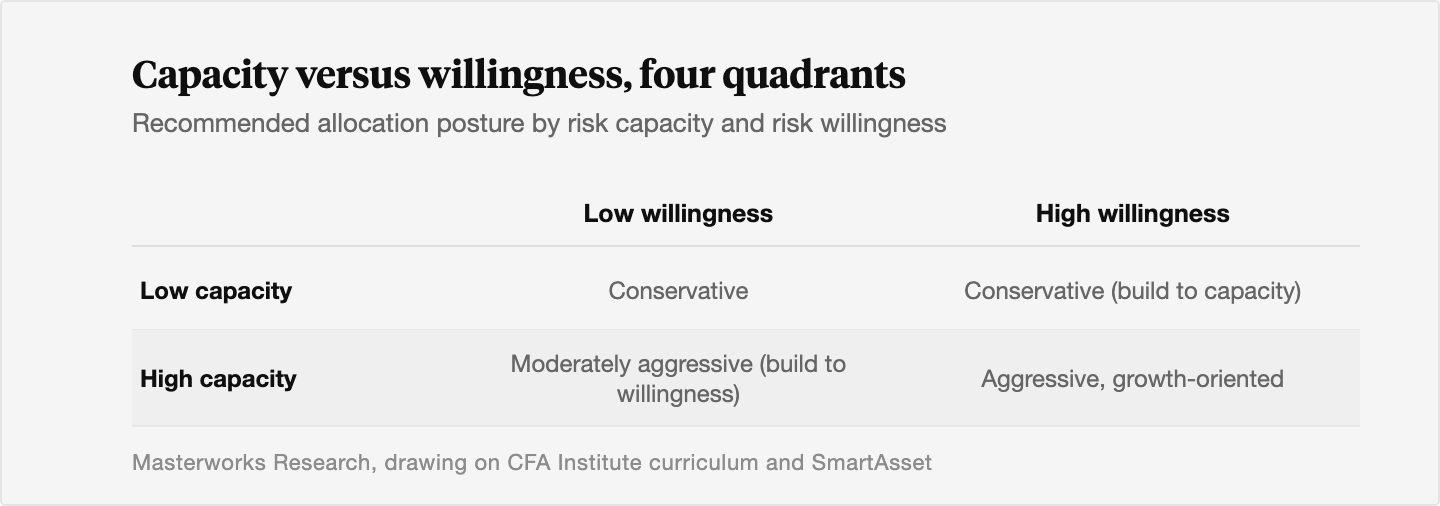
- Capacity and tolerance are different questions, and conflating them builds the wrong portfolio. Risk capacity is objective and financial. Risk tolerance is subjective and emotional. SmartAsset describes a 45-year-old earning $180,000 with a long runway as having high capacity but possibly low tolerance, which calls for a moderately aggressive mix rather than an all-stock one.[1]
- When the two conflict, the lower one usually wins. The CFA curriculum holds that when ability and willingness to take risk disagree, the prudent course is to set risk-taking below both, because a plan the investor abandons in a drawdown is worse than a more conservative plan they keep.[2]
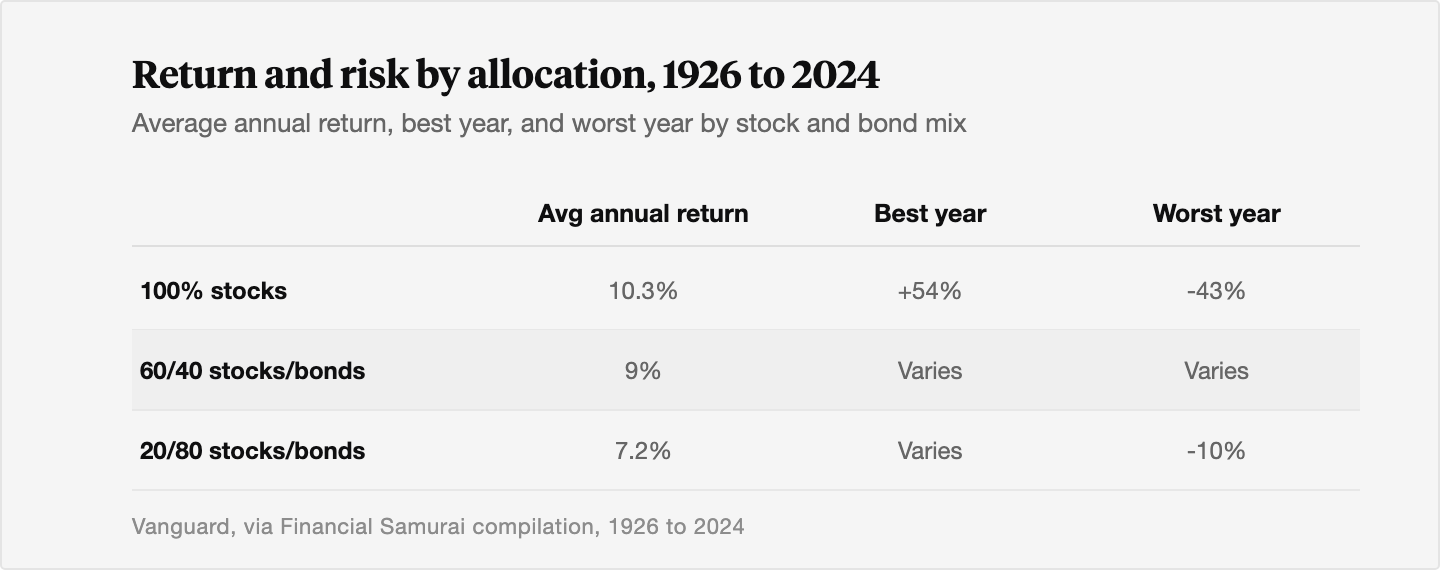
- Time horizon changes the math, not just the mood. A 100% stock allocation has averaged roughly 10.3% a year since 1926 but had a worst year near -43%, while a 20/80 stock/bond mix averaged about 7.2% with a worst year near -10%.[3][4] Longer horizons give losses time to recover, which is why the SEC ties allocation directly to how long money can stay invested.[5]
- Liquidity is the constraint people skip and regret. Advisers broadly recommend holding three to six months of essential expenses in cash before committing to illiquid assets, so a downturn never forces a sale.[6]
- Art is a long-horizon, illiquid, low-correlation sleeve, sized to what you will not need. Citi GPS finds that over a century art has underperformed equities and outperformed bonds, with low correlation to financial markets, which suits a small, multi-year allocation funded from capital outside your liquidity reserve.[7] Past performance is not predictive.
1. Risk capacity: what your finances can absorb
Risk capacity is the objective side of the question. It is your financial ability to take on investment risk without putting a goal at risk, and it is set by measurable inputs: income, net worth, expenses, time horizon, and the cash flows you expect.[1] Investor.gov frames the core driver plainly. The allocation that works best "will depend largely on your time horizon and your ability to tolerate risk," and an investor with a long runway "is likely to make more money by carefully investing in asset categories with greater risk."[5]
Capacity is not a feeling. It is closer to an accounting exercise. The CFA curriculum measures the ability to take risk by "time horizon, expected income, and level of wealth, relative to obligations."[2] Two people with identical net worth can have very different capacity if one has a pension covering all spending and the other is funding three children through college on a single income.
Capacity sets the upper bound. It is the most risk your balance sheet can support, no more. A portfolio built above that line is fragile to events that have nothing to do with markets, the death, divorce, and debt that force assets out the door at the wrong time. A portfolio built at or below it has room to recover.
2. Risk willingness: what you can actually hold
Risk tolerance, or risk willingness, is the emotional side. It reflects "an individual's psychological and emotional comfort with investment risk," shaped by temperament, past experience, and how someone reads a falling market.[1] It is measured with questionnaires and conversation rather than a spreadsheet, and it is less stable than capacity, because the same person who tolerates volatility in a calm market often cannot during a crash.
The reason willingness matters as much as capacity is behavioral. The worst outcome in investing is not a paper loss. It is selling a sound long-term position into a panic and locking the loss in. An allocation your balance sheet can support but your nerves cannot is a plan you will break.
The CFA curriculum is direct about what happens when the two disagree. The advisor "should not aim to change the client's willingness to take on risk," and the prudent approach is to "find a risk tolerance level that is lower than the ability and willingness to assume risk."[2] When capacity and willingness conflict, build to the lower of the two. A 45-year-old with stable income and a long horizon has high capacity. If short-term losses keep them up at night, the right answer is a moderately aggressive mix, not the all-equity portfolio the balance sheet alone would allow.[1]
3. Time horizon: why the clock changes everything
Time horizon is "the number of months, years, or decades you plan to invest to achieve your financial goal."[5] It is the single input that most changes how much volatility you should accept, because time is what lets a drawdown heal.
The numbers make the case better than any adjective. Using Vanguard's long-run record of stock and bond allocations back to 1926, a 100% stock portfolio has returned roughly 10.3% a year on average, with a best year near +54% and a worst year near -43%, and posted a loss in about 25 of 91 years.[3] A more conservative 20/80 stock and bond mix averaged around 7.2%, with a worst year near -10%.[4] The higher-return mix is far more violent on the way there.
An investor with thirty years can ride out a -43% year, because history says the recovery and the years after it more than repaid the patience. An investor who needs the money in two years cannot, because there may be no time to recover before the spending date arrives. This is why the SEC ties the two together so plainly: longer horizons "may feel comfortable taking on riskier or more volatile investments," shorter horizons "may prefer to take on less risky or less volatile investments."[5] The horizon does not change the average return. It changes whether you can survive the path to it.
The practical move is to match each pool of money to its date. Cash needed inside a year stays in cash. Money for a goal three to ten years out can hold a balanced mix. Capital with no claim on it for a decade or more is where the highest-volatility, least-liquid holdings belong, because that capital has the one thing those assets demand, which is time.
4. Liquidity needs: the constraint people skip
Liquidity is how quickly you can turn a holding into spendable cash without taking a loss to do it, and how much of your wealth must stay that reachable. It is the constraint investors most often skip, and the one that does the most damage when ignored, because illiquidity only hurts at the moment you are forced to sell.
The standard guidance is to build a cash reserve first. Advisers broadly recommend three to six months of essential expenses in liquid, low-risk holdings before committing capital to anything illiquid, with six to twelve months suggested for those with variable income or dependents.[6] The logic is simple. A funded reserve lets the rest of the portfolio stay invested through a downturn, because you are never forced to sell a long-term position to cover a short-term bill.
This is the sequencing rule that governs where illiquid assets fit. First the liquidity reserve. Then the long-horizon, growth-oriented core. Only capital beyond both, money you can leave untouched for years, should fund the most illiquid sleeves. An asset that cannot be sold quickly is fine to own. It is only a problem when it is funded with money you turn out to need.
5. Building the allocation around the four constraints
Put the four together and a sequence falls out. Start with the lower of capacity and willingness, which sets how much volatility the portfolio can carry. Use time horizon to decide how that risk budget is spread across short, medium, and long pools. Carve out the liquidity reserve before anything illiquid is funded. What remains, the long-dated, fully discretionary capital, is the only place the highest-volatility and least-liquid holdings belong.
Asset allocation itself is the act of "dividing your investments among different assets, such as stocks, bonds, and cash."[5] The constraints decide the proportions. A balanced 60/40 stock and bond portfolio has averaged roughly 9% a year since 1926, a middle ground between the 10.3% of all-stock and the lower, steadier return of bond-heavy mixes.[3][4] Where an investor lands on that spectrum is a function of the four constraints, not a guess about which way markets are headed next.
True diversification means owning assets that move to their own rhythm, that are largely indifferent to the forces driving everything else. A holding that simply rises when stocks fall would be a lucky hedge. The more useful property is low correlation across the whole cycle, which is what lets a sleeve reduce the swing of the total portfolio rather than just offsetting one bad quarter. We cover this in more depth in our piece on art's impact on portfolio drawdowns and in our note on the Sharpe ratio and risk-adjusted returns.
6. Where art fits given these constraints
Now place art against the same four constraints, and its profile is specific. Art is long-horizon, illiquid, and low-correlation, which means the constraints, not enthusiasm for the asset, decide whether and how much.
Take the constraints in order. On time horizon, art is a multi-year hold by nature. Research on auction repeat sales and industry practice points to minimum holding periods commonly cited at seven to ten years, and most collectors build positions gradually over a decade.[8] On liquidity, art sits at the far illiquid end. Selling typically means consigning to an auction months ahead or finding a private buyer, and transaction costs are steep, with auction houses charging sellers and buyers fees that together can run well above 20%.[7] On capacity, that combination means art should be funded only from capital outside the liquidity reserve and beyond the near-term goals, the discretionary, long-dated money described in section 5. On the diversification side, Citi GPS finds art has had low correlation to financial markets, and over more than a century has underperformed equities while outperforming bonds.[7] Academic work on its diversification role is mixed, with some studies finding art lowers portfolio variance for a given return and others finding limited benefit, so the honest framing is a modest diversifier, not a free lunch.[9]
That profile points to a clear use. Art suits an investor who already has capacity and a long horizon, who has funded the liquidity reserve, and who is willing to hold for years through an illiquid, slow-to-trade market. For that investor it can act as a small, low-correlation sleeve, commonly a single-digit share of a portfolio, sized to what they will not need to touch. It does not suit anyone whose horizon is short, whose reserve is thin, or whose willingness cannot hold an asset that may not be sellable on demand.
Two cautions belong in the open. First, past performance is not predictive. Long-run art index returns describe the market's history and do not forecast any specific work or any future result. Second, art index data is comparative only, drawn from whole works rather than fractional investments, and each painting is unique, so historical figures are not a direct proxy for any single asset. For the long-horizon logic specifically, see our note on why patience is rewarded in art markets, and for how advisers frame the sleeve, our framework for art as an alternative allocation.
The Bottom Line
- Risk capacity is the objective ceiling your finances can support. Risk willingness is the subjective comfort you can hold. They are separate questions and should be measured separately.
- When capacity and willingness conflict, build to the lower of the two, because a plan you abandon in a drawdown costs more than a more conservative plan you keep.
- Time horizon decides how much volatility you can carry. Long horizons let a -43% year heal. Short horizons cannot wait for the recovery.
- Fund a liquidity reserve of three to six months of expenses before committing to any illiquid asset, so a downturn never forces a sale.
- Art fits the long-dated, discretionary capital left after the reserve and near-term goals are covered. It is a small, illiquid, low-correlation sleeve for patient investors, and past performance is not predictive.
Sources
- SmartAsset (Lena Borrelli, Patrick Villanova, CEPF). "Risk Capacity vs. Risk Tolerance: What's the Difference?" SmartAsset, April 1, 2025. https://smartasset.com/investing/risk-capacity-vs-risk-tolerance
- AnalystPrep. "Financial Risk Tolerance, CFA Level 1 Portfolio Management." AnalystPrep, 2025. https://analystprep.com/cfa-level-1-exam/portfolio-management/financial-risk-tolerance/
- Visual Capitalist. "Visualizing 90 Years of Stock and Bond Portfolio Performance." Visual Capitalist (Vanguard data, 1926 to present). https://advisor.visualcapitalist.com/investment-returns-over-history/
- Financial Samurai. "Historical Returns Of Different Stock And Bond Portfolio Weightings." Financial Samurai (Vanguard data, 1926 to 2024). https://www.financialsamurai.com/historical-returns-of-different-stock-bond-portfolio-weightings/
- Investor.gov, U.S. Securities and Exchange Commission. "Asset Allocation and Diversification." Investor.gov, 2025. https://www.investor.gov/introduction-investing/getting-started/asset-allocation
- Vanguard. "Comprehensive Guide to Building an Emergency Fund." Vanguard, 2025. https://investor.vanguard.com/investor-resources-education/emergency-fund
- Citi Global Perspectives and Solutions. "The Global Art Market." Citi GPS, 2025. https://www.citigroup.com/global/insights/global-art-market
- Antique Sage. "What Is the Optimal Holding Period for Art Investments?" Antique Sage, 2025. https://www.antiquesage.com/optimal-holding-period-art-investments/
- Barro, Diana, Antonella Basso, Stefania Funari, and Guglielmo Alessandro Visentin. "Portfolio Diversification Including Art as an Alternative Asset." SSRN Working Paper, 2024. https://papers.ssrn.com/sol3/Delivery.cfm/SSRN_ID4617318_code1823916.pdf?abstractid=4617318
- Morningstar (Christine Benz). "Risk Tolerance and Risk Capacity: Why the Difference Matters." Morningstar, 2025. https://www.morningstar.com/personal-finance/whats-difference-between-risk-tolerance-risk-capacity
- Family Wealth Report (Tom Burroughes). "Art Market Auctions Rebounded Late 2025, But Not A Comeback, Citi Wealth." Family Wealth Report, May 7, 2026. https://www.familywealthreport.com/article.php/Art-Market-Auctions-Rebounded-Late-2025,-But-Not-A-Comeback-Citi-Wealth?id=207639
- T. Rowe Price. "Why purposeful asset allocation is key for long-term success." T. Rowe Price Personal Investor, 2025. https://www.troweprice.com/personal-investing/resources/insights/asset-allocation-planning-for-retirement.html
Disclosures
Investing involves risk. Past results are not indicative of future outcomes.
Masterworks is providing this communication as an agent for its issuer entities, not Masterworks Advisers. This material is produced by Masterworks for informational purposes only and does not constitute investment advice, a recommendation, or an offer or solicitation to buy or sell any security. Masterworks is not a licensed broker-dealer by the SEC or FINRA.
Masterworks can only make and accept sales after an offering statement has been filed, and "qualified", by the SEC. Any offers may be revoked before notice of qualification. Indications of interest involve no obligation. For further disclosure visit the offering documents filed with the SEC and Important Disclosures at masterworks.com/cd.
Forward-looking statements and internal estimates are based on assumptions that may prove incorrect, and actual outcomes may differ materially. Figures denoted in brackets are subject to confirmation. Investing in art and alternative assets involves risk, including loss of principal.
Art sales price data is comparative only. Each painting is unique and historical data is not a direct proxy for any specific painting or investment. Data represents whole art, not an investment into our offerings which includes fees and expenses. Any comparative images are not currently live offerings and are provided for educational purposes only.
Masterworks, LLC is located at 1 World Trade Center, 57th Floor, New York, NY 10007.